Tomorrow is National Women in Wine Day in the USA. Created as a social initiative by the co-founders of Papapietro Perry Winery in California it has the laudable aim of creating a scholarship fund to help with education for women in, or wanting to enter, the wine industry. This initiative is part of the annual March International Women’s History Month.
Do will still need to shine a light on women in the wine industry? There are many women leading the way across the wine world, opening doors for others from inside and outside the industry. We’ve come a long way from women being banned from French cellars because they made the wine turn!
This was brought home to me when I researched for an article for Decanter Magazine highlighting Women in Wine in Bordeaux for International Women’s day. I feel as if I only scratched the surface. As soon as I submitted my piece, so many other Bordeaux women in wine sprang to mind, (sorry if I left you out) . Women are not only owners, cellar masters and managers but also cellar and vine workers, back office admin, guides and chefs. In France, a lot of women make up the army doing the back breaking work of tending the vines, de suckering, pruning, attaching. These are often part time jobs, fitting around child care. Picking up my kids from school, these women would be at the school gates in wellies and muddy fingers.
Historical Heroines. Even if it was exceptional, as we’re in Women’s History Month, it’s good to remember a few Bordeaux historical heroines as well as contemporary ones. Champagne isn’t the only wine region with wine widows! Francoise-Josephine d’Yquem,Caroline de Villeneuve, Virginie Comtesse de LalandeandOlive de Lestonnacare headliners, interesting with women following in their footsteps today. I’m sure many lesser known women ran and grew family domaines that I’m unaware of – I’d love to hear from you if you know their stories.
Today there are many industry organisations, events and tasting groups aimed at women. The third edition ofWomen in Wine Expo, created by Senay Ozdemir, takes place in the UK this May. Queena Wong started the Curious Vinescommunity around 7 years ago. Originally for consumers it has evolved to support the industry and make it more accessible for women through in-person events and an engaging newsletter. Battonnagewith the strap line ‘Stirring up the conversation on women in wine’ is a community driven platform that creates channels for women to enter, grow and thrive within the wine business through an annual forum and a mentorship programme. Deborah Brenner organized the first Women of the Vine & Spirits Global Symposium in Napa in March, 2015,. it is now a global organisation pushing the wine, beer and spirits industry towards a more diverse future.
Women for Wine sense visit Bordeaux women in wine
These initiatives aren’t new, the American association Women for Wine Sense (WWS) was created in 1990 by Californians Michaela Rodeno and Julie Johnson to increase knowledge about wine through education as a counterweight to the anti-alcohol lobby. Their premise is a better understanding of wine leads to more responsible consumption. WWS now has a network of 10 chapters through the US and their charitable arm sponsors wine education for women in the industry.
In France, Les Aliénor is a group of Bordeaux women wine makers. 3rd and 4th april 2023 sees the 17th anniversary of Feminalise, a wine and spirits competition where the wines are tasted and assessed uniquely by women.
Encouraging women to enter the industry is great, but so is giving women confidence choosing a wine and navigating their way around a wine list – traditionally seen as the man’s role. A shout out to the amazing women somms*, wine critics and writers making what can feel like an intimidating world more accessible.
Raise a glass
Wine and wellness An advocate for wine and wellness, I’m acutely aware that women have a physiological disadvantage when it comes to drinking wine, this aside, the best way to support these women in wine is to buy their wines. If you need inspiration read my piece for Decanter Magazine mentioning some of them or scroll through my blog. You’ll see many of my favourite women in wine regularly pop up in these pages. I love them, their wines and the supportive community they’ve created.
Power in our purse. Women across the world buy well over 50% of wine, so let’s raise a glass to them with of one of their wines and not only in March.
*According toBatonnagethere’s a $7000 average wage gap between women and men somms in the US.
This tiny island off Auckland isn’t the most obvious place to start an exploration of New Zealand wines. Waiheke is one of three Auckland wine regions and Auckland itself is around just 1% of New Zealand’s 36,000 hectares of grapes. So why Waiheke?
People first, place later. My recommendation for visiting a new wine region is go with a wine maker, it opens doors and bottles. Nicola Allison from Château de Seuil in Graves, Bordeaux, was my guide. She married Kiwi Sean and is an ex Auckland resident .
My intrepid guide, bottle in hand
This was my first trip to New Zealand, I’m certainly no expert but here are a few things I learnt to set the scene. I highly recommend the free text book on the New Zealand wines website for a more thorough introduction.
Place
New Zealand’s wine regions extend across 1,100 km from 35-45°S, from the subtropical North down to Central Otago, in the South, islands that benefit from the moderating effect of a maritime climate.
Wine growing dates back to early 1800s. The most famous wines are Marlborough Sauvignon Blanc and Pinot Noir, wines that dominate the 285 million litres produced pa, from 731 wineries exporting 1.8 Billion NZ $ to over 100 countries. The principle markets are the UK, USA and Australia.
Sustainability and biosecurity. In 1995, as befits their image of a green and pleasant land, New Zealand introduced Sustainable Winegrowing NZ™, one of the first sustainability programmes for grape growers. It was followed in 2002, by a sustainable winery certification. Now, 96% of New Zealand’s vineyard is SWNZ certified and over 90% of wine is produced in SWNZ certified facilities. The SWNZ logo can only be used for wine made from certified grapes and in certified wineries.
The SWNZ logo
Indigenous subtropical forest – worth protecting
If you’ve travelled to New Zealand, you’ll know how strict their bio security controls are. Their isolation (and it’s a long way) protects them from many vine pests and diseases, although they too have phylloxera, and this year, mildew – see below. In 2017, New Zealand Winegrowers joined the Government Industry Agreement(GIA) for biosecurity readiness and response. Winegrowers are encouraged to only plant certified Grafted Grape Standard high health vines sourced from members of the Vine Industry Nursery Association (VINA).
All agriculture and wildlife are considered at risk. Many visitors come to New Zealand to hike and washing your hiking shoes is par for the course. Areas of original and replanted indigenous flora on Waiheke are clearly sign posted to wash shoes to protect the indigenous Kauri trees.
Auckland. Despite the small area of vineyards, Auckland on the North island is one of New Zealand’s oldest wine regions, thanks to Croatian, Lebanese and English immigrants in the early 1900s. As New Zealand’s biggest city (Wellington further South is the Capital) it’s home to many leading wine companies and a historical centre for consolidation, packaging and shipping wines. Having New Zealand’s largest, most economically important city at its heart also helps drive wine tourism.
WWA Trade Mark
Waiheke Island, in the Pacific Ocean east of Auckland, is a 40 minute ferry from the city. The wines have their own geographical indication and the WWA (Waiheke Wine growers Association) Trade Mark certifies wines are made from 100% Waiheke island grapes, on vineyards that are part of the sustainable programme.
The terroir is a mineral rich, montmorillonite clay (not dissimilar from the blue clay at Petrus in Pomerol) over volcanic bedrock. With richer alluvial soils in valley floors and volcanic ash soils at the eastern end of the island. The temperate maritime climate is usually described as warm and dry, although I arrived 24 hours before a biblical storm.
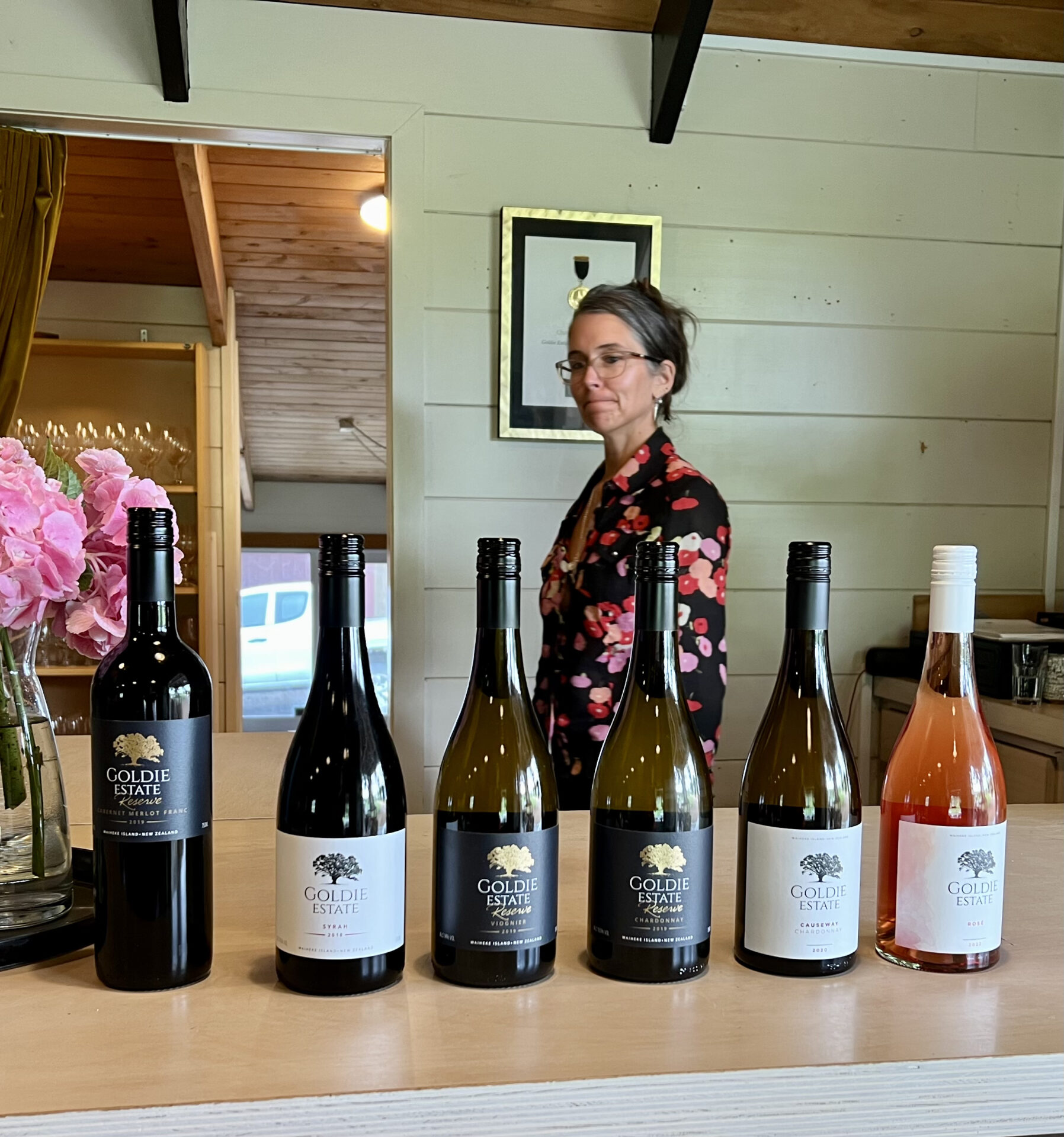
Varieties Waiheke is traditionally known for its Cabernet driven ‘Bordeaux’ blends, but more recently for their elegant Syrah (some of my favourites) and Chardonnay.
Syrah at Passage Rock
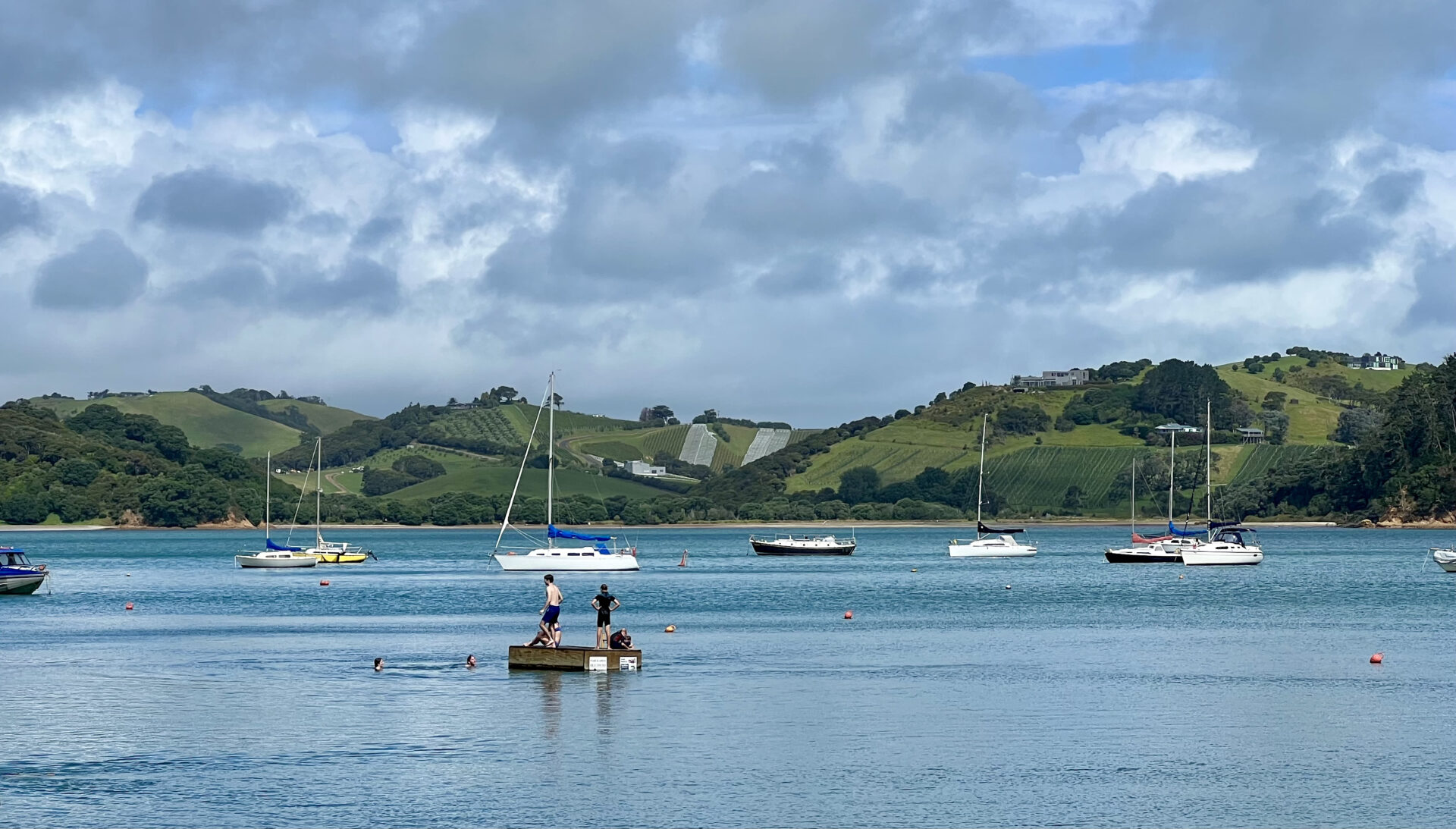
So much for the technical, the real reason to visit is the island is gorgeous. Vineyards are often in beautiful locations, but in Waiheke you can add an ocean back drop to rolling vines. With just 216 hectares under vine, and 30 growers, winegrowing on Waiheke is ‘boutique’. Quality and the loyal following this creates ensures economic viability driven by wine tourism that offers a warm and relaxed welcome and innovative hospitality – everyone offers food and tastings.
Golden.
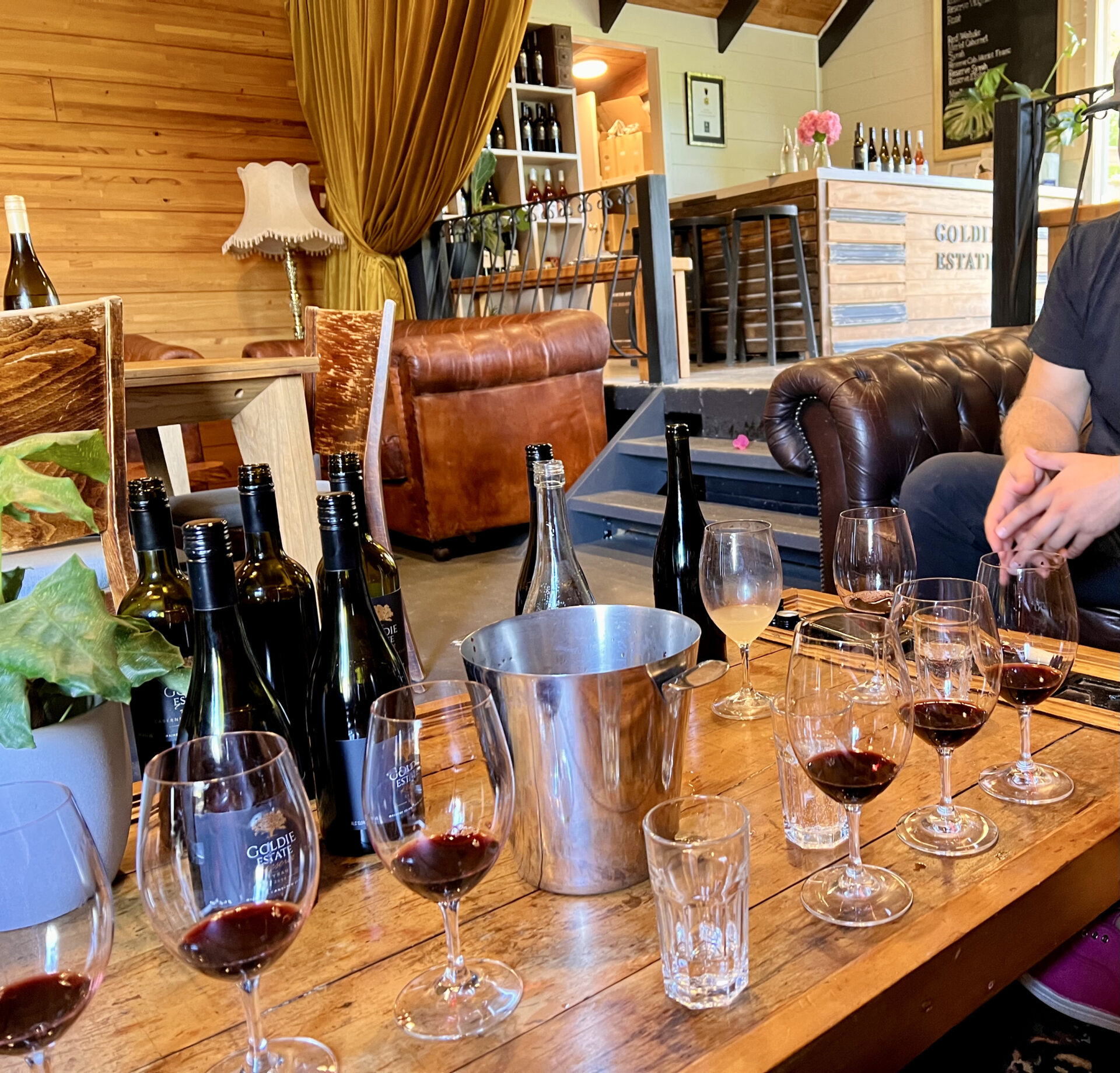
Heinrich Storm, director and wine maker at Goldie Estatesince 2008,gave us a potted history of wine on the island at the island’s oldest vineyard. Enthusiastic sailors Kim and Jeanette Goldwater came to Waiheke in 1977, they were the Waiheke wine pioneers, buying pastureland despite scepticism about the island’s suitability for viticulture. They planted the first vines at Goldwater Vineyard in 1978.
Tasting at Goldie
Every weekend, they sailed over from Auckland bringing posts, plants and fixing up the house before sailing back to their full time jobs on Sunday night. Their 1st vintage, Goldwater Cabernet Sauvignon 1982, was tiny, but its success led to more plantings, adding Merlot for their ‘Bordeaux blend’ released in 1987. They bought more land to plant Chardonnay, releasing Goldwater Zell Chardonnay in 1998. Today, the vines are spread across 30 acres of native bush overlooking Putiki Bay, and produce Cabernet Sauvignon, Merlot, Cabernet Franc, Syrah, Chardonnay and Viognier.
Supporting New Zealand industry initiatives, Goldwater Estate joined the Sustainable Winegrowing pilot programme at its inception and the Screwcap Initiative in 2001, again at its inception. Currently 90 per cent of New Zealand wine is sealed with screwcaps, an initiative to eliminate cork taint.
Screw caps at Goldie Estates
Investments across New Zealand included Marlborough and Hawkes Bay, eventually creating the NZ Wine fund. In 2009 they removed the Waiheke wines from the fund and in 2010, Goldie Wines was created to differentiate the family’s Waiheke vineyard from the Goldwater holdings.
In 2011, the family transferred the Goldie estate to the University of Auckland, creating the Wine Science Centre. Rather than a research facility, it’s a commercial & academic wine science programme where students get a hands-on learning experience. 9-12 students live in the homestead working alongside winemakers in the winery with the conference room as their classroom.
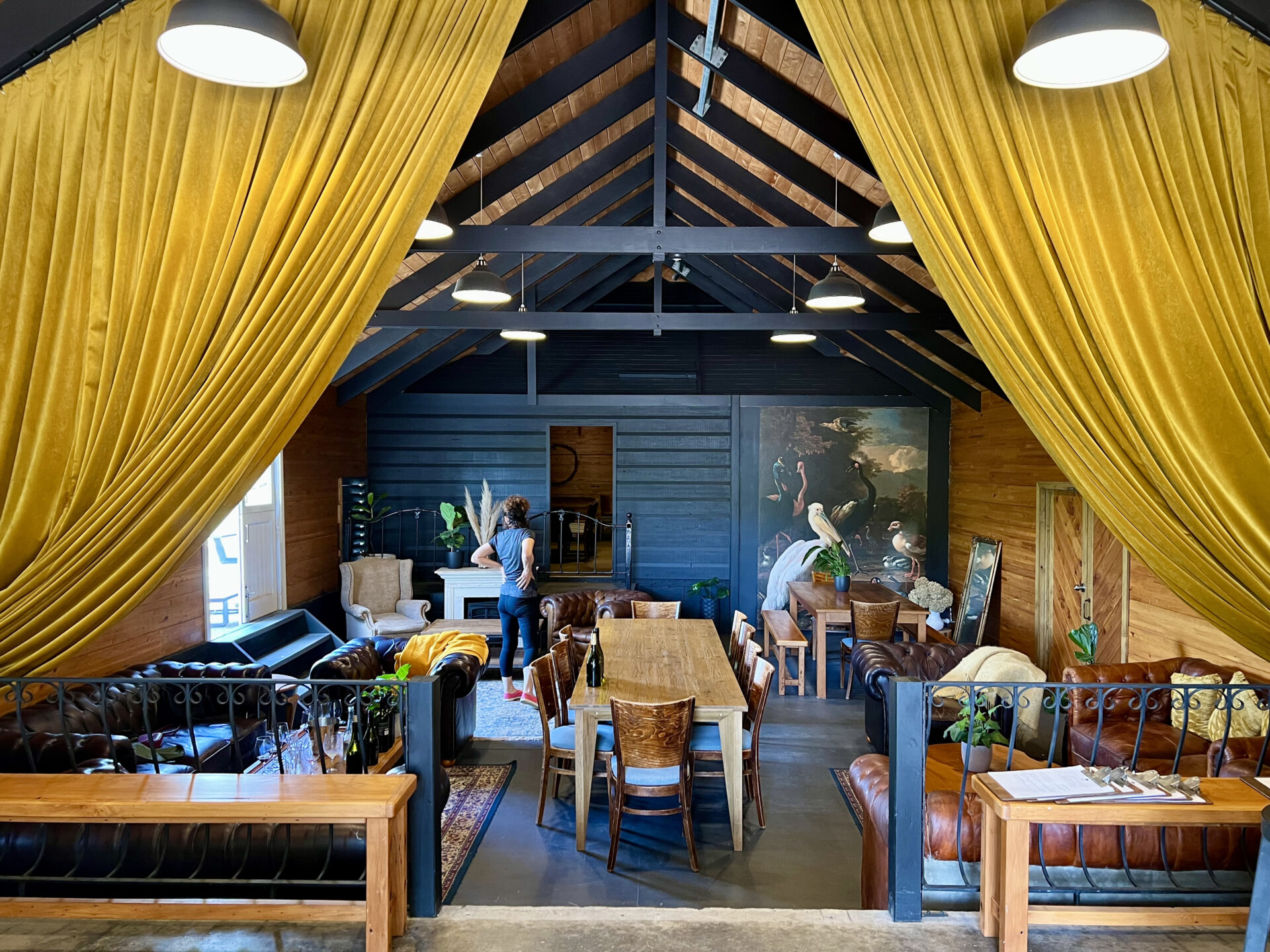
Not your classic university classroom – always a warm welcome at Goldie
Henrich took us through a vertical of the Syrah, the Bordeaux blend and the Chardonnay. The vintage affect is clear in the wines, he obviously has fun experimenting with wine making techniques to adapt to this vintage variation, using whole bunch fermentation if acidity is low, adding freshness floral notes and in the hotter vintages. He produces 25-30 tonnes of grapes from the heavy clay terroir, relying on the orientation of slopes for plot differentiation – and there are some impressive slopes. They underlined the importance of hospitality and cellar door sales in their success, and they do it well.
Stormwood Henrich also shared the collaborative nature of the wine business on the island, it’s small, everyone knows each other. He works with Michael Wood, winemaker of Obsidian Vineyards to produce Stormwood, farming parcels of organic vineyards across the island. We tasted their delicious Marsanne at dinner a few days later at Three Seven Two on Onetangi Beach.
Make wine not war. The biggest and best known island winery is Man O’ War, producing around 500 tonnes of grapes. The total farm covers almost 2 000 ha, 75 plots of vines are planted on volcanic soils amongst olive groves, orchards and pastureland all part of the farm to table philosophy at their restaurant.
A water front welcome at Man o’ War
You can discover all this on e-bikes but do go to the tasting room and restaurant right on the beach of Man O’ War Bay. On the eastern end of the island, it is the most beautiful venue, there’s even a quaint chapel next door for a picture perfect wedding. They are happy to riff on this name see above). Like many they have a sense of humour, (the title above is a riff from their T shirts) taking the wine, but not themselves, too seriously. A theme with wine makers across the island.
A light hearted approach at Goldie too
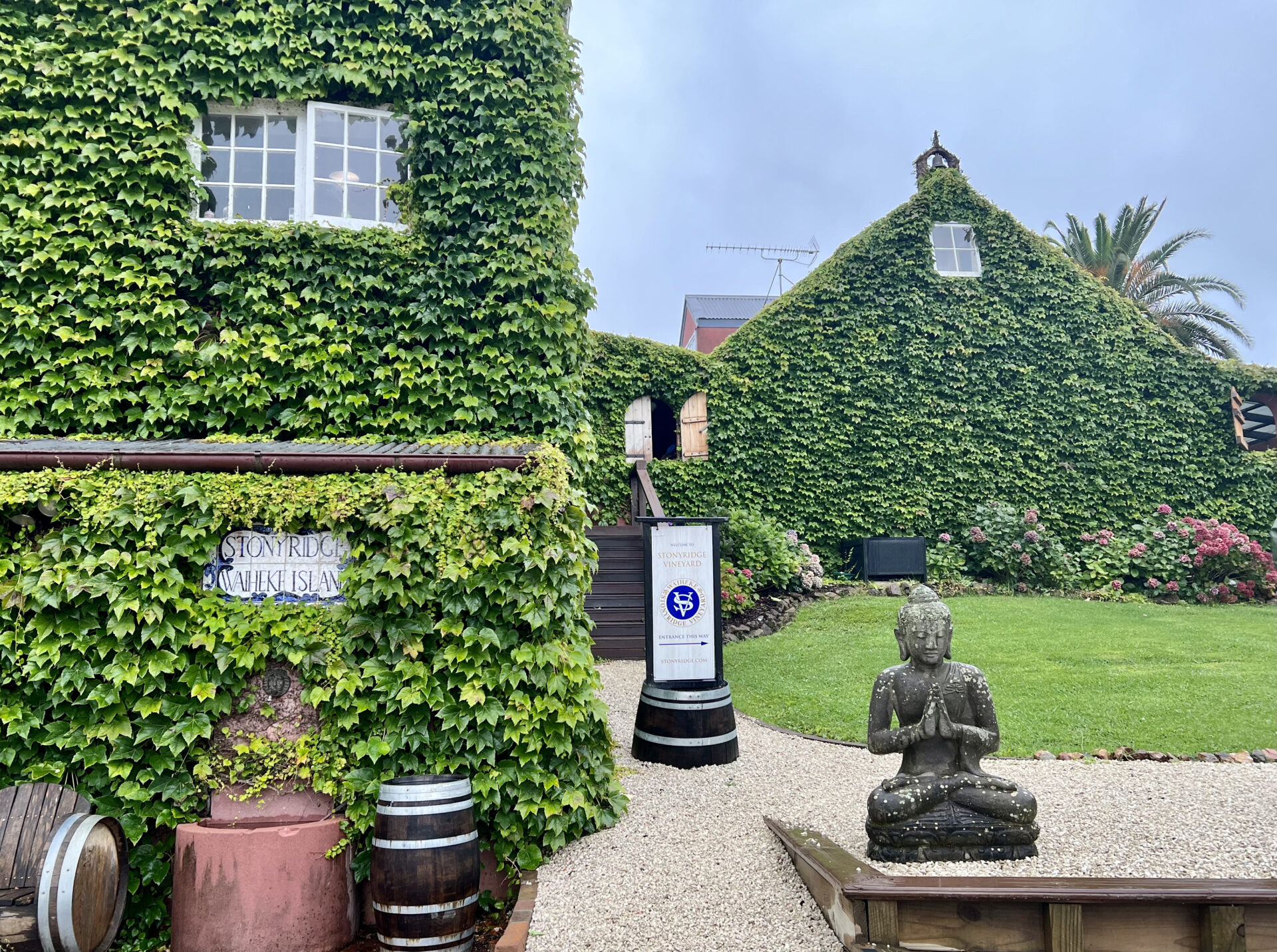
Stonyridge has a back story close to my heart, owner Stephen White is a yogi (there’s a vibrant yoga community on the island – I went to at least five different yoga studios during my stay). As a wine maker he also has close ties to Bordeaux. Wine Marker Martin Pickeringexplained the history to us.
Picking up on the yoga vibe at Stonyridge. Yogis take a close look at the label below
In 1981 Stephen returned to New Zealand after skippering yachts around the world and sailing a Whitbread Round the World Yacht Race. (There’s a theme here). He worked in wineries in France, California and Italy and before choosing Stonyridge, with its north facing slopes (we’re in the Southern hemisphere remember) to plant Merlot vines and olive trees in 1982 (the first commercial olive grove in New Zealand). Cabernet Franc and Malbec followed in 1983 and in 1984, following a vintage with the Sichel family at Chateau d’Angludet, he brought Petit Verdot back from Bordeaux. Way before biosecurity measures, I imagine.
1985 was the first Stonyridge Vineyard vintage, in 1987 he made the Bordeaux Blend ‘Larose’ to international acclaim. It still reaches high 90s in international tastings. It’s the most expensive commercially made wine in Waiheke, and yes they are close friends with Château Gruaud Larose in Saint Julien. Such is his love for Bordeaux they use Bordeaux barrels and emulate the En Primeur system, offering ‘wine futures’, to members since 1987. They make the estate wines from 12ha and a Fallen Angel range from elsewhere in New Zealand, mainly to offer a broader range to restaurant guests. The winery restaurant is another illustration of the important role hospitality plays in the success of vineyards here. Fatboy slim performed here the night before we visited – the staff was looking a little weary after what was, by all accounts, a memorable evening despite the dodgy weather.
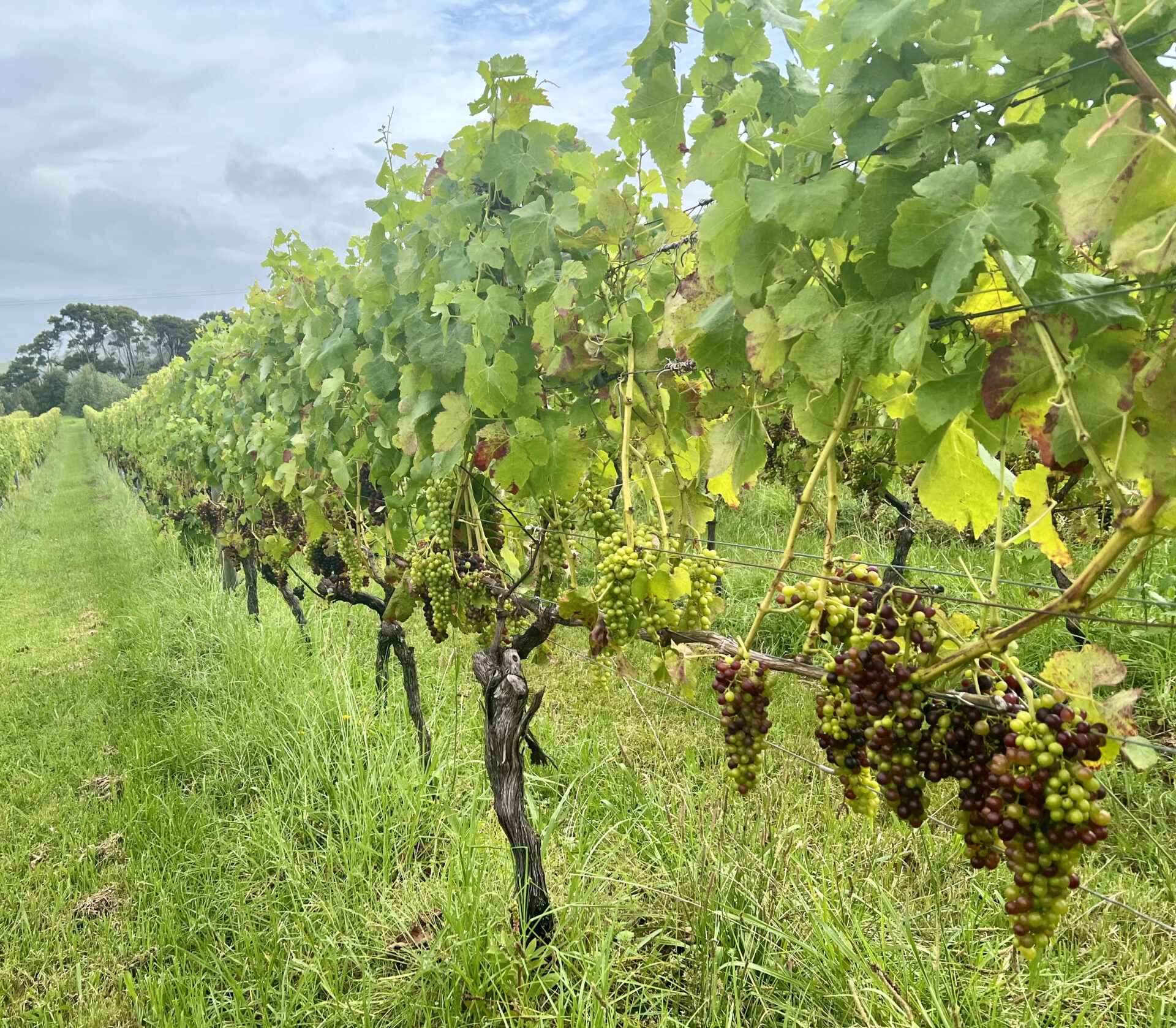
Nets. Sailing into harbour on arrival, what first struck me were the nets on the vines, protection against voracious birds as veraison started. Bird pressure is not a problem in Bordeaux, the joke is the French shoot them all. As we sat on the terrace of the restaurant watching vine workers checking the nets for damage, Martin explained that indigenous birds don’t peck away at the grapes but the newer arrivals, such as sparrows and mynah birds.
Netted vines, olive trees, yachts and spectacular views – welcome to Waiheke.
There are a lot of natural habitats for birds across the island, agro-forestry may be new in Bordeaux, but here vine plots are spread out between lots of natural and replanted sub-tropical woodland. Most of the indigenous forest, uprooted in the 1800s and early 1900s for pasture, is now being re-introduced. During the 2020 lockdowns Stonyridge planted 300 native trees around the property.
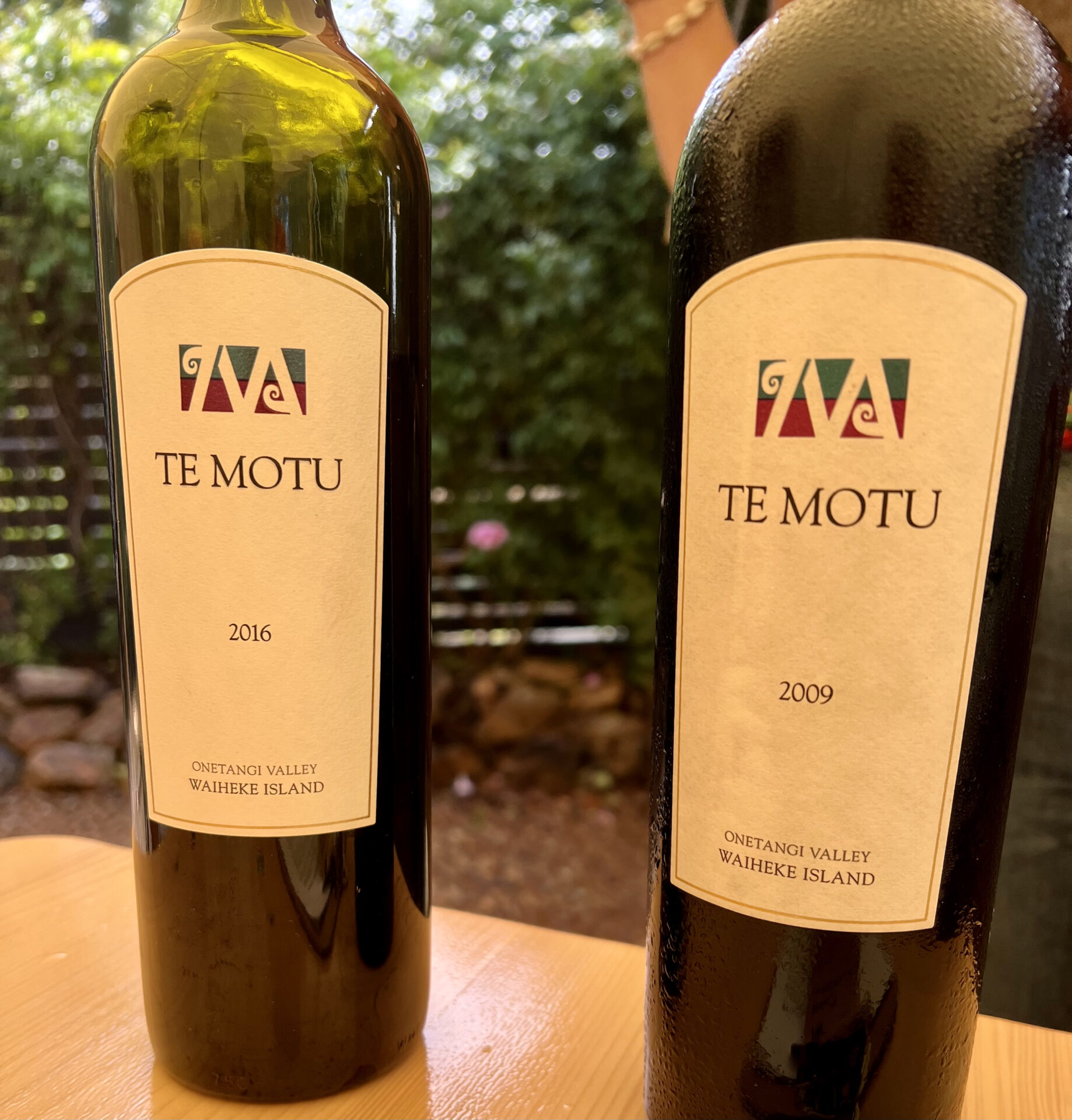
Other memorable visits were tiny Te Motu, where the restaurant is as much a pull as the wines. Planted in 1989, by the Dunleavy family on the Jurassic clay and gravel soils of the Onetangi valley where night time warmth contrasts with cooling day time ocean breezes. The flagship Te Motu is a Cabernet Sauvignon dominant Bordeaux blend with Merlot, Cabernet Franc and Malbec, producing only 4500 bottles a year. Kokora is their right bank Merlot driven blend.
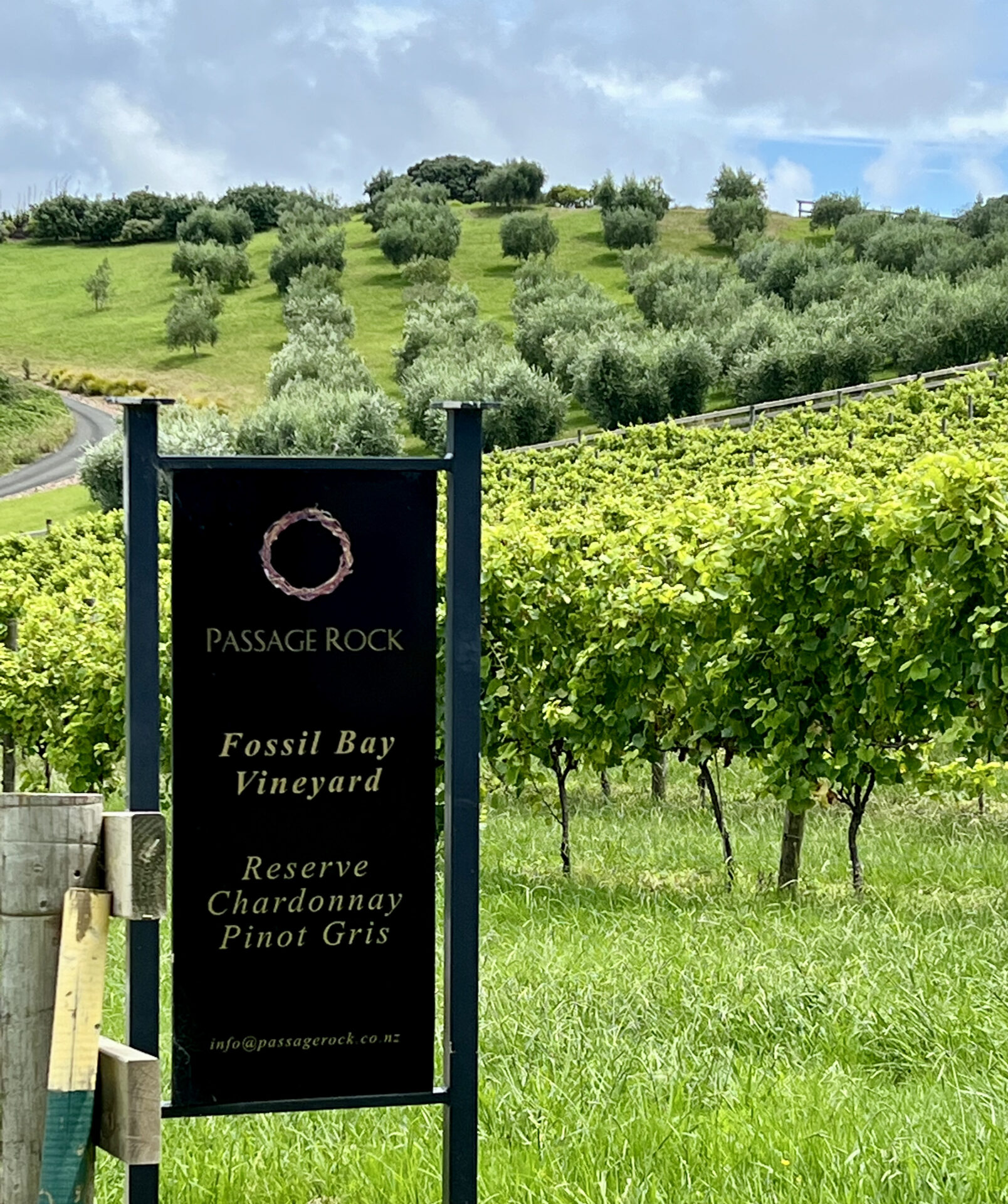
Passage Rockwas my first taste of Waiheke Syrah, thanks to my generous host. I was immediately seduced, and a visit was scheduled to Tematuku Bay to discover this pioneer of Syrah on the island.
Seduced by Syrah
At Passage Rock
The winery is busy, with smells of delicious food welcoming diners inside and out. Tucked into the valley again near the water – you never forget Waiheke is an island – we were welcomed by the new generation Johnny, clearly with an inherited passion for wine, from his pioneer father David. Almost everyone on the island picked our brains about Bordeaux as well as sharing their own passion.
Olive trees and vines on a Passage Rock plot
Gin with a view. Wineries aren’t the only places to sip admiring stunning views. The tiny Waiheke Distilling Company is perched high above Cowes Bay, also on the eastern edge of the island. The gleaming stills are in a modern facility, but the tasting room is an old wool-shed. Under the parasols between a botanical garden and impressive sculpture from a Macrocarpa log off the property we discovered the range of gins distilled with local botanicals and even seaweed. The tasting menu lets you choose your gins and or vodkas and your mixers or opt for one of the colourful cocktails.
Gin with a view
Olives . There are around 20 thousand olive trees on the island, planted, alongside the vines, many wineries sell their own olive all (and manuka honey) alongside their wines.
The oldest at 40 years old are at Stony ridge (see above). We tasted a range of olive oils at the Allpress Olive mill in the foothills of Rangihoua mountain in Aotearoa. The mill produces oil from its own groves as well as being a community press for independent olive growers across the island who can choose to bottle independently or add their oils to the press range.
They produce blends, single estate and single variety oils. The tasting was fascinating with stunningly different flavours and mouth feel between the different oils. The Picual variety was my favourite, a real bite thanks to high polyphenols levels – and you know how I feel about polyphenols. Locals bring their own bottles to be refilled.
Weather notes
I arrived just before a storm, and we were locked down for a couple of days. No serious damage to report on Waiheke although Auckland fared less well. As I left, wine makers were already worried about mildew and rot. Then, a few days later storm Gabrielle hit the North Island to devasting effect, and a national state of emergency was declared. At Hawkes Bay and Gisborne orchards, vineyards and wineries were washed away just before harvest. If you want to help, buy more North Island New Zealand wine, they’ll need all the support they can get.
and just as I left the sun shone – but not for long………
With 30 years in Bordeaux, I bring you a twice-monthly perspective on the stories shaping this, and other wine regions — from sustainability to wellness, women in wine, and beyond.