Les Vignobles de Larose, making big beautiful 

Five years and 25 million € of investment have transformed Les Vignobles de Larose. This huge property covers four chateaux, three production sites and 255 ha of vines across the Haut Médoc and Saint Estèphe totaling an average production of 1.2 Million bottles a year. 

Value, volume and accessibility

Their wines have always been excellent value for money and, thanks to their size easy to find across many markets. They try to emphasis this ‘easy access’ in the style of wine they produce – pure, precise and fruity. Exactly what the market seems to be looking for right now. You’re very likely to find a bottle near you and I recommend looking out for one.

A pioneering lineage

This investment is the latest chapter in the history of a property that has embraced change and innovation since 18th century. Vines were planted at Domaine Perganson in 1719, a little later at Larose Trintaudon in Saint-Laurent-Médoc. More planting in the 1800s made this the largest vineyard in the Médoc, at the time when French and international retail markets were opening up. The Chateau was built under the ownership of Comte Ernest de Lahens, who also brough railways to the Médoc. It’s iconic tower is still visible today from miles around.

A history of firsts 

The property is also a pioneer of certification, unsurprising perhaps as the current owners are the Allianz insurance Group, who bought the property in 1986. They believe third-party certification mitigates risk and is objective proof of their commitment to quality, the environment and social responsibility. 

They are pioneers, Larose was the very first vineyard to obtain ISO 9001 certification in 1999 and by 2003, the first French vineyard to obtain both ISO 9001 & 14001. In 2008, they were effectively guinea pigs for the AFNOR certification Engaged CSR (Corporate, Social Responsibility) – the first European vineyard and first Aquitaine company to qualify. By 2022, they were rated as ‘exemplary’ by AFNOR for the fifth time – a first for a European vineyard in the history of the certification. They will be reassessed for the sixth time at the end of this November.
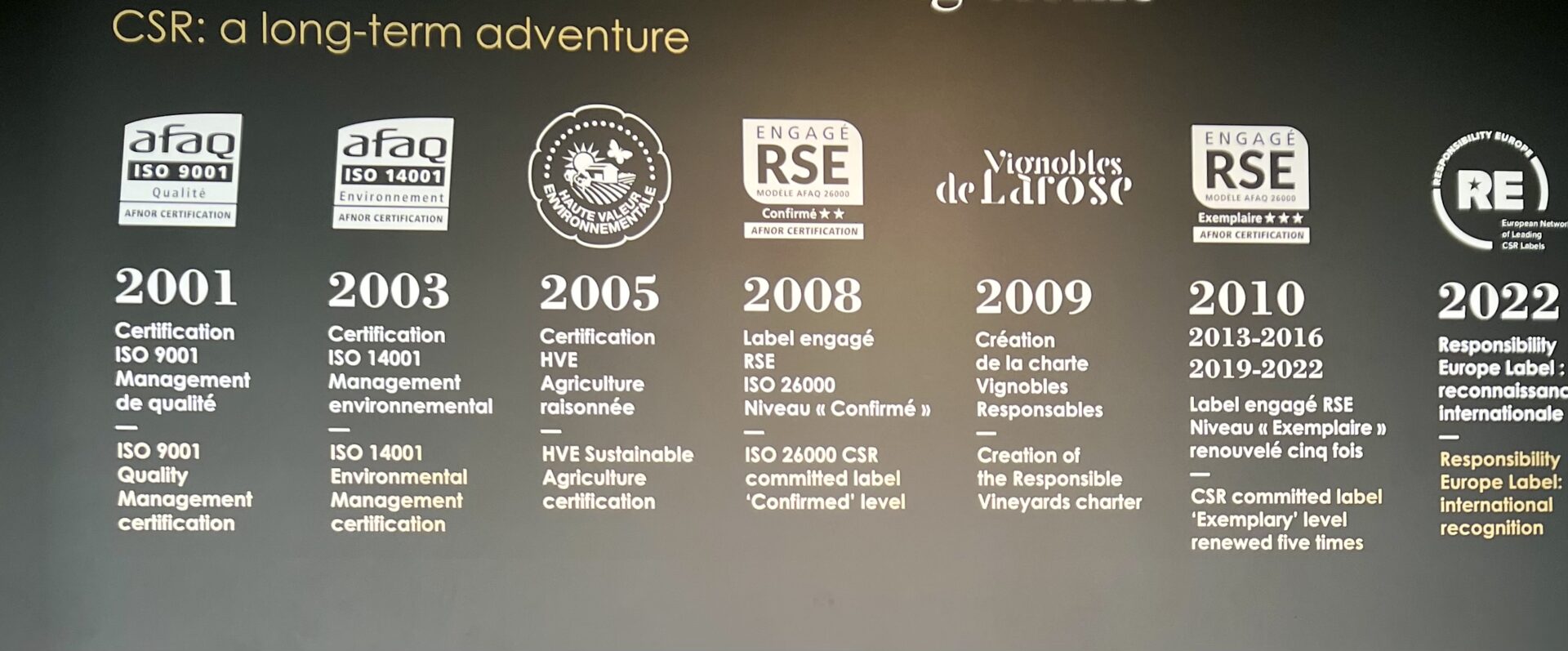
Sharing their commitment to certifications with visitors

Aligned with the vision of the United Nations Sustainable Development Goals in 2007, they created the brand ‘Vignobles Responsibles’ (Sustainable Vineyards). They wanted a definition of sustainability that embraced production, employment and business. A property can’t be sustainable if it’s not making money. Something ringing very true in Bordeaux right now.

Global Sustainability 

No weed killers or synthetic pesticides are used in the vines and 36% of the estate is dedicated to the preservation of flora and fauna. In 2022, working with Bordeaux start up Net Carbon they were the first vineyard to measure their carbon capture using infra-red and satellite images, right down to the calculating the contribution of each hedgerow planted for wild life.

Inside sustainability 

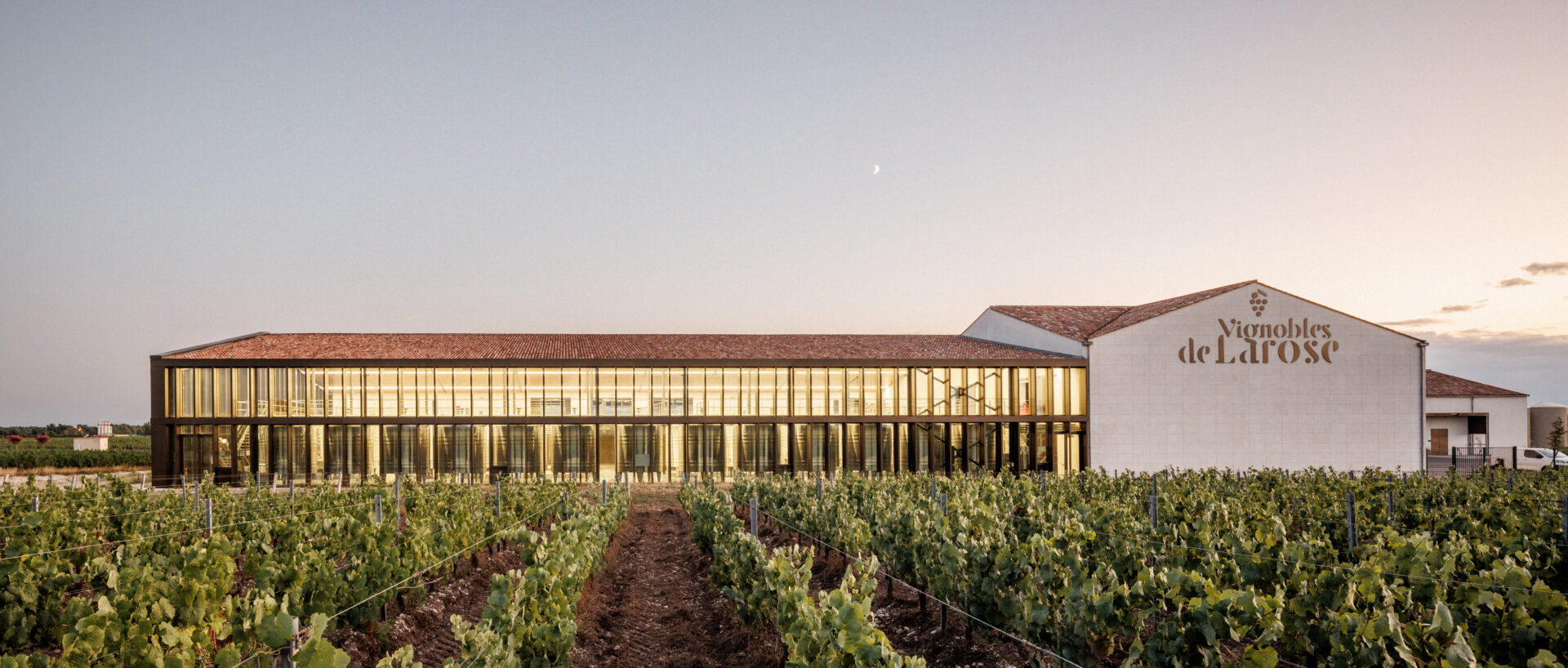
The new cellar project was an opportunity to bring this sustainability philosophy inside, optimising electricity and water consumption. Innovative building materials increased insulation capacity 25 times compared to classic breeze blocks, large bay windows maximize natural light, (and the view for workers – it’s very cool) and 1850 m2 of solar panels now supply 60% to 70% of electricity consumption during harvest, and 100% the rest of the year. 
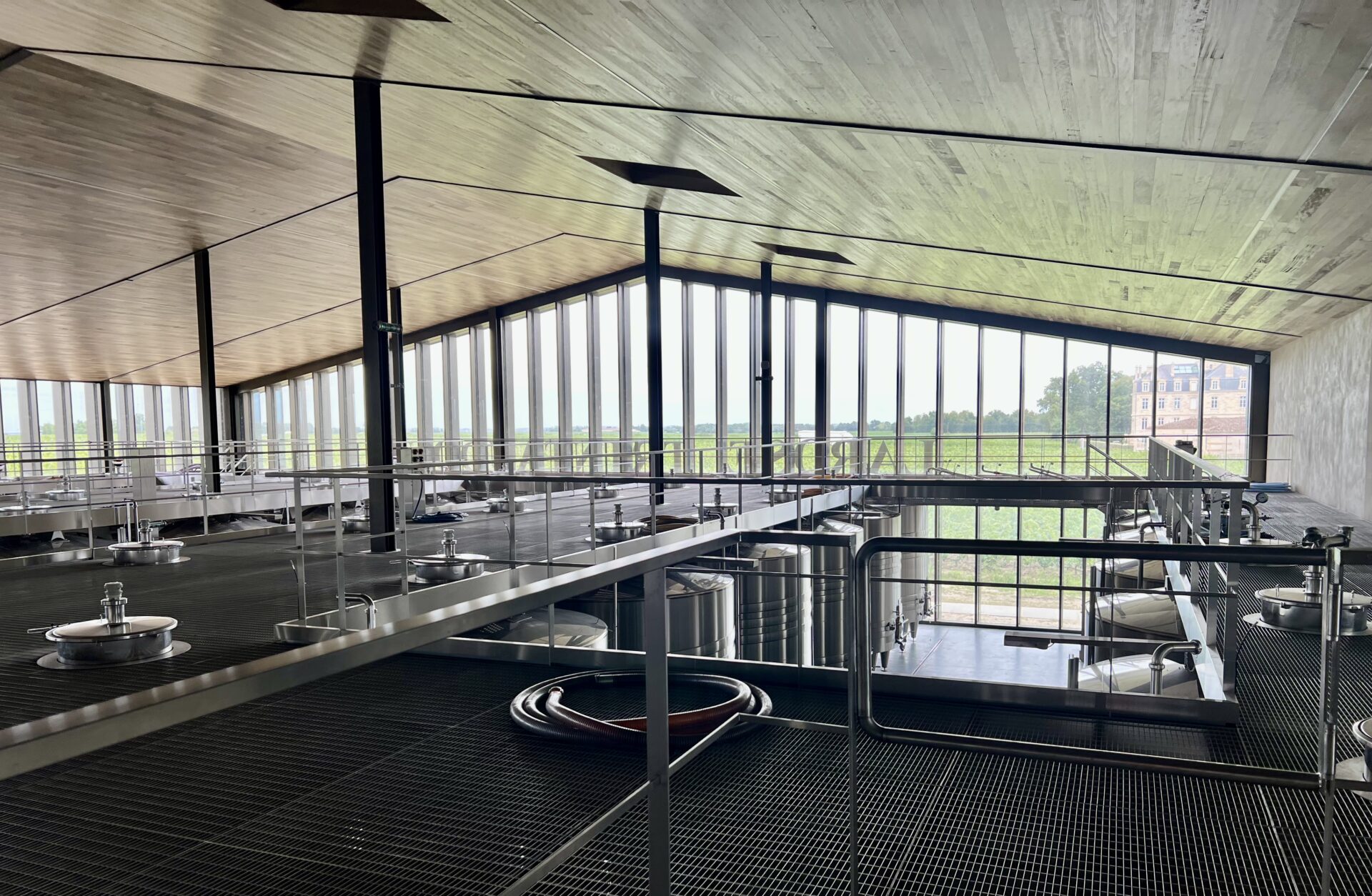
Safe working platforms and a cellar with a view

A 200 m2 water treatment plant provides recycled water for cleaning of agricultural machinery (they have the largest tractor garage of the region), reducing water waste to half of current standards. Green spaces have been redesigned, reducing lawns, favouring flowering shrubs to encourage bees to visit their beehives. Abandoning automatic sprinklers in the summer has reduced water consumption by half. 

Two cellars, two chateaux 

Delivered in 2023, there are two dedicated vat cellars in the new build, one for Château Larose-Trintaudon, the other for Château Larose Perganson. The new vats are less than half the size of the old, reducing plot size at Larose-Trintaudon from 7 to 2.5-hectares across the 190 hectares of vineyard and down to 1.7-hectare from 5 hectares for all 20ha of Larose Perganson. 
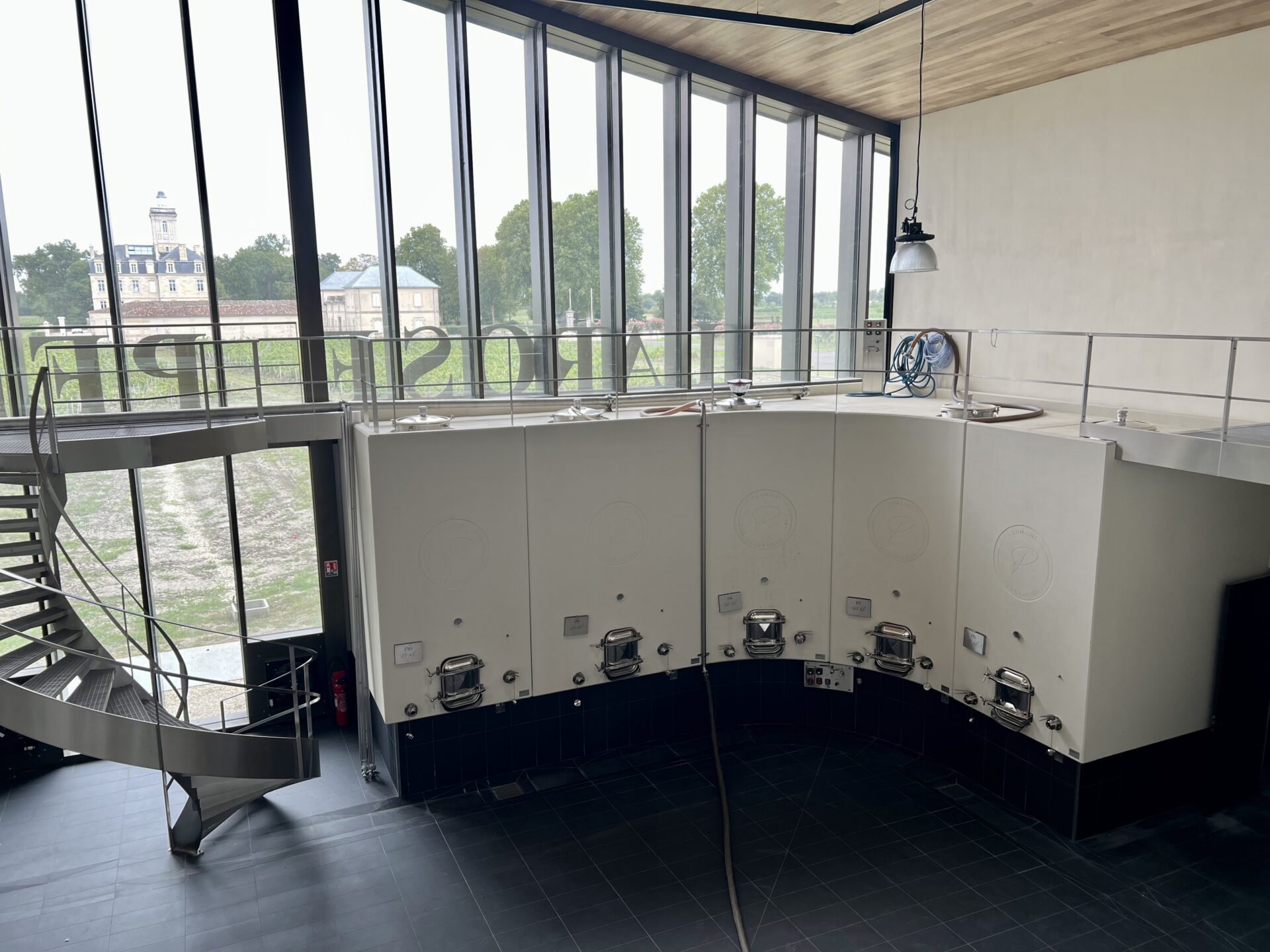
The new cellar of château Larose Perganson with a view of Château Larose-Trintaudon

Upcycle

Nothing is wasted, the older, larger vats are now used for blending. Even the glazed paper support from self-adhesive wine labels is collected and recycled for insulation – another first.

Taking the temperature 

Adapting to climate change means managing rising temperatures, they can now chill all 190 hectares of harvest, by more than 10°C between sorting and vatting, even when grapes come in at around 30°C. No more  night harvesting for workers, their signature freshness is preserved, and sulphur use reduced to  65 mg /litre – less than biodynamic certification. CO2 recovery during vinification and their own nitrogen production protects the fruit, and two large (of course), air-conditioned barrel cellars help microbial stability during ageing.

Future forward

A small vat house with ten temperature controlled 13-hectolitre ‘cute cuves’ is devoted to experimental micro vinifications. They have also introduced new grape varieties. 2025 is the first vintage of their white Chardonnay, Semillon, Viognier blend, all grafted onto Merlot rootstock. It will be released next year as a Vin de France as these varieties chosen with rising temperature in mind don’t all fit into the new White Médoc appellation. The in-house bottling line is sound insulated and wine is shipped in lighter 410g glass bottles sealed with technical corks. 
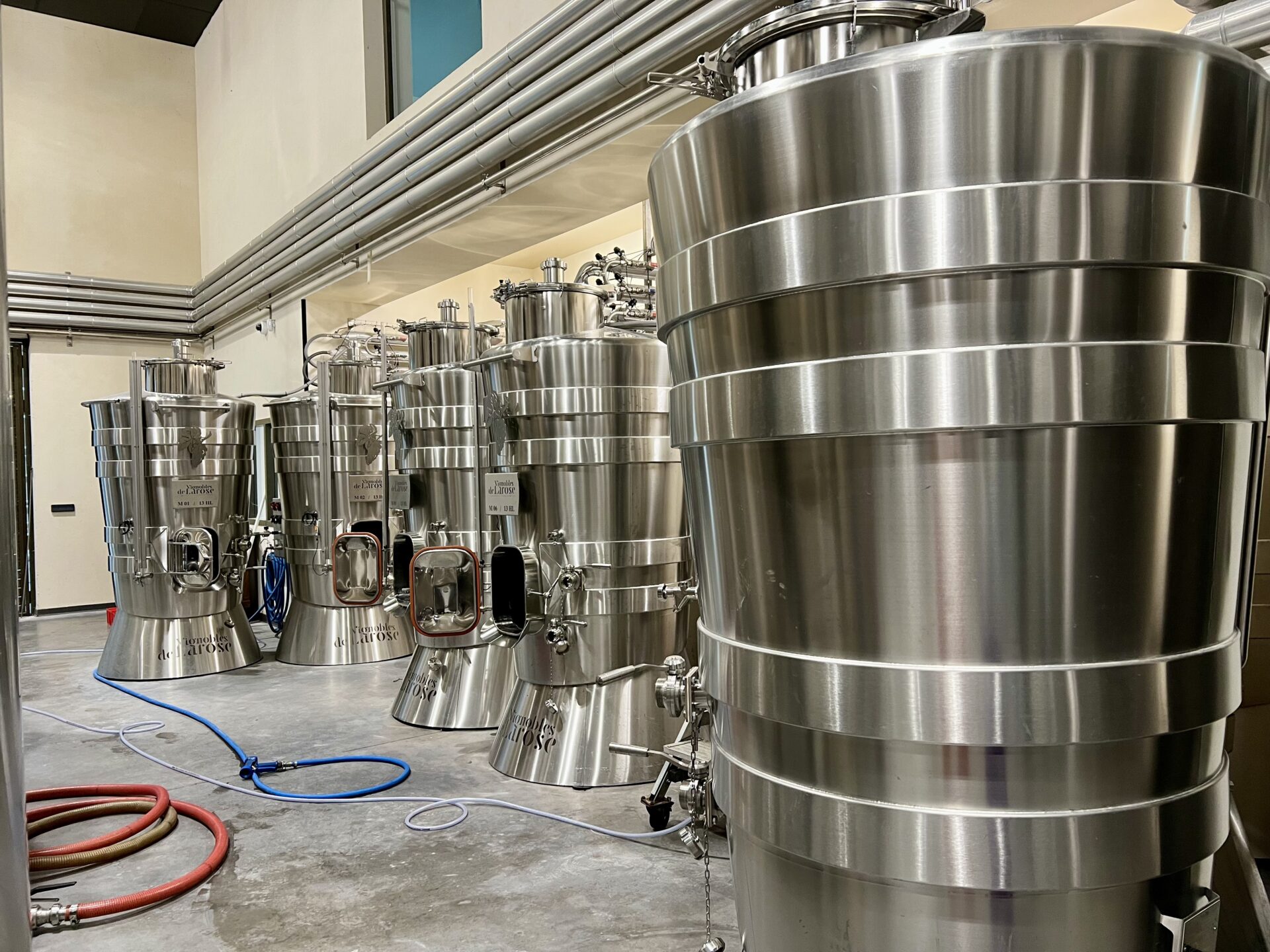
The experimental cellar with those ‘cute cuves’

People and place 

The cellar was designed by for the technical team, and you can tell they are proud of the new cellars. As well as having fun with innovation, ease of production and safety were a priority.  Walkways are replaced by work platforms, water and power sub meters through the vat rooms mean no lugging and pulling pipes and tubes as well as gaging consumption, CO2 detectors and automatic ventilation all enhance safety. 

There’s a staff sports and leisure room where a personal trainer offers bi-weekly classes keeping workers in shape. Wine making is physical work  both in the field and the cellar. It‘s also an opportunity to create and reinforce community, although there’s a staff room for meals and more relaxed breaks and electric charging stations for staff cars. 
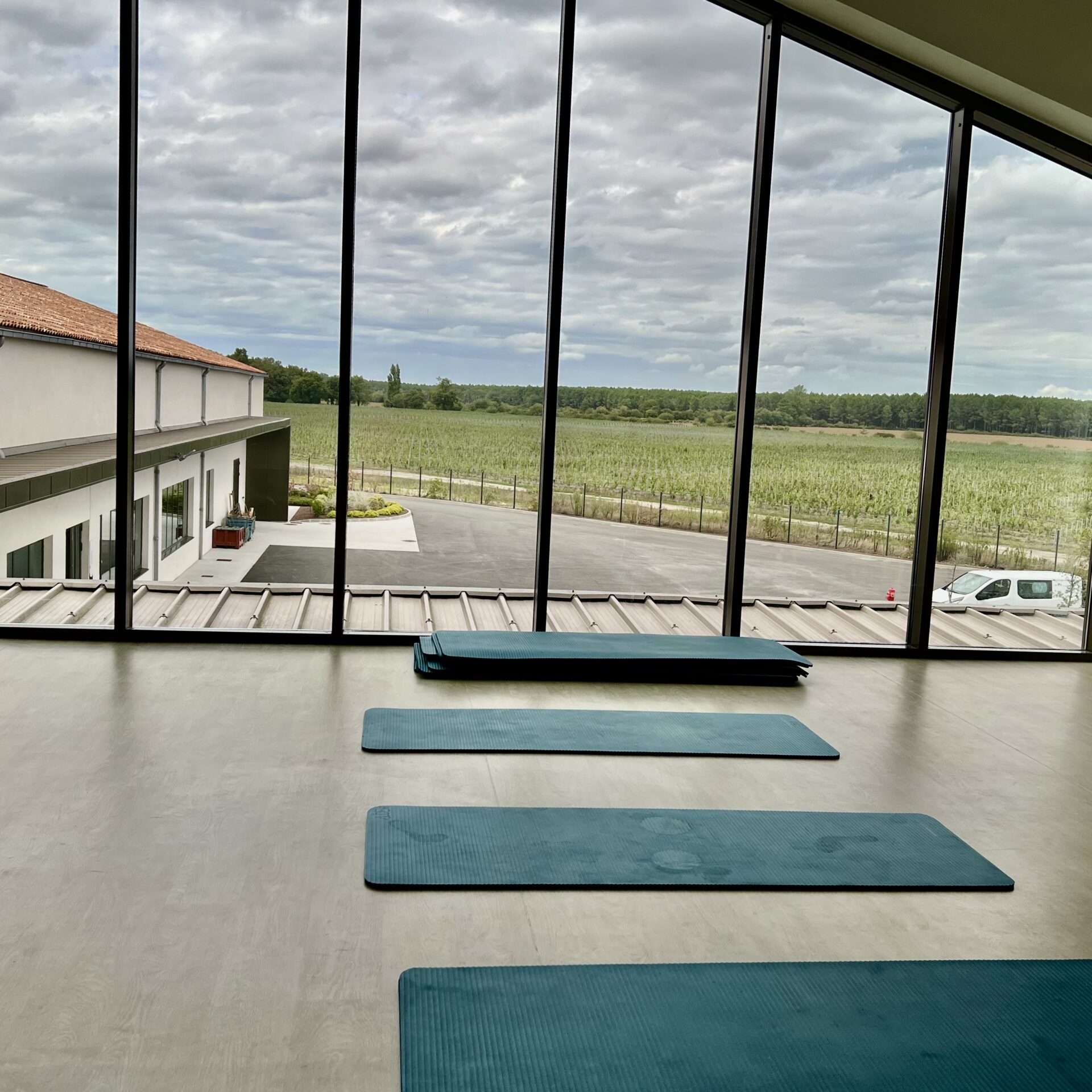
Ready for a workout

Ongoing training 

Training isn’t limited to physical fitness, there’s on-going professional training, leading to professional certifications. 100% of the vine workers have the ‘Diplôme Universitaire de Taille et d’Épamprage (university pruning qualification). The scheme is so successful their staff often get poached. 

Size matters

They take their situation as the largest local vineyard seriously, very aware of their role as an economic actor of the Médoc. Aiming to grow in and with the region, over 75% of all purchases are made locally, and a partnership with the social inclusion agency Ares Coop has already led to five permanent jobs

Visitor Transformation

The chateau seized the opportunity of the new build to re think the visitor experience. Opened mid 2025, the wine tourism centre is open all year round, including Saturdays in the high season. It is open to all thanks to Tourism Handicap Label (yet another certification) 

Aware that not everyone wants a full-blown wine tour, they encourage people to pop in for a self-guided immersive experience, no appointment needed. It’s accessible to all regardless of their level of wine knowledge and time constraints. It allows guests to visit at their own pace, short or long, depending upon their level of interest. They discover the history, seasons and terroir of the property thanks to clever scenography and videos before enjoying a tasting. In July and August visitors can also enjoy a bite to eat on the terrace or inside, all without an appointment. 
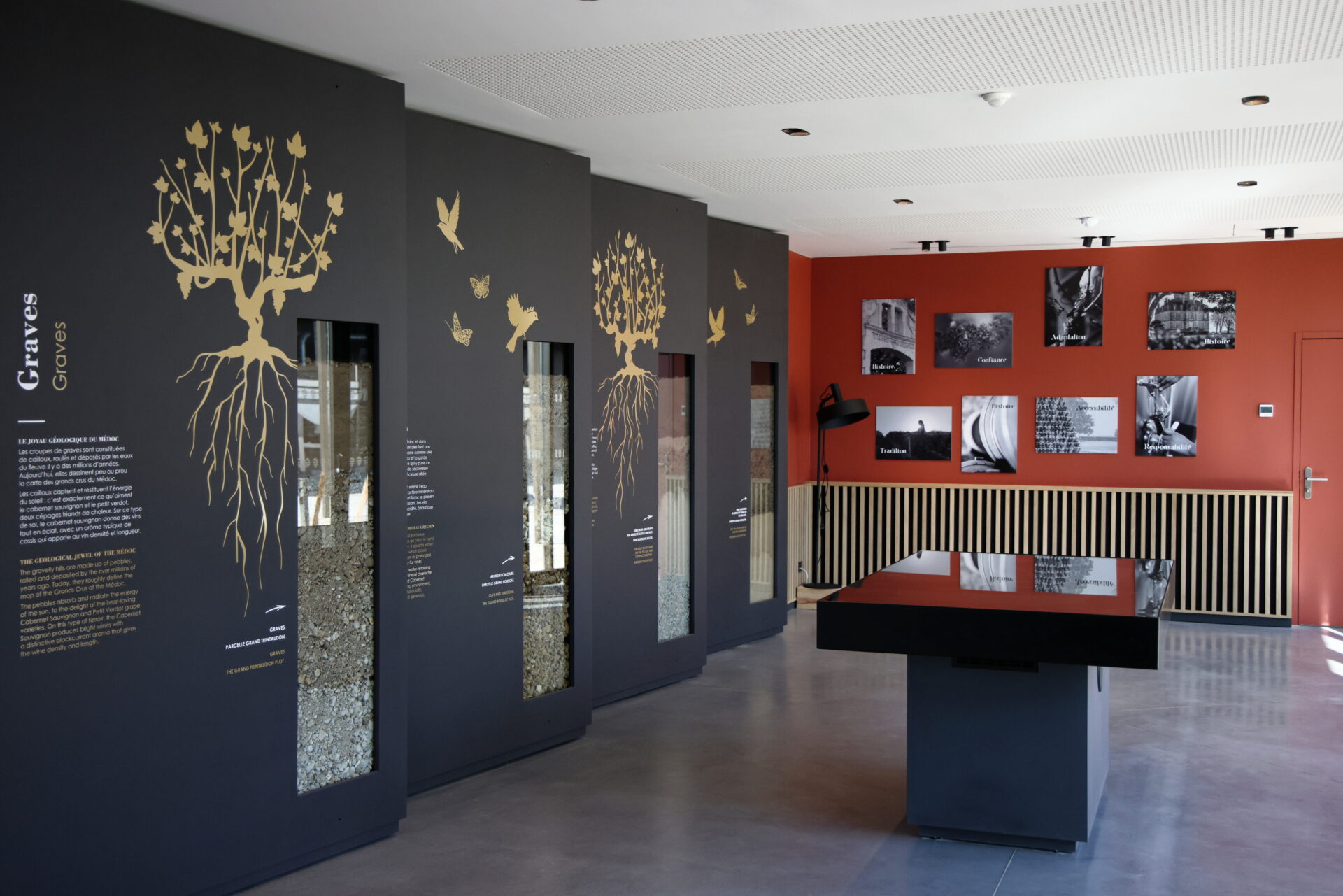
The interactive visit open all year rond for drop ins Cr @11h45 Florent Michel

For enthusiasts who do want to dive deeper they cellars tours are available by appointment. Also designed to be accessible to all, lifts to raised walkways allow guests access to the impressive new cellars and views across the vineyards, even during the busy harvest time. There’s an opportunity to taste wines from all four properties of the group. The wines from the range  are available to consume on site or take away and there’s an IRL/online combo to pre-order. 

This new initiative, that shares their history of sustainability led them to win this year’s Best of Wine Tourism Award for Sustainable Tourism at the Great Wine Capitals AGM in Bordeaux this November.

Forward thinking 

Their broader vision of wine tourism includes being part of ENOTOUR, a European joint venture that offers online wine tourism training leading to certification (again!). They are the only French vineyard out of 18 partners across 4 countries, Spain, Italy, Portugal and France that brings together universities, vineyards, hotel schools and institutionals  to raise the quality of wine tourism. Bordeaux partners are the ISVV (Université de Bordeaux), the Lycée de Gascogne and the CCI de Bordeaux (also at the origin of the Great Wine Capitals best of Wine tourism Awards).
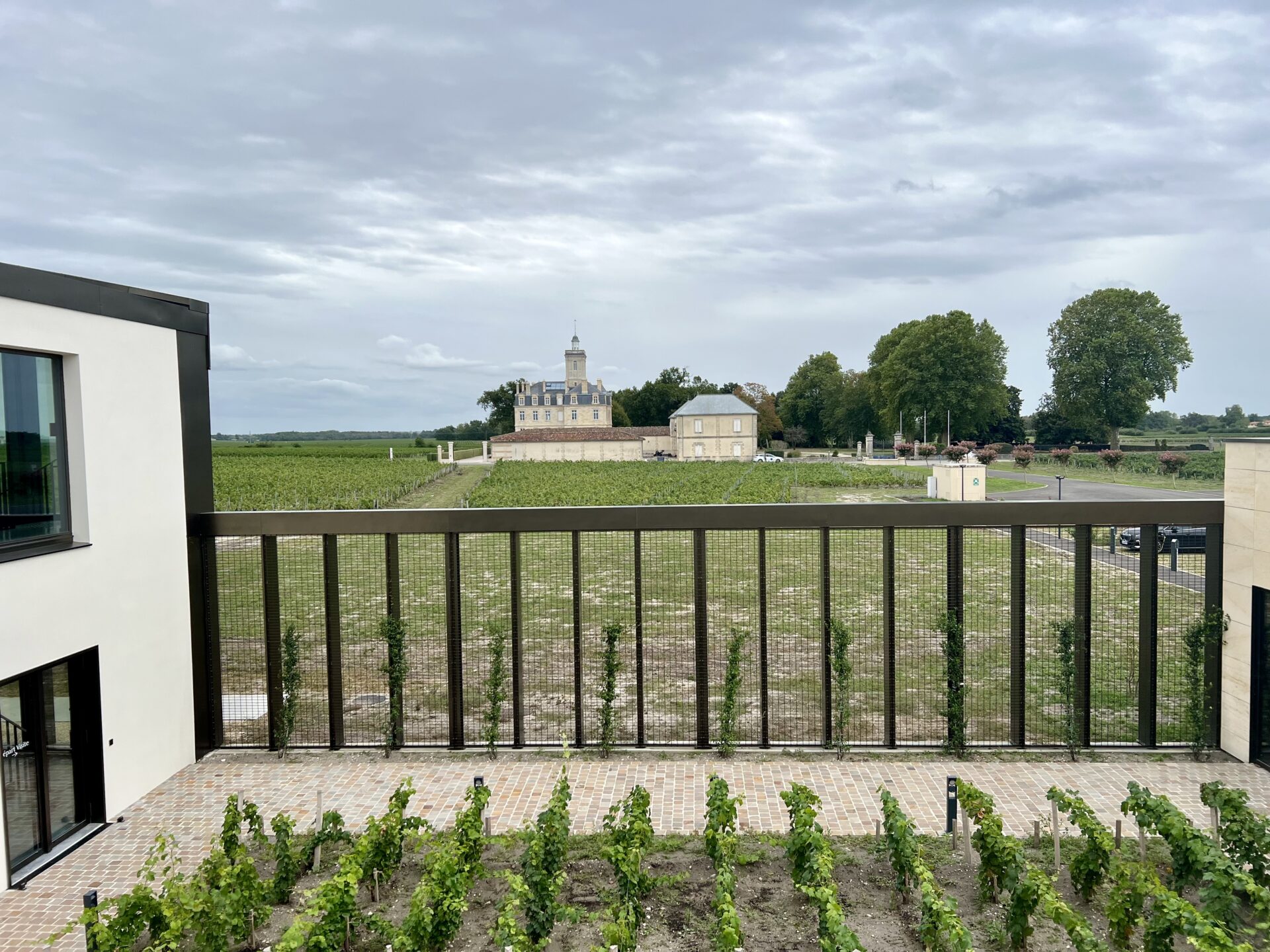
View of Château Larose Trintaudon from the terrace above the vat cellar

This year they finished the renovation of the 18th century Larose-Trintaudon Chateau with eight bedrooms, reception rooms and that famous tower. 

Big and beautiful 

Vignobles Larose is the CSR market leader with the certifications to prove it. It reflects a desire to make their wines accessibility to as large a public as possible but also to share their sustainable responsibility. They want to prove that big can be beautiful in terms of wine quality and price point whilst still protecting the environment and the people who work in it. 

Thanks for reading, please share with anyone interested in discovering more about Bordeaux. Sign up here to receive future posts directly to your inbox.  Read the new Green Edition of Bordeaux Bootcamp, and explore Wine and Wellness, with  The Drinking Woman’s Diet  or just say hi  here.
I also share my healthy passion for Bordeaux (and more) in other wine publications and with online classes. Contact me here to learn more.
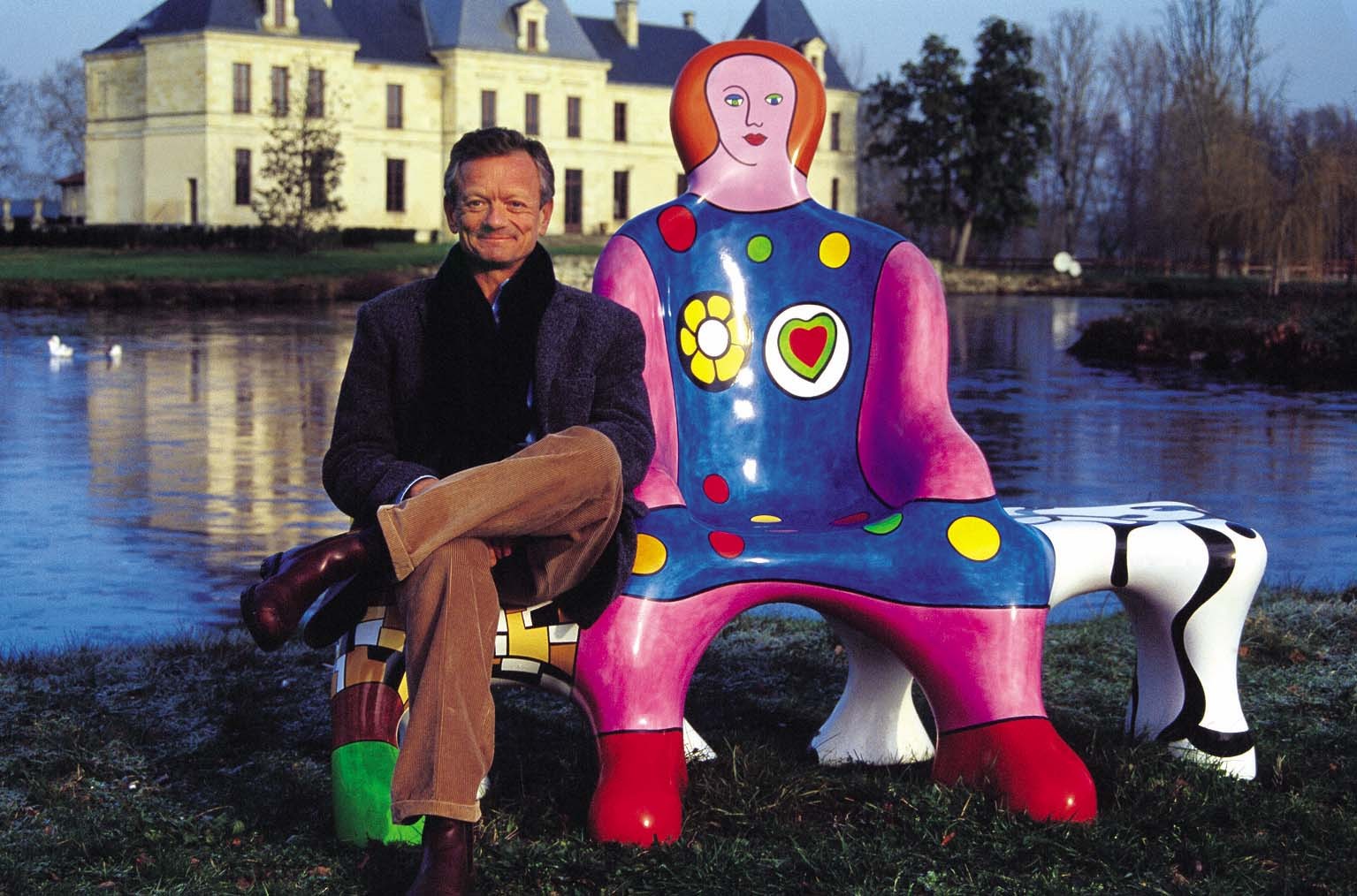
Philippe Raoux, looking back on the legacy of a pioneer of wine as art.

It’s the time of year for reflection and as I think about the past year and look forward to the new, (they’s a newsletter coming shortly so sign up now if you haven’t already!). I realised it’s been over a year since Philippe Raoux left us in October 2023. Some news takes a while to digest.

It’s tempting to sum up Philippe’s life through his passion for sharing art in the vineyard. It’s certainly the most visually stunning mark he has left on Bordeaux. But it’s far from the only one. Philippe Raoux bought Château d’Arsac in 1986, one of the oldest and once the largest property in the Médoc dating back to the 12th century. It was owned by such historical names as Pichon and the Segur and at  its 19th century heyday, under the ownership M. Dubosc, it covered 250 ha of vines. 

Phylloxera, falling sales and indifferent owners who uprooted almost all the vines meant that, when Philippe acquired the property, it was a shadow of its former self. There were just 3ha of vines, a ruined cellar and the chateau in a sorry state, the only thing that worked were six industrial chicken barns on one of the best gravel outcrops! Philippe rose to the challenge.

A family history  

The Raoux family were no strangers to wine or Bordeaux. Growing grapes in Algeria since the 1880s, they moved back to Bordeaux in 1962. In the 1920s his grandfather created Chamvermeil, the first, and by the 1980s, the largest French Negociant house specialized in selling bulk wines directly to over 600 000 consumers in France and Belgium.

Back to Margaux 

Philippe set about restoring Château d’Arsac to its former glory. Although unplanted, the domain covered 250 ha of which 160 were in AOC Haut Médoc, an attractive project for someone with Philippe’s vision. 

Shortly thereafter, he discovered that Arsac missed inclusion within the Margaux appellation in 1953 (also Philippe’s birth year) as it was not then under vine. He commissioned a terroir study by the Bureau de Recherches Géologiques et Minières comparing the Arsac terroir to other Margaux vineyards, concluding  that they were the same as certain properties within the appellation. This led to a long and tortuous legal battle, that ended in 1995 with AOC Margaux boundaries being changed to include part of the vineyard of Château d’Arsac. A decision reconfirmed in 2008.

Today the 250 ha property has 108 ha of vines; 54 in Margaux, 50 in Haut-Médoc and 4 in Bordeaux blanc, the remainder covered by forests and fields. 

In her book ‘Inside Bordeaux’, that dives deep into Bordeaux terroir, Jane Anson states, ‘Although it caused some bad feeling at the time, it did lead to a far clearer understanding of what type of terroir constitutes Margaux; so perhaps we can all be grateful to Raoux for that’. 

That alone is quiet a legacy! 

Quality 

Château d’Arsac was promoted to ‘Cru Bourgeois Exceptionnel’ in 2020 one of just 14 châteaux in the classification. A recompense for the work that he has undertaken in the vineyard and in the cellar. 

The vineyard as a sculpture garden 

In the wine tourism world, Château d’Arsac is well known for its contemporary art collection spread through the vines, cellars and chateau. The inspiration for this collection came in 1988 with a visit from The Peter Stuyvesant Foundation. The foundation’s philosophy was to bring art into the workplace. They were fascinated by Arsac that was both a working vineyard and, at the time, had virtually empty cellars with lots of room for works of art, as the vineyard gradually came back into production.

Together they organised a summer art festival and the 1989 harvest was brought in under the watchful eye of works from artists Indiana, Vasarely, Appel, Viallat, Morellet and de St Phalle. The harvest finished, the works of art left, leaving the chateau bereft. Philippe continued to organise art festivals from 1990 until 1996. 

By 1994, his investment in the vineyard started to pay off, the vines were gaining recognition for their quality and the chateau could afford to curate its own collection. The vines funded the art, the original budget was one French franc per vine, they had 600 000 vines. 

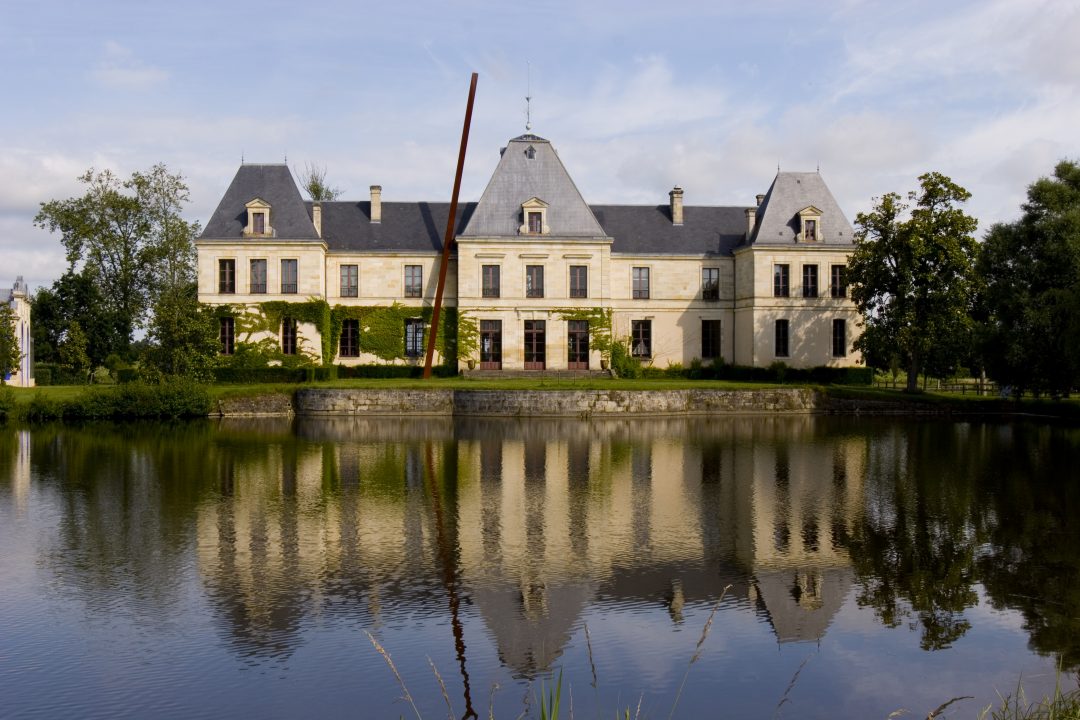
Each vintage saw a new work installed in the park, the vines, the cellar or the chateau. The art and vines grew together, with works chosen for their link to wine. The enormous flowerpot ‘Le Pot Rouge’ by Raynaud, a reminder that they are gardeners of a vineyard, and ‘la Diagonale’, a large metal girder resting on the chateau, illustrates the continual ‘work in progress’ to constantly improve the vineyard and the wines. 

Château d’Arsac, always a work in progress BERNAR VENET,LA DIAGONALE D’ARSAC, 2004, FAÇADE DU CHÂTEAU D’ARSAC © COLLECTION DU CHÂTEAU D’ARSAC – PHILIPPE RAOUX

From art to label 

This work created a lot of comments and questions, was the chateau still under construction? Philippe loved this idea of the property as a continual work in progress, always looking towards something new. The Diagonale became so intimately connected with the property that since the 2015 vintage, it graces the labels. In 2018 Le Kid d’Arsac, a second label from the Margaux appellation, joined the wines of the property. True to his artistic and slightly irreverent style, the label is a hand drawing of the big brother’s label featuring the iconic chateau outline and the infamous girder.

Le Kid – a nod to innovation and accessibility

The chateau itself is a work of art. It was in such a dire state when he bought the property, he almost destroyed it, finally making it inhabitable in 1999. The fire-damaged roof has been replaced with glass tiles letting light down through the centre, showing that respect for tradition and a desire to innovate. 

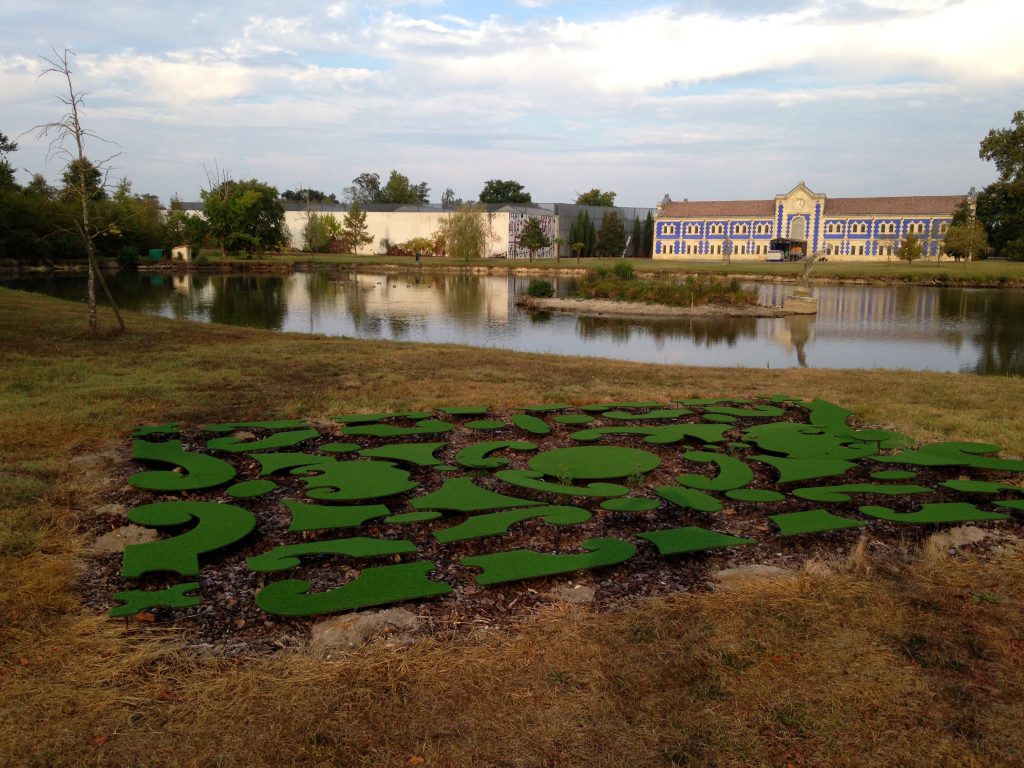
The ensemble is the most striking example of a permanent art show in the Medoc including the bright blue cellars, a colour certified by the Yves Klein foundation as being Klein blue and created as a nod to the past use of copper sulphate. 

The blue cellar as a work of art © LAURENT CERCIAT, CLIMAX, 2009,

Universal Welcome 

Under Raoux’s management, everyone was welcome. Local primary schools, whose visits are commemorated by the drawings the children leave behind as a thank you, wine lovers and art schools from around the  world. It remains one of the most visited properties in the Médoc open all year, 7 days a week by appointment for tastings or in depth art and wine tours. including the new musical son et lumière in the cellar, ‘Si Arsac m’était chantait,’ an original way to discover the history and renewal of the property. Visitors can also explore the park and the art by themselves during the week and stay for tasting plate to accompany the wines of the property.

Wine tourism and La Winery 

Raoux’s vision for wine tourism expanded beyond Château d’Arsac. In 2007 he created La Winery, a few kilometres from the chateau on the D1 road heading to the Atlantic coast. He was ahead of his time, creating a futuristic structure of metal and glass wanting to share a different vision of Bordeaux from classic chateaux. 

Moving the negociant company from Bordeaux centre, he transferred the business here and created a wine shop, wine bar, restaurant, an interactive tasting experience, conference rooms and of course more works of art. 

Amongst the thousands of bottles from around the world on sale were his Winemakers Collection. Each year he handed over the same plot of Haut Médoc vines to a visiting wine maker. Famous names from Bordeaux and further afield included Michel Rolland, Denis Dubourdieu, Andréa Franchetti, Stéphane Derenoncourt, Eric Boissenot, Zelma Long, Susana Balbo, Ntsiki Biyela, Dany Rolland and Alain Raynaud. 

In 2014, La Winery was sold to La Passion des Terroirs, the Lurton family negociant and it continues his vision of selling and tasting wines from around the world.  

A pioneering signature 

Philippe talked with great affection and passion about his ‘aventure en Arsakie’ his desire to create a lasting and original image for the property, imbibing it a real and unique personality.

He signed the wines ‘Le Mariage du Beau et du Goût’ (the marriage of beauty and taste). In his desire to share this passion for both wine and art, he broke conventions and pushed for change. He wanted to make both art and wine accessible to all, young and old, neophyte and connoisseur. He was ahead of his time in many ways, but what once seemed outrageous is now accepted. A signature of a real Bordeaux pioneer.   

Thanks for reading right to the end, to receive future posts directly to your in box, please  sign up here. Learn more about Bordeaux with the new Green Edition of Bordeaux Bootcamp, and explore Wine and Wellness, with  The Drinking Woman’s Diet  or just say hi  here.

Comments always welcome below.

The 2020 vision of Cru Bourgeois.

As a roving Bordeaux, and in particular, Medoc wine educator, Cru Bourgeois are always part of my class. I’m a fan. For me, many Cru Bourgeois wines represent excellent value from a region that is, all too often only associated with wines at the pricier end of Bordeaux.  If you’ve followed previous blogs, including the recent one by Laura Clay on the 2017 vintage classification, you’ll know there were changes afoot for the Cru Bourgeois of the Medoc. 

Last week the latest classification was announced. It was unusual on three counts: first its announcement in February, second it will last for five years, and third it reintroduces the historic hierarchy.

Since the 2007 vintage, the Cru Bourgeois have announced their classification annually in September, vintage by vintage. This is two years after the harvest, at the point of bottling, when wines are released onto the market. The 2007 vintage was classified in 2009 and last September 2019 was the 10th anniversary with the 2017 vintage, as reported by Laura.

The Cru Bourgeois classification has been unique in the Medoc in re classifying each vintage, unlike the famous and immoveable 1855 classification, and the less well-known Cru Artisan classification, which has only undergone two classifications since its inception in 2006. 

The other difference is the origin of the classification. The 1855 classification was based on market values, whereas with the Cru Bourgeois tis based on blind tasting. It also included properties in Sauternes and Barsac.

After ten years of a very successful classification system, and in parallel a promotional campaign to raise awareness for the wines, the Cru Bourgeois are feeling confident enough in their established quality and independent system to now classify every five years. 

In 1932 when the Cru Bourgeois Classification was first introduced, there were over 400 properties and, along the lines of the 1855 Classification, it had three-tier quality hierarchy. When the classification was re established in 2003 they tried to reintroduce this hierarchy, it didn’t go well, so as of 2007 one level it was. 

Tasting the wines over these ten years that the classification has established itself, it is clear that, although there is a minimum quality level within almost 300 properties there are differences not only in style, as you would expect from the seven (at the moment) appellations of the Medoc that participate, but also a difference in quality. The same names seem to regularly rise to the top.

It was time to reintroduce this historical hierarchy. Not a simple task. Having a classification that lasts five years changes everything. Rather than the wine of a particular vintage being classified it is now the property that is classified, facilitating the reintroduce of the three-tier system of Cru Bourgeois, Cru Bourgeois Supérieur and Cru Bourgeois Exceptionnel. 

Of the 249 Cru Bourgeois awarded last week, 170 are Cru Bourgeois, 56 Cru Bourgeois Supérieurs and 14 Cru Bourgeois Exceptionnels. The levels were awarded by an independent jury, based on a blind tasting of five vintages between 2008 and 2016 chosen by the producer, but also, for the two top tiers, on technical commercial and promotion aspects including environmental certification. 

This classification will hold good for the vintages 2018 through 2022 allowing for a smooth commercial strategy for the chateaux but also for the commercial intermediaries and hopefully the consumer. 

Congratulations to the 14 winners at the top of the pyramid: Chateaux d’Agassac, Arnauld, Belle-Vue, Cambon La Pelouse, Charmail, Malescasse, de Malleret, and du Taillan in the Haut-Médoc, Château Lestage in Listrac-Médoc, Châteaux d’Arsac and Paveil de Luze in Margaux  and Châteaux Le Boscq, Le Crock and Lilian Ladouys in St-Estèphe.

You can see the full classification here.

The next classification in 2025 will be based on a blind tasting from the 2017 and 2021 vintages. Something to look forward to.

If you have enjoyed this post please sign up here  to receive future blog posts directly to your in-box. If you would like to learn more about Bordeaux, buy your copy of Bordeaux Bootcamp here and to learn more about Wine and Wellness, buy your copy of The Drinking Woman’s Diet here. 

Cru Bourgeois, the latest chapter.

Laura Clay kindly reports back from the tasting of the Cru Bourgeois 2017 selection tasting in London. Laura is a leading wine educator in the UK, president of the Association of Wine Educators and an accredited Bordeaux Educator. She often runs tastings for the Wines of the Médoc in the UK and, like me, is a fan of the Cru Bourgeois.

The latest Crus Bourgeois classified wines have just been released. They are from the 2017 vintage which, by any standards, was a tricky one with the unusual extreme spring frosts being the biggest culprit for causing yields to be very low, as much as 50% lower than normal in some areas. The classification is only for wines of the Médoc, and those appellations closest to the estuary suffered the least and were able to produce very high quality wines. It seemed to me, admittedly tasting through only a small selection of 32 wines, that location, which is always particularly relevant, was key in 2017. The vines of the communes of Margaux, St Julien, Pauillac and St Estèphe suffered little and produced good wines. Those of the northern Médoc were not so lucky and it seemed to me that because yields were so low there were some less than ripe grapes in the mix. Apparently, according to Jane Anson in Decanter there was some co-fermentation of different grapes to fill the tanks. There’s nothing wrong with this in itself if all your grapes were sufficiently ripe at the same time – unlikely for Cabernet and Merlot grapes.

The eight appellations of the Medoc.

This may all sound a bit negative and you might think I wasn’t impressed with the wines. Actually, I was.  And this is the whole point of the classification. The wines have to be blind tasted annually (for now) and it seems that the fact there were far fewer châteaux which were successful in attaining the classification proves that it works. This year there were 226 Crus Bourgeois compared with last year, the elegant yet structured 2016s, when 270 wines were classified. And I should make it clear, it is the wine and not the château which is classified. The 2017s are wines which show a lightness and early drinkability in some, with an attractive balance and length in those from the communes and from my point of view, those with a good proportion on Cabernet Sauvignon seemed to do best. 

You can find the full list of the Crus Bourgeois along with a great deal more information on the Crus Bourgeois website. However, here are my picks, with their retailer references in the UK, from the limited range I tasted:

Médoc: Château Vieux Robin (O.W. Loeb, Fine & Rare)

Haut-Médoc: Château d’Agassac (Hedonism),

 Château Bernadotte (Farr Vintners), 

Château Cambon La Pelouse (Millesima, Vinissimus), 

Château de Malleret (Crump, R ichmond & Shaw), 

Château Peyredon Lagravette (O.W. Loeb) 

Listrac: Château Fonréaud (Goedhuis, Tanners, Berry Bros, Fareham Wine Cellar)

Moulis: Château Caroline (Goedhuis, Tanners, Berry Bros, Fareham Wine Cellar)

Margaux: Château Deyrem Valentin (Waitrose)

St Estèphe: Château Le Crock (Uncorked)

I have always been a fan of this classification. There is value to be had in these wines in an area where prices can be steep for even the deepest pockets. There is a clarity about the wines and the chateaux they come from – you can scan the QR code on the wine to have access to a lot of information about the wine before you buy it, they work together as the Alliance des Crus Bourgeois and I note a pride in this. I have faith that this will still be the case when things change a bit next year.

The Cru Bourgeois label can be read as a QR code to learn more about the wine.

What’s afoot is a back to the future scenario. In the past, prior to 2003, the wines were classified in a three tier structure but since 2009 the wines were blind-tasted two years after the vintage and declared Cru Bourgeois (or not), all at the same level. From next year, and the 2018 vintage, there will be three hierarchical levels – Cru Bourgeois, Cru Bourgeois Supérieur and Cru Bourgeois Exceptionnel – and the wine will be classified for five years. The selection process will be rigorous with several criteria needing to be followed including good agricultural and environmental practices, traceability at every point of production and active marketing of both the wine and the classification including reception of the public and trade to the property. The most important factor is what’s in the bottle and this will be judged on vintages between 2008 and 2016. For the next classification in 2025, the wines will be tasted blind from 2017 and 2021 vintages. 

I like the direction the classification is taking. It’s clear and fair, and, for consumers, will explain why there might be a difference in price between one Cru Bourgeois and another. Do look out for wines with the Cru Bourgeois logo and note that wines from slightly older vintages are worth buying. I can recommend 2012’s and 2014’s for their freshness and elegance both drinking beautifully now, and 2015’s for their ripeness and generosity

Here’s a few tmore o whet your appetite.

  1. Château du Cartillon, Haut-Médoc 2015 (Aldi online £11.99)
  2. Château Lamothe Bergeron, Haut-Médoc 2014 (Fraziers £24.00)
  3. Château Petit Bocq, St Estèphe 2014 (Crump, Richmond and Shaw £18)
  4. Château Caroline, Moulis 2010 (Alexander Hadleigh £21.45)
  5. Château La Roque de By 2016, Médoc (Tanners £13.50)

If you have enjoyed this post please sign up here  to receive future blog posts directly to your in box. If you would like to learn more about Bordeaux buy your copy of Bordeaux Bootcamp here.

Château Loudenne – can history repeat itself?

I have always had a soft spot for Château Loudenne. Arriving in Bordeaux in the late eighties I knew very few people, but I was soon introduced to the world of Château Loudenne, then under British ownership. It was party central for Bordeaux Brits and most of the players in the Medoc.

The hospitality was legendary. The dining room was the scene of many a memorable dinner and the amazing vintage kitchen hosted many more. I even remember London based Chef, Albert Roux flying over one August with fresh grouse in his suitcase for a Glorious 12th dinner.

IMG_0916
View to the back of the Château looking donw from the gravel outcrop.

The rooms were always welcoming, and waking to look at that view over the Gironde Estuary was a treat. In those days Château Loudenne was owned by IDV, having been in the portfolio of Gilbeys when they purchased that company.

Gironde from terrace
The view from the terrace of Château Loudenne to the Gironde Estuary

The history of Château Loudenne goes back over 300 years. Built in 1670 in the typical ‘Chartreuse’ style, the traversing rooms ideally suited to the spectacular views over the Gironde Estuary. This beautiful pink chateau is still at the heart of the large vineyard, 132 ha under vines including 12 ha in white. As early as 1880 it was the very first Medoc vineyard to produce a white wine.

Traversing rooms
A view through the Château

Alfred and Walter Gilbey purchased the chateau in 1875 and made it their home as well as the base for their Bordeaux commerce. They were the first negociants to be based in the Medoc, rather than in the Port of Bordeaux, establishing their trade out of the huge Victorian waterfront cellars near the property’s private port. Chateau Loudenne remains the only property in the Medoc to have its own private port.

Loudenne port
The ‘Port’ of Château Loudenne from the water

It became ‘The Pink Château’ at the time of the Gilbeys; it has remained so ever since. The Gilbeys, in true English style, created the stunning landscaped park which has a rare collection of David Austin English roses.

In 1963, their family company changed hands to become IDV, which went on to join the spirits group Diageo. In their move away from wine investments, Diageo sold the chateau in 2000.

After a few years in the hands of owners that sadly didn’t invest either in the wine or the architecture, Moutai purchased Chateau Loudenne in 2013, joined by Camus Cognac as minority shareholders in 2016. They are old friends having worked together as distribution partners for over 10 years. Moutai is the number one Chinese Liquor Company and Camus Cognac the largest family-owned independent Cognac house. Camus took over the management of Chateau Loudenne when it entered into the capital in 2016.

The involvement of the Cognac family is a back to the future moment; monks from the Saintonge region, near Cognac, were the first to plant vines in the village of Saint-Yzans-de-Médoc in the 13th century.

Folly
One of the gravel outcrops with its folly

Château Loudenne is in the Médoc appellation, in the North of the peninsula just beyond the boundary with the Haut Médoc. Here two large Garonnaise gravel outcrops rise above the tide line of the estuary. Victorian brick and stone follies, the function of which is still unknown, crown these outcrops. They were possibly built to store vineyard tools but more likely to make the site easily identified from the water. Or perhaps they are simply follies with no need for justification. The traditional coat of arms of the property show one of these towers with a Wyvern sitting on top.

I remember a party for the Ban des Vendanges in 1992 when a ‘son et lumière’ bought these Wyverns back to life to the amazement of hundreds of guests in dinner evening dress strolling though the vineyard. Heady days.

The new owners have reworked the presentation and marketing using a ‘belle époque’ design for the labels reminiscing about its illustrious past reinforced by strap line ‘I will always remember’. Also playing on the word Rose (pink in French) as a reference to both Chateau and its rose garden in the new stylised rose design on the labels and capsules.

New labels
The new Chateau Loudenne Labels

Rose
and the stylised rose design

The renewal is not solely a marketing operation. They are not simply looking over their shoulder at the past. New vines are being planted with ‘complanting’ in the older vineyards, introducing Petit Verdot to the Cabernet/Merlot blend and Sauvignon Gris to the white blend with the goal of becoming organic in five years,

New planting
A recently replanted plot near the estuary

General Manager, Philippe de Poyferré, plans to modernize the emblematic waterfront cellars, adapting the Victorian vats to handle the plot selection to suit the different vineyard plots. These majestic cellars date from 1876 and were a perfect example of the Gilbey brothers’ drive to modernize the estate during the 19th century. Designed by Bordeaux architect, Ernest Minvielle, they are a classic Médoc-style two-story vat hall, already harnessing gravity to manipulate the harvested grapes and wine.

Cellars
The victorian cellars from the waterfront

De Poyferré has already reintroduced hand harvesting, sorting tables, and gone back to gravity rather than use pumps.

Cuvier
The 19th century vat room

Chateau Loudenne still produces white wine under the Bordeaux appellation. Fermented and aged in oak with 25 % of Sémillon, unusually high for a dry white from the Medoc, it is reminiscent of a Graves in style and elegance.

The red wines of Chateau Loudenne are Cru Bourgeois, currently a 50:50 Cabernet/Merlot blend and tasting recent vintages the improvement in quality as of 2014 vintage is marked. One to watch with hopefully a future party invite.


Getting technical

One of the challenges of being a wine educator is finding all the details about the different wines we share in the classroom. Every audience is different but as I am usually talking to the trade they love hard data.

Despite touring vineyards with groups and students for over twenty years, I still haven’t managed to visit all 7 000 Bordeaux producers, let alone discover all the many second and third wines produced by each property, and then there’s the negociant and cooperative brands. Of course, each vintage is different so it adds more fascinating complexity to the challenge. So many wines, so little time.

When I am in front of a class, be it in Bordeaux, Asia or like this month, in the US, having the technical details of each wine: the blend for that vintage, the oak treatment and even details such as picking dates are useful.

As a consumer, this nitty-gritty might not appear that fascinating, it is more the stories behind the wines; the people, the places and their history that really engages with consumers. The trade enjoys a good story too, but there will always be a few wine geeks in the audience that want to know the minute detail. Questions are often about how the blend changes each year compared to what is planted in the vineyard. After all, blending is one of the signatures of Bordeaux, and the differences from year to year reflect the changing weather of each vintage and how the wine maker has risen to these challenges.

Preparation is everything; I am supposed to be an authority after all! But how to find this information? Thank goodness for the Internet – many chateaux now share these specific details in technical sheets, vintage-by-vintage, on their web sites.

A tech sheet always comes in handy

Although it can be quite search to find the web site of some less well known properties, don’t be too harsh in your judgement of these smaller properties. They don’t have the financial resources or the manpower to spend the time and money on glamorous websites – they are busy out there growing the grapes and making the wine! Often an e-mail or a telephone call will see a tech sheet arrive in my inbox.

To learn more about lesser known vineyards, the app Smart Bordeaux – developed by the CIVB (Conseil des Vins de Bordeaux – The Bordeaux Wine Council) is a useful resource. By taking a photo of the label or typing in the name of the property, details will pop up. It is down to the chateau to enter the information though, so some carry more detail than others.

The Smart Bordeaux App

Other useful sites include the Cru Bourgeois site where you can search chateau details by name or by using the flash code on each bottle guaranteeing the authenticity of the Cru Bourgeois designation. The Wines of the Medoc site also collates useful information about each vineyard in the region, including harder to find brands and cooperative wines.

The Cru Bourgeois label can be read as a flash code to learn more about the wines.

Chateau websites are often designed more as a marketing tool for consumers rather than for the trade and geeky somms. More style over substance, although there’s nothing wrong with sharing the dream. Others offer a fascinating insight into the philosophy of the vineyard; Chateau Palmer, for example, manages to balance the dream and reality, it is a pleasure to visit the site even when I’m not looking for some specific piece of information.

The new website of Château Leoville Barton is another example showing there’s no conflict between tradition, history and a modern approach to communication.

Château Brane Cantenac has embraced technology, thanks to food and wine marketing an design specialists Taylor Yandell, with their recent mobile web site. Responding to the demand from itinerant geeks needing to access information on the road, it makes the tech sheets for each of their three wines available with a click, clearly showing those percentages by vintage in an easy to grasp graphical.

Château Brane Cantenac tech sheets – with a visual of the blend.

Bordeaux technology is not just in the vineyards and wine cellars; it’s on the smartphone in your pocket.


Behind every great wine…. there’s another one.

For those in the know, the second wines of top Bordeaux estates have long been considered some of the best value drinking in town.

Rather than a ‘dustbin’ for everything that isn’t good enough to make the grade of the first wine, these wines carry the château name, are part of the brand, and are treated as such. Not only do they profit from the know-how of the same wine-making team but they may be made from parcels and lots kept specifically for these wines, perhaps from younger vines or different terroir, often giving a lighter expression, benefiting from a lighter oak treatment giving easier and earlier drinking wines – more approachable both in style and in price! Their quality continues to grow as many properties are introducing third wines, Le Pauillac de Chateau Latour since 1990, and the Petit Lion de Marquis de Las Cases since 2007, to name but a couple.

Whilst these wines are now on most wine enthusiasts’ radar, it’s worth taking a peek behind these chateau labels, as many of the top properties have other strings to their bows.

In the official figures for 2015, released by the CIVB earliest this year, the number of growers, all Gironde wines combined, was 6,822 (fallen by half in the last 20 years). The total number of wine properties is probably nearer 10 000 however as many of the ‘Growers’ are the fortunate owners of several properties.

Although the other wineries owned by top growths may not be classified, these lesser-known properties will also benefit from the know-how of the top winery teams, the deep(er) pockets of their owners and the marketing push as they are presented alongside their big brothers at tastings. Other advantages include access to newer barrels with a guaranteed provenance, as barrel turnover will be faster in top growths that use a higher percentage of new oak.

Chateau Le Crock
Chateau Le Crock

I was reminded of this when I visited Chateau Le Crock recently. Chateau Le Crock is a magnificent chateau perched high on a gravel outcrop of Saint Estèphe, in between prestigious neighbours Chateau Montrose and Cos d’Estournel. It is a Cru Bourgeois, part of the new classification as well as the original one. The owners, the Cuvelier family, are also owners of Chateau Leoville Poyferre, second growth of Saint Julien, as well as Chateau Moulin Riche. Moulin Riche used to be considered a second wine of the property but now is a stand-alone label, the second wine is Le Pavillon de Leoville Poyferre.
Tasting Moulin Riche and Leoville Poyferre

The neighbouring Leovilles also have other properties; Chateau Leoville Barton is also home to Chateau Langoa Barton, (although originally it was the other way round, as the cellars of Langoa welcomed the wines of Leoville back in the 1800s). The Barton family have more recently invested in Moulis, at Chateau Mauvesin Barton, as I mentioned in a previous post. Chateau Leoville Las Cases also has hidden treasures, the Delon family own Chateau Potensac in the north of the Medoc appellation.

The line up of Barton family bottles

This is not a uniquely Saint Julien affair, just next door in Pauillac several top properties have hidden jewels; Chateau Pichon Baron, a second growth of Pauillac, owns Chateau Pibran a neighbouring Pauillac property and, across the road, when Roederer purchased Pichon Comtesse they also bought the lovely Chateau de Pez in Saint Estephe. The Cazes family, as well as owning Lynch Bages, own Chateau les Ormes de Pez in Saint Estephe and the lovely and very affordable Château Villa Bel Air further afield in Graves.

Another Médoc family the Quiés are spread over several left bank appellations. Famous for their 2nd growth in Margaux Rauzan Gassies, they own 5th growth Croizet Bages in Pauillac and Bel Orme in Haut Medoc, another Cru Bourgeois.

It’s not a uniquely left bank phenomenon either. Some brave souls dared to cross over to the dark side. Leoville Las Cazes owns Chateau Nenin in Pomerol, Château Lafite has Chateau L’Evangile in Pomerol and Chateau Rieussec in Sauternes as do Pichon Baron owners Axa Millesimes again with properties in both Sauternes: Chateau Suduiraut and in Pomerol: Chateau Petit Villages.

Right bank properties also have jokers up their sleeves, investing in lesser-known estates and surrounding appellations such as the Saint Emilion Satellites or the Côtes appellations.

The von Nieppergs, owners of Chateau Canon la Gaffeliere in Saint Emilion, also own Clos de l’Oratoire and Chateau Peyraud in the same appellation and have invested both in the Côtes de Castillon buying Chateau d’Aiguilhe where a modern wine cellar makes this one of the leading lights of the appellation. Angelus owners, the de Bouards, have used their Lalande de Pomerol property, La Fleur de Bouard as a testing ground for a lot of experimental wine making that they have since harnessed at Angelus, so the advantages work both ways. They have more freedom to experiment in smaller properties rather than in their flagship vineyards where is it perhaps more risky to test out new techniques.

The innovative cellars Chateau La Fleur de Bouard

Francois Despagne, owner wine-maker of the classified growth Chateau Grand Corbin Despagne in Saint Emilion is also using his expertise making Chateau le Chemin in Pomerol and Chateau Ampelia in the Côtes de Castillon. Look out for Chateau la Maison Blanche, owned and made by his brother Nicolas just across the boundary of Saint Emilion in Montagne Saint Emilion; some of the purest expression of terroir in organic and biodynamic production.

Somes of the wines from the Francois Despagne stable

These are just a few of many examples well worth looking out for, other owners that are spread across several appellations include the Cathiards of Chateau Smith Haut Lafitte who have recently invested in Pomerol and Sauternes and Bernard Magrez who has a finger in many Bordeaux appellations.

I’ll stop now before this sounds too much like a shopping list, as these are just a few of many examples well worth looking out for and I haven’t even mentioned investments made in other French wine regions or abroad – another blog post perhaps?

These investments in lesser known estates and appellations by leading wineries brings not just money but know-how and experience, raising the bar of excellence and increasing their reach to the wine enthusiast. If you thought second wines were worth looking for, take it to the next level; it’s worth getting off the beaten track a little and looking behind those top labels to see what other treasures they are hiding.


Back to the future at Chateau Lamothe Bergeron

You’ll know by now, even if you only read this blog occasionally, I’m a big fan of Cru Bourgeois. The history, the concept, the rebirth of a classic and the all important value for money represents for me, what Bordeaux does so well, taking the classics and adapting them to the current market.

Many of the individual chateaux in this ‘classification’, have the same philosophy and Chateau Lamothe Bergeron, a Cru Bourgeois in the Haut Médoc appellation, is firmly in this category.

Chateau Lamothe Bergeron, Cru Bourgeois of Haut Médoc

The vines here go back to the Middle Ages but the chateau became famous thanks to its owner Jacques Bergeron who inherited it from his father in the 1800’s. His innovations in all things agronomic after the French revolution included the creation of a style of grafting that still carries his name. The prestige of his name was such that the next owners added it on to the property in the 19th century.

The vines seen from the observation post on the edge of the park.

Improvements to the property have continued through various owners including the Bordeaux Negociant house Mestrezat, under whose ownership in the 70s and 80s the vines were replanted and the winery modernised. But it is under the current ownership that the property has come resolutely into the 21st century.

Having sold the Vodka brand Grey Goose, Cognacs H. Mounier and Hardy had some spare cash in their pockets and in 2009 they invested in this classic Medoc property, another example of the cliché that if you want to make a small fortune in the wine business start with a large one…..

Cognac producers know a thing or two about marketing and it’s clear to see here when you visit this beautifully renovated estate. Opened to the public last summer the elegant château, which dates from 1868, has been restored to its former glory, having been more or less abandoned after a fire in the 1950s. It has been cleverly renovated to blend the old with the new included fourguest rooms, a dining room and a conference facility under the eaves.

The dining room at Chateau Lamothe Bergeron

The tour is high tech too. The Chateau was awarded the recent ‘Discovery and Innovation’ Best of Wine Tourism award. As you visit the chateau, paintings come to life to tell the history of the Chateau, there’s a wooden cabin/look out post from where you can see the replanting of the vineyard and take in the blend of 58% Merlot grapes, 38% Cabernet Sauvignon, 2% Cabernet Franc and 2% Petit Verdot that make up the 67 hectares, of the vineyard.

The blending light show in the cellars of Chateau Lamothe Bergeron

But it’s not all show; serious investment has been made in wine making including appointing Hubert de Bouard, of Château Angelus fame, as their consultant. Visitors are treated to a detailed video explanation of the stages involved in wine making and another more humorous video projected on to the glass panels of the wine cellar of the blending operation showing de Bouard and the director Laurent Mery in action. The visit ends with an underground tasting room, cellar and shop. The difference being the tasting is not limited to just the château’s wine but also an excellent range of the company’s Cognacs.


So many wines, so little time.

You can see from the previous post that I’ve just returned from a trip to the wine lands of South Africa where the hospitably was wonderful – more of which later. To get there, I took a circuitous route via London and Hong Kong. I mentioned Hong Kong in a previous blog post but not London. London remains the centre of the international wine trade, a world wine hub. It is old and established and at the same time extraordinarily innovative and modern. You can find just about any type of beverage here, unlike the wine regions I’m usually visiting.

It is not surprising then that the Gardinier family have chosen London as the latest outpost for their food and wine empire.

I first met the family in Bordeaux where they have owned the beautiful, and in my opinion still underrated and undervalued, property Château Phelan Segur since 1985. This elegant château is at the heart of Saint Estèphe, the most northerly of the Medoc ‘Communal’ appellations. The 70ha are spread between classified neighbours such as Chateau Calon Segur, Château Lafon Rochet and Chateau Montrose, to whom they sold some of their vines in 2010.

The beautiful Château Phelan Segur

It missed the 1855 classification and was a ‘Cru Bourgeois Exceptionel’ until 2003 when, under the new rules, the hierarchy within the Cru Bourgeois was eliminated.

One of the 3 brothers, Thierry Gardinier, is at the head of the estate alongside the director Veronique Dausse. As the director of the Alliance des Cru Bourgeois Thierry was pivotal in overseeing its development  to its present form.

Tasting in the orangerie at Chateau Phelan Segur

This elegant property has one of the most spectacular views from the plateau of Saint Estèphe across a majestic lawn, the vines and the Gironde Estuary. Upon appointment, you can enjoy the view as well as the wines. They will happily share verticals of recent vintages and their hospitality reaches as far as the family dining room. You can even participate with a cooking class in the kitchen with their in-house chef and then sample your hard work with the wines.

Their al fresco lunches on the lawn at harvest time are some of the best in Bordeaux, where you will rub shoulders with most of the Bordeaux wine trade.

Harvest lunch at Chateau Phelan Segur

It comes as no surprise then that the family has a very gastronomic background. Their home base is Champagne where their father, Xavier Gardinier, owned and ran both Lanson and Pommery Champagne houses since the 1970s including Le Domaine Les Crayères. Les Crayères remains in the family, a Relais Château Hotel and Michelin starred restaurant.

In 2011 they purchased the Taillevent group. The Taillevent restaurant opened in Paris in 1946 and is a French gastronomic legend, winning its first Michelin star in 1948, a second in 1954 and a third in 1973.

It is also famous for its wine selection; the cellar holds over 2000 listings of wines and spirits from 16 countries. Trading on this reputation, they opened a wine shop in 1987 ‘Les Caves de Taillevent’, originally as part the restaurant.  From 1994 to 2013, Les Caves de Taillevent also opened in Japan, with five wine shops in Tokyo, Yokohama, Nagoya, Kyoto and Osaka.

In 2012 the Gardiniers renamed the bistro Les 110 de Taillevent, after the 110 wines served there by the glass. From this selection different wines are suggested each day to match the menu. 4 for each dish: starter, main and dessert at 4 different price points. The wines are available by the glass in two sizes (7cl or 12.5) the wines are kept under argon gas system.

110 Taillevent London on Cavendish Square

The London 110 de Taillevent Restaurant opened in October this year on Cavendish Square, just as I was passing through London. Serendipity. The by the glass selection is eclectic (and very international), the food delicious and varied and the portion sizes perfect, the atmosphere a happy blend of sophistication and fun (or was that just the girlfriends I was lunching with?) and the staff extremely friendly. The decor is classically elegant and it really is all about the wine, there are bottles everywhere.

I didn't count but that looks like 110 wines at the Taillevent bar
I didn’t count, but that looks like 110 wines at the Taillevent bar.

They open for lunch, diner and breakfast (wine with breakfast? But of course!). Food and wine matching underlies the Gardinier philosophy and the range of wines on offer makes it a perfect venue. They should receive a very warm welcome from London wine and food lovers.

A Table!
A Table!


They’re Back!

Cru Bourgeois properties can’t rest on their laurels. Every year they have to reapply for the right to use the qualification Cru Bourgeois on their labels.

The Cru Bourgeois label can be read as a flash code to learn more about the wines;

The list of successful candidates for the 2013 vintage was just announced. Why now? Well the wines are tasted at the point of being released onto the market place. So they will be heading your way for the end of year festivities.

251 properties make up the new official 2013 selection; you can see the complete list here. They represent about 30% of the surface area and 25% of the production of the Médoc including the appellations Médoc, Haut-Médoc, Listrac-Médoc, Moulis, Margaux, Pauillac and Saint-Estèphe. That’s about 20 million bottles released onto the markets at home and abroad.

The Cru Bourgeois 2013 Classification Logo

If you need proof that it is not an automatic right check out the figures since the creation of the new quality control introduced in 2010 for the 2008 vintage.

2008 – 243 Crus Bourgeois du Médoc

2009 – 246 Crus Bourgeois du Médoc

2010 – 260 Crus Bourgeois du Médoc

2011 – 256 Crus Bourgeois du Médoc

2012 – 267 Crus Bourgeois du Médoc

The selection is severe and influenced by the general quality of the vintage but numbers are also increasing as the producers see the growing success and reputation of the Cru Bourgeois name and the commercial advantage that sporting the Cru Bourgeois label can bring. A total of 166 million bottles have been released onto the market over the last six years, which gives an impetus to the ‘brand’.

The challenge doesn’t stop at the selection. At its creation in in 1932, the Cru Bourgeois classification had a hierarchy of 3 levels: Cru Bourgeois, Cru Bourgeois Supérieur and Cru Bourgeois Exceptionnel. This three-tier system was abandoned in the new organisation but they are now looking at reintroducing a hierarchy within the classification over the next few years. In the meantime, they measure up against each other in an annual blind tasting competition. The ‘Coupe des Cru Bourgeois’ takes place in June each year and selects 12 champions from across the appellations.

The last Coupe took place at Vinexpo in June this year. An international jury of wine professionals tasted their way through all the Cru Bourgeois and amongst the 12 top properties they selected one final winner: Château Lilian Ladouys in Saint-Estèphe.

Chateau Lilian Ladouys, Cru bourgeois de Saint Estèphe and winner of La coupe des Crus Bourgeois.

The organisation behind the classification, The Alliance des Cru Bourgeois, continues to innovate with their promotions too. A few weeks ago, I joined eight of the twelve winners of the Coupe in a live on-line tasting from Château Paveil de Luze in Margaux, directly broadcast to journalists in the US. They tasted the same wines in America while the owners and wine makers tasted with them, explaining the particularities of each one and answering questions over a live twitter feed.

If you can’t come to the Cru Bourgeois, they will come to you – you can see the video of the tasting here.