The 2020 vision of Cru Bourgeois.

As a roving Bordeaux, and in particular, Medoc wine educator, Cru Bourgeois are always part of my class. I’m a fan. For me, many Cru Bourgeois wines represent excellent value from a region that is, all too often only associated with wines at the pricier end of Bordeaux.  If you’ve followed previous blogs, including the recent one by Laura Clay on the 2017 vintage classification, you’ll know there were changes afoot for the Cru Bourgeois of the Medoc. 

Last week the latest classification was announced. It was unusual on three counts: first its announcement in February, second it will last for five years, and third it reintroduces the historic hierarchy.

Since the 2007 vintage, the Cru Bourgeois have announced their classification annually in September, vintage by vintage. This is two years after the harvest, at the point of bottling, when wines are released onto the market. The 2007 vintage was classified in 2009 and last September 2019 was the 10th anniversary with the 2017 vintage, as reported by Laura.

The Cru Bourgeois classification has been unique in the Medoc in re classifying each vintage, unlike the famous and immoveable 1855 classification, and the less well-known Cru Artisan classification, which has only undergone two classifications since its inception in 2006. 

The other difference is the origin of the classification. The 1855 classification was based on market values, whereas with the Cru Bourgeois tis based on blind tasting. It also included properties in Sauternes and Barsac.

After ten years of a very successful classification system, and in parallel a promotional campaign to raise awareness for the wines, the Cru Bourgeois are feeling confident enough in their established quality and independent system to now classify every five years. 

In 1932 when the Cru Bourgeois Classification was first introduced, there were over 400 properties and, along the lines of the 1855 Classification, it had three-tier quality hierarchy. When the classification was re established in 2003 they tried to reintroduce this hierarchy, it didn’t go well, so as of 2007 one level it was. 

Tasting the wines over these ten years that the classification has established itself, it is clear that, although there is a minimum quality level within almost 300 properties there are differences not only in style, as you would expect from the seven (at the moment) appellations of the Medoc that participate, but also a difference in quality. The same names seem to regularly rise to the top.

It was time to reintroduce this historical hierarchy. Not a simple task. Having a classification that lasts five years changes everything. Rather than the wine of a particular vintage being classified it is now the property that is classified, facilitating the reintroduce of the three-tier system of Cru Bourgeois, Cru Bourgeois Supérieur and Cru Bourgeois Exceptionnel. 

Of the 249 Cru Bourgeois awarded last week, 170 are Cru Bourgeois, 56 Cru Bourgeois Supérieurs and 14 Cru Bourgeois Exceptionnels. The levels were awarded by an independent jury, based on a blind tasting of five vintages between 2008 and 2016 chosen by the producer, but also, for the two top tiers, on technical commercial and promotion aspects including environmental certification. 

This classification will hold good for the vintages 2018 through 2022 allowing for a smooth commercial strategy for the chateaux but also for the commercial intermediaries and hopefully the consumer. 

Congratulations to the 14 winners at the top of the pyramid: Chateaux d’Agassac, Arnauld, Belle-Vue, Cambon La Pelouse, Charmail, Malescasse, de Malleret, and du Taillan in the Haut-Médoc, Château Lestage in Listrac-Médoc, Châteaux d’Arsac and Paveil de Luze in Margaux  and Châteaux Le Boscq, Le Crock and Lilian Ladouys in St-Estèphe.

You can see the full classification here.

The next classification in 2025 will be based on a blind tasting from the 2017 and 2021 vintages. Something to look forward to.

If you have enjoyed this post please sign up here  to receive future blog posts directly to your in-box. If you would like to learn more about Bordeaux, buy your copy of Bordeaux Bootcamp here and to learn more about Wine and Wellness, buy your copy of The Drinking Woman’s Diet here. 

How low did you go?

Did you go dry for January? Me neither, I didn’t do Veganuary either. Some of my friends, even some in the booze business, did. Others have embarked on dry February – everyday counts, even in a leap year! One friend has decided to aim for a whole year without booze, claiming the benefits to her sleep quality and well-being are so great she might never go back, despite her love of wine. 

Breaking a drinking cycle can be an interesting way to test for, and tackle dependence. Taking a few days off can help to “reset” your tolerance level.

I’m more for moderation, (there a whole chapter about it in The Drinking Woman’s Diet) and I’ve written about my rule of two on this blog before-. I am for two booze free days a week, so I sympathise with those trying not to drink.

What to choose instead of booze? Not drinking in social situations can be tricky. Peer pressure is a powerful thing, and keeping to a limit is even more difficult if friends or partners are saying, “Go on, just have one.” Bear in mind this lack of support might not be about you. You cutting back might shine a light on a friend’s own issues with drinking. It’s not always an easy subject to broach.  A friends father, when he didn’t want any alcohol, reckoned that the more precise you are when ordering your drink, the less likely people would be to challenge your choice.  He would say something like “Ooh, I’d love a Slimline tonic with a lot of ice. But no lemon.”

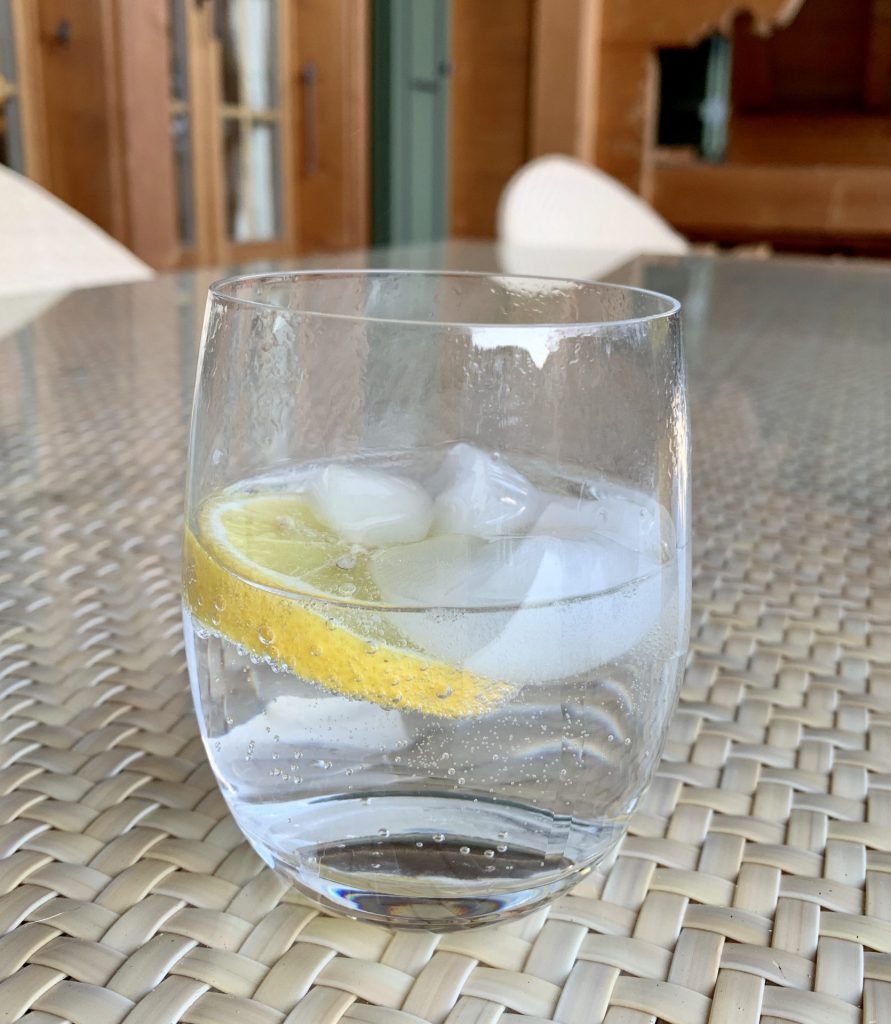
Ice and a slice but just what are those bubbles?

So just what can you have to hand that will stop people commenting on your non-alcohol choice? A fizzy drink might look the part, you can always pretend it’s a mixed drink, but the last thing you want to do is replace alcohol with sugar – sugar is just as bad for your liver, not mentioning your waist line, so forget sodas. 

Slimline tonic could be an answer but I’m nervous of artificial sweeteners that aren’t great for your gut microbiome. Last year, Skinny Tonic launched a tonic with 100% natural ingredients, replacing artificial sweeteners with stevia .

Sparkling water also works, but it sounds a bit boring. A friend, whose identity I will protect, gets her husband on board when she is having an alcohol-free evening.  When she asks for gin and tonic in front of friends, he dutifully brings a sparkling mineral water with an ice and a slice and no one is any the wiser. 

Skinny Tonics

The disadvantage of fizzy drinks, even water, is that bubbles of carbonic gas may increase the production of ghrelin, a hormone that stimulates appetite.  If you’re cutting back with the aim of reducing calories, that might not work for you! 

Kombucha is slightly fizzy and a healthier alternative thanks to its gut friendly bacteria. Alcohol is not always your gut micro biome’s best friend. Watch here to see the Liz Earle explain how to make you own. 

In the interests of research I have been trying some of the non-alcoholic alternatives. There are more and more on the market, reflecting the demand, or perhaps trying to create it?  Sadly, I can’t say I’m thrilled with what I’ve tried so far.  There are some great stories behind some of the products,  and I do love a good story but, I fear, there is often more style than substance. 

Jukes No 6,

I had great hopes of Jukes Cordialities. I love the concept of little bottles you can take with you, it certainly looks the part, the packaging is very chic, and I was very excited by the ingredients containing gut friendly cider vinegar. I found them a bit sweet (in all fairness they are cordials). I miss the mouth feel that alcohol brings. They do look like wine though, both red and white, so will fool those trying to twist your arm to drink. 

In an attempt to mimic a Gin and Tonic, one of my favourite non-wine tipples, I tried both Seedlip, now so mainstream I even found it in a health food shop, and Ceders, a South African version using African botanicals. Both these products have a great back-story, and I do love a good story but again I was disappointed. They don’t really taste of much, and when mixed with tonic they didn’t really bring much to the party. 

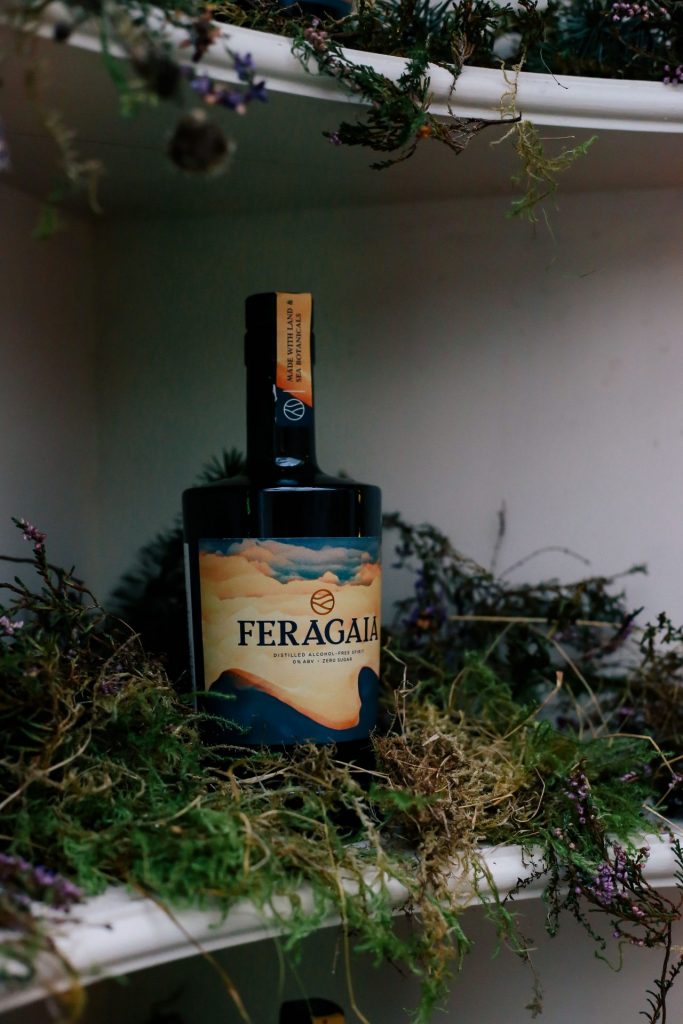
The beautifully presented Feragaia with some of that seaweed!

I was also excited to taste Feragaia. Mimicking another favourite tipple of mine, whisky. It has a wonderful story and lovely packaging (another weakness of mine). It certainly has more flavour. It’s slightly medicinal, but not unpleasant, due perhaps to the seaweed botanicals. Despite its Scottish origins and looking like whisky once in the glass it doesn’t taste like whisky. It is sugar free though, so if you are cutting back on calories as well as alcohol it could be the drink for you.

At 70cl bottle of Seedlip costs about £22, more expensive than many good gins. Feragaia retails through their site at £28.00 for 50cl, so these alternatives are not cheap, but then, given their artisanal production, perhaps we shouldn’t expect them to be? 

My problem is that I’m looking at these drinks to replace an alcoholic drink and they are marketed as such. Perhaps they need to be considered as a category in their own right rather than an ‘instead of’.

I do miss the weight or mouth feel that alcohol brings to a drink, so in the interests of moderation I’m favouring cooler climate wines from Alsace or Germany for example, with a naturally lower alcohol. Although lower alcohol wines have been harder to find since the eighties when powerful reds were all the rage, recently wine makers seem to be, once again, embracing a notion of ‘elegance’ over power houses. A trend I thoroughly support and wines worth looking out for.

Low alcohol Gosnells

Or try  something completely different, I wrote about Mead sometime ago, it may be the oldest drink in the world but modern producers are now right on trend with lower alcohol versions. This January Gosnells launched an even lower alcohol version. It’s Low Alc Sparkling Mead comes in at just 0.5% abv. It even comes in an elegantly designed, party worthy can. 

I’m sticking to low rather than no.

If you have enjoyed this post please sign up here  to receive future blog posts directly to your in-box. If you would like to learn more about Wine and Wellness, buy your copy of The Drinking Woman’s Diet here and to learn more about Bordeaux, buy your copy of Bordeaux Bootcamp here.