
The tenth generation of Bartons in Bordeaux and the eighth as Saint Julien owners, Melanie and Damien Barton Sartorius are bringing a light touch to the Barton Family vineyards.
Damien and Melanie Barton Sartorius, children of Lilian Barton Sartorius and Michel Sartorius, are the eighth generation of the Barton family, owners of the two of the best known and best loved Grands Crus Classés of Saint Julien, Châteaux Langoa and Léoville Barton. It’s not easy to put your mark on properties that have been in the family since the 1800s. But a passion for the place and its unique environment are allowing them to do just that.
It takes a village
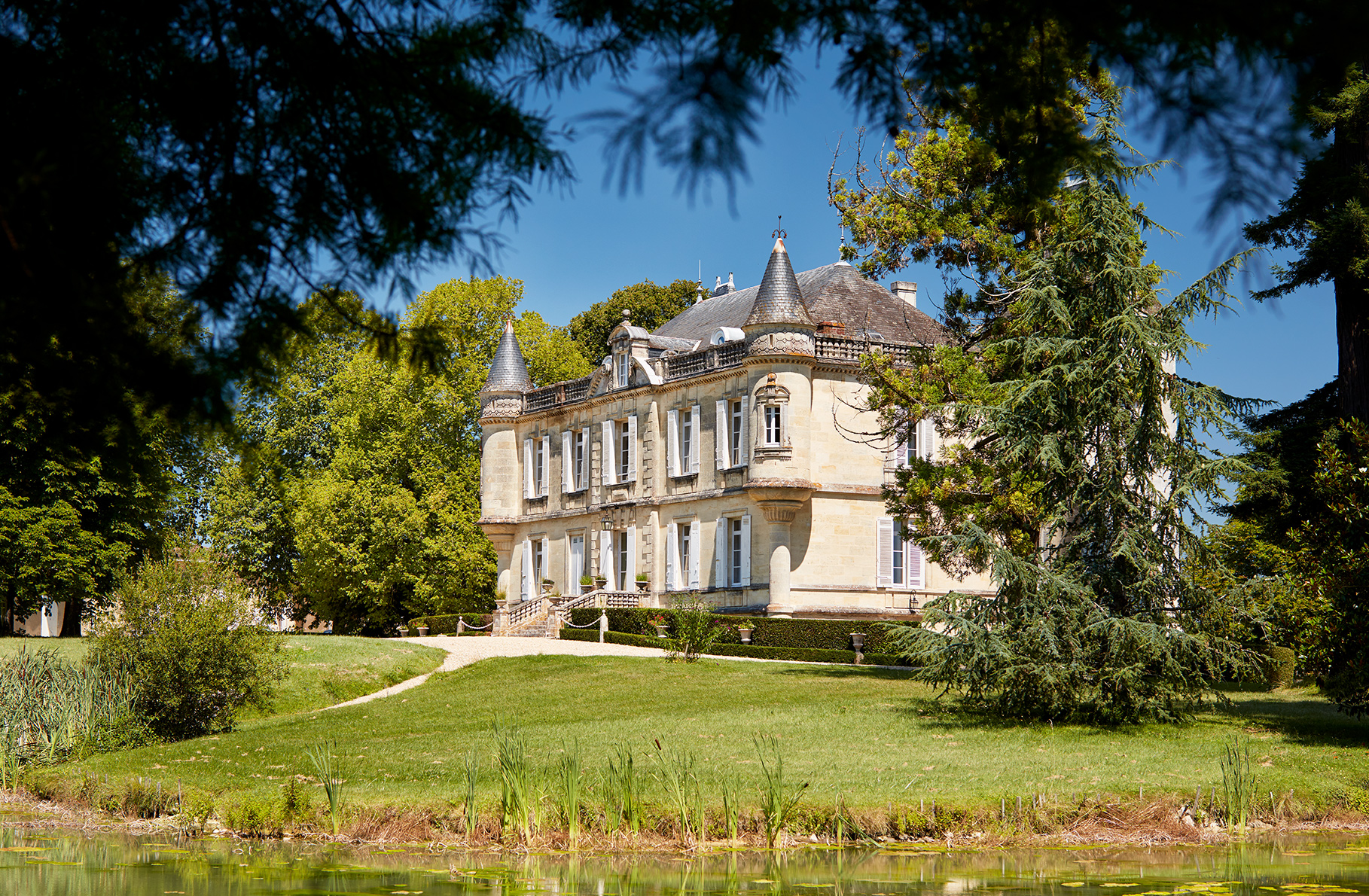
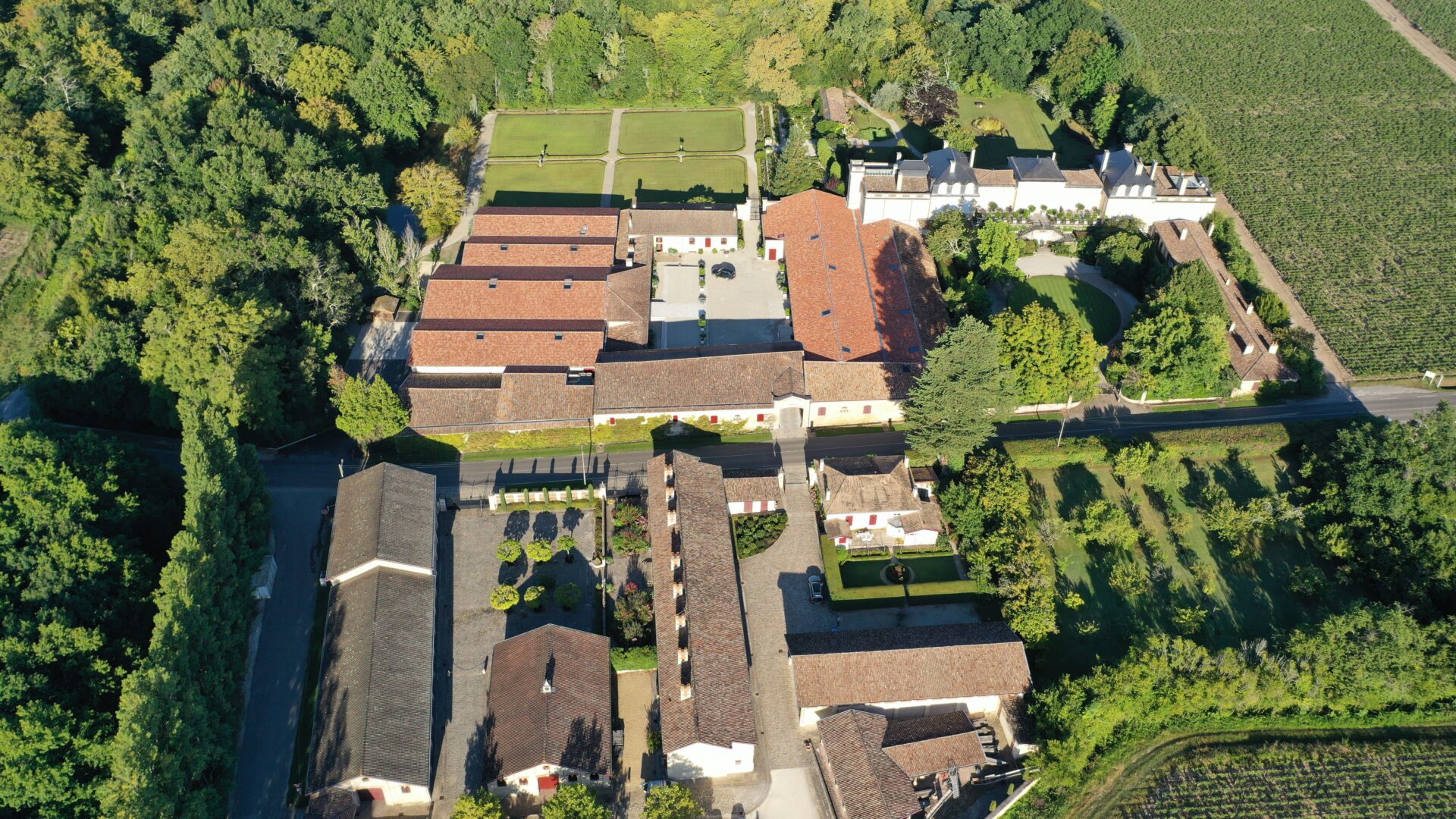
Château Langoa Barton is at the heart of the family, it’s here that the wines of both Langoa and Leoville are made, in buildings that surround the beautiful ‘chartreuse’ family home. The Barton family has been making wine on the estate of Langoa since 1821, making them the longest standing family owners of two Médoc Classified Growths. The 50-hectare vineyard of Château Léoville Barton has been managed by the family with the same characteristic care and passion since 1826.

New generation, new initiatives
Melanie joined ‘the firm’ in 2013, she is the first officially qualified oenologist in the Barton family, having studied in both Bordeaux and Burgundy. She is the Technical Director of Château Mauvesin Barton, the latest edition to the family portfolio purchased in 2011, just 4km away in Moulis-en-Médoc. Her challenge has been to continually increase the quality of the wines in this lesser known appellation. She has focused on the vineyard, progressively upgrading the planting, replacing vines using rootstocks focused on quality over quantity. It’s not without its challenges after centuries of expertise on gravel the Moulis property has a different terroir profile with more clay and limestone.

The beautiful stables at Château Mauvesin Barton bear witness to Mélanie’s life-long love of horses, she’s an accomplished horsewoman, and a keen photographer, whose photos illustrate the family websites.
Damien who joined in 2016, is spearheading their strong sustainable policy across all the properties with the aim of passing on healthy and sustainable vineyards, and business, to future generations (the 9th generation is already here!).
Saint Julien is the archetypal Bordeaux signature of elegance, small but perfectly formed, at 5km long and 3.5 kms wide it covers 900ha of vines (6% of the Medoc peninsula vineyards). 75% of the appellation is under deep gravel, explaining the majority of Cabernet plantings with the best terroir on the slopes down towards the river whose proximity protect against frost. Divided between just 19 properties of which 11 are classified (1855). there are no firsts, nor fifths which adds to that signature consistency and reliability. No family personifies this better than the Bartons.

A natural tradition
Agroforestry may be a new buzzword in viticulture, but it’s age-old for the Bartons. The family’s connection with and love of nature, has put them well ahead of the latest eco-agrology trends. In Saint Julien, alongside the 20 ha of vines at Langoa and 50ha at Leoville are 80 ha dedicated to forests and meadows and another 4 ha to the stunning gardens (with over 1000 rose bushes around the elegant lawns). At Château Mauvesin Barton, of the 220 ha, just 55 are under vine alongside including meadows, grazing (mainly for the family horses), water and forests.
As well as this natural and historical biodiversity they continue to plant and maintain hedgerows, no weedkillers have been used since 2010, they use organic fertilizers of which 30% are composted residues from the property, sexual confusion controls insects, natural vimes (reeds) attach vines to trellising and cover crops keep soils healthy, mowed to respect pollination and maintain the important insect population. HVE (Haute Valeur Environmental) certified, some plots are farmed organically. Damien said it was stunning just how quickly biodiversity came back as they returned to natural methods.
Local and low key
The most visual proof of this sustainable philosophy is the new Langoa cellar opened in 2022, where the wines of both Leoville and Langoa are made. It was an ambitious project, but as you would expect from this understated family, they have kept things simple and sober compared to the bling of some of their more corporate neighbours. There’s no big international architectural signature here. It’s traditional by choice, because the tried and trusted methods work. Damien admits, it might not be great for marketing but it lets the wine speak for itself.

It was an interesting challenge, the iconic wine making cellar of the property, with the huge wooden fermentation tanks had remained unchanged for decades and was very much part of the image of the estate. They have brought under one roof the production and the administrative offices that now overlook both the cellar and the stunning chateau gardens. Reinforcing this traditional village atmosphere. The barrel aging facilities are reached via a tunnel under the courtyard.
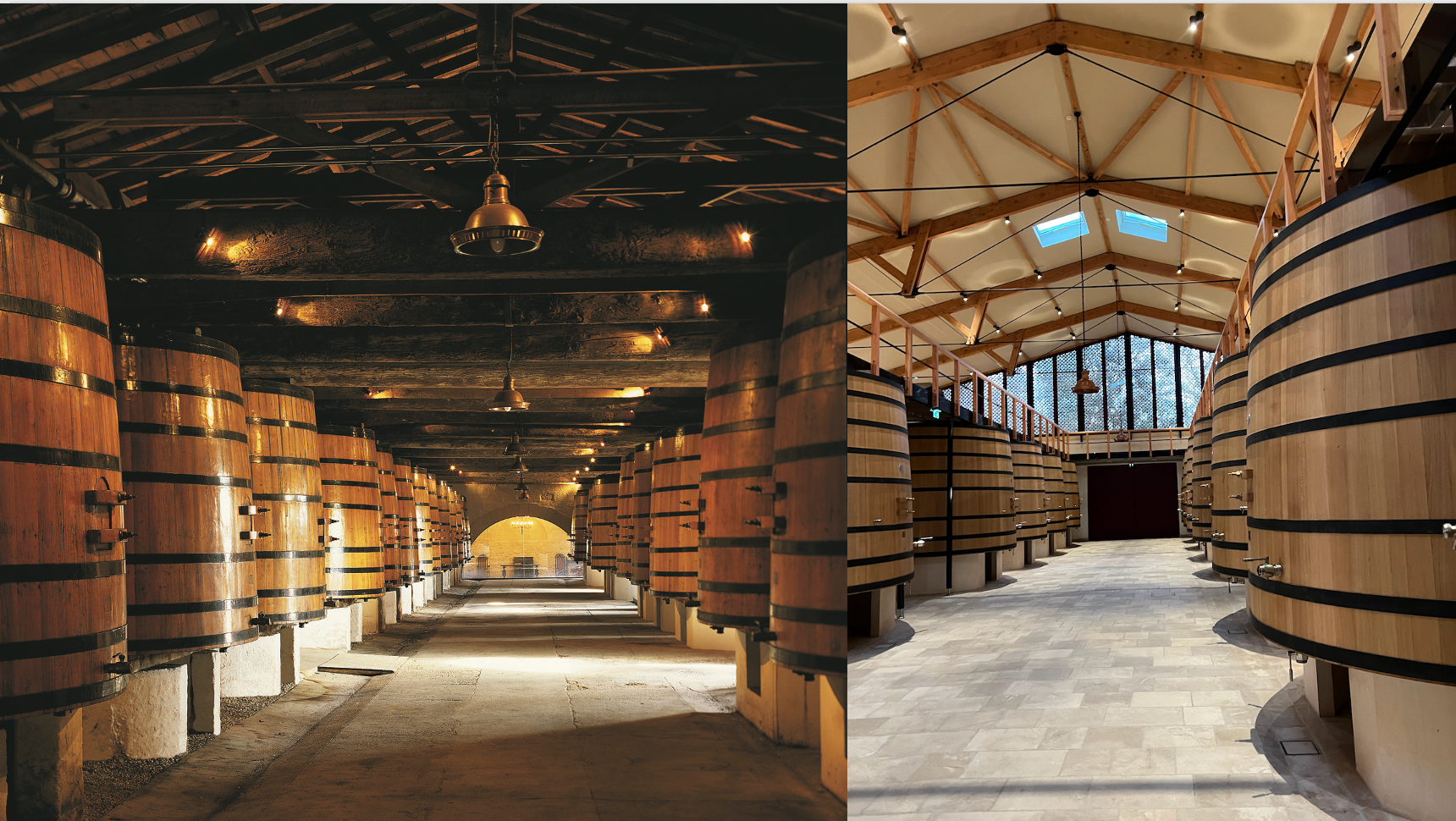
Discreet doesn’t mean old fashioned, there’s a harmonious transition from old to new, with the environmental impact of the new gravity-flow vinification room and barrel-ageing cellars being front and centre. Over 80% of the companies involved in the construction were local, including a local pottery making the rounded terracotta tiles, naturally designed to filter low winter sunlight in, and harsh summer sunlight out, eliminating the need for air conditioning.

It’s also high tech, co-inoculation keeps energy usage down, water use is limited thanks to the blending vats lined with ‘Inox electropoli’, a suppressor that increases water pressure whilst reducing water flow, a Barilav system to clean barrels and a communal water treatment plant. An air filter generates nitrogen to protect wines during wine making.
Lightning the load
Their commitment to the environment doesn’t stop at the cellar door. In 2017, independently of the family properties, Damien created “SBJ”, selling wines based on varieties rather than place. He already emphasised the importance of packaging and shipping in the carbon footprint of wine, introducing bottling wine at its place of consumption and even using returnable bottles.
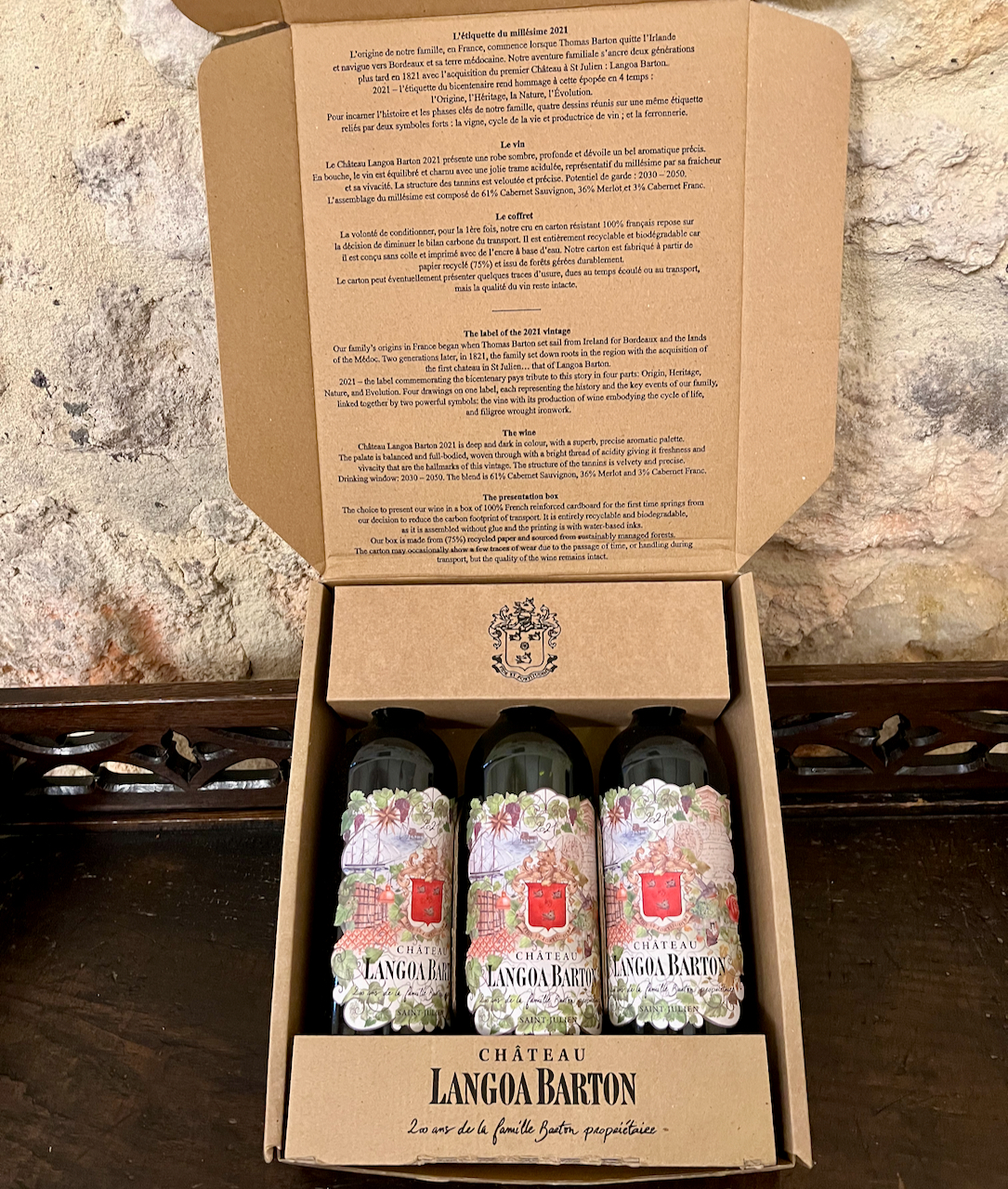
Not an easy concept to translate to a classified growth, but since the 2023 vintage the family have introduced lighter bottles, economizing 40 tonnes of glass. Damien has also challenged the traditional wooden case. Since the 2021 vintage bottles of Chateau Langoa Barton are shipped in 100% French cardboard cartons, reducing six-fold the carbon footprint of shipping. The cardboard is made from 75% recycled paper and 25% sustainably managed forests and is biodegradable using neither glue nor staples and water based inks.
Celebration
This ink is important, especially for the 200th anniversary 2021 label. Anne-Lise Yandell, created images that trace the family history, illustrating the themes of origin, heritage, nature and evolution. The individual images can be found in the beautiful , limited edition celebratory packaging, designed by Patrice Begnier that brings together bottles of 1994, 2000, 2009 and 2016 vintage. All the images then come together to create a unique, colourful label on a magnum of the celebratory 2021. This same label is on all bottles of the 2021 Château Langoa Barton vintage.

Château Mauvesin Barton is also delivered in cardboard, in classic flat cases of six. Château Leoville Barton is still delivered in wooden cases, for the moment.
Out of Africa
Wooden cases are still available for Langoa Barton upon request, but at a premium. This extra resource is then donated to two environmental charities including local NGO HISA with whom they work on monitoring, preserving and developing the local fauna and flora. The choice of the second charity, Wild Tomorrow, who protect, restore and re-wild land in strategic, ecologically important areas, also reflects Damien’s love of the natural environment but in Africa, a passion nurtured by his grandfather, the late Anthony Barton. Family trips to Africa inspired Damien to pass his safari guide diploma.
Sharing the future
Wine lovers visiting the property are also part of their philosophy, and the new design. The Bartons have always welcomed wine lovers, and visits here are the perfect opportunity to taste wine from the three family properties including older vintages.There are future plans to expand their welcome to include hospitality, but for the moment these are long term projects. Just because you have 200 years of history behind you doesn’t mean can’t look forward – and this generation has no shortage of ideas and inspiration.
Thanks for reading, to receive future posts directly to your in box please sign up here. You can learn more about Bordeaux with the new Green Edition of Bordeaux Bootcamp, and explore Wine and Wellness, with The Drinking Woman’s Diet or just say hi here.