My insider guide to where to retreat to in Bordeaux
The October wine and wellbeing retreat at Château Sigalas Rabaud in Sauternes is sold out. Sorry if you missed it. There are only five guest rooms so places weren’t going to hang around.
Don’t worry, there are other options, Bordeaux châteaux have really embraced wine tourism, and it goes way beyond tasting rooms. Now, I can privatise some of the most stunning properties across the region. Could there be a better way to experience Bordeaux than staying in your own private château? Beautiful rooms, private salons, gardens and even pools, a private chateau allows guests to tailor experiences to suit exactly what they want. As well as meeting amazing wine makers and discovering their properties and wines, it might be morning yoga in the vines, healthy food and wine experiences or cooking classes after scouring local farmers’ markets, chef led dinners or just relaxing by the pool after a busy morning tasting. Here’s a selection of different Bordeaux châteaux you can call your own.
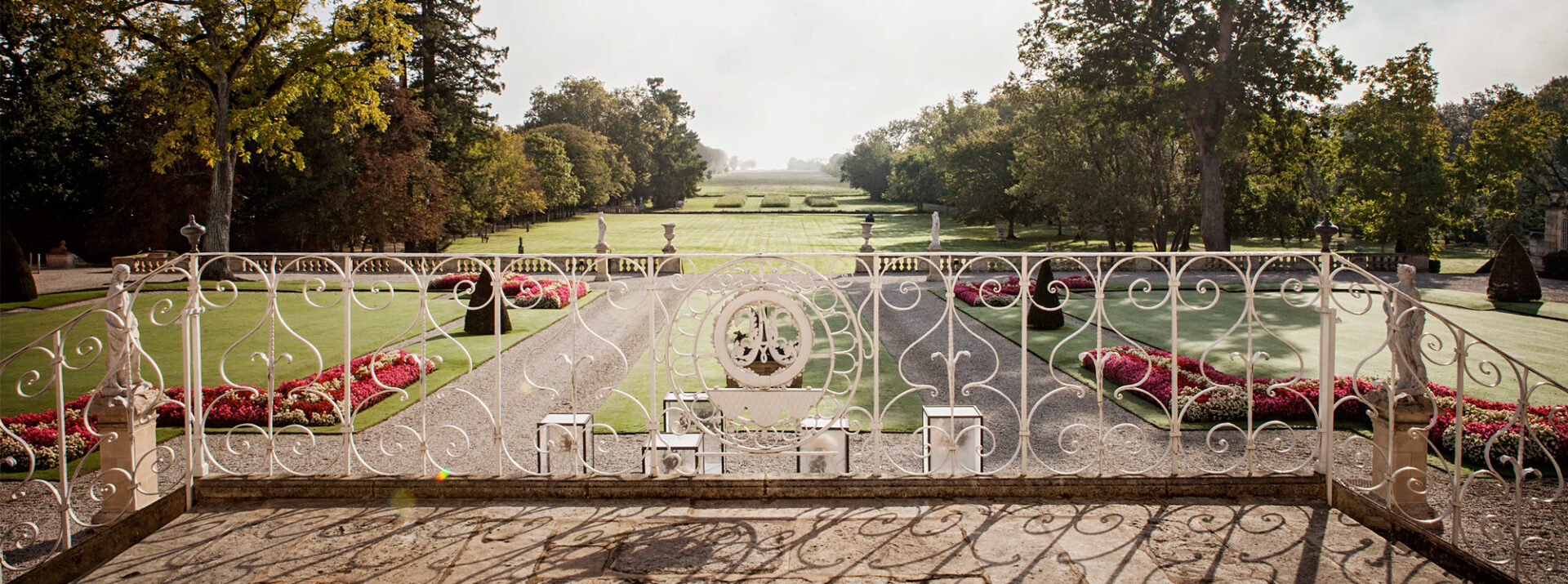
I’ll start with Château Sigalas Rabaud,where our October retreat is taking place. This beautiful 17th-century Chartreuse, is the smallest of the first classified growths in Sauternes. It is been home to the de Lambert des Granges family since 1863. Sixth-generation, Laure de Lambert Compeyrot took over in 2006. She has given the property a new lease of life not only creating stunning Sémillon wines but also five beautiful, en-suite guest rooms. The rooms, lounge and dining room have a family feel, an elegant mix of traditional, cosy and eclectic. Don’t miss the ‘shower in the tower’ in the Marie-Antoinette room, named after her grandmother.
Her desire to welcome people to the estate is rooted in her passion for the wines. She invites guests to join her on the sunny terrace of the château for her favourite pairing, a glass of Sauternes with old Parmesan cheese, a ‘sweet aperitif’ by the lap pool near the vines or a morning cup of coffee made from beans aged in her Sauternes barrels.
Sunset dining at Château Sigalas Rabaud
Keeping it in the family,Château de Ferrandin Saint-Émilion is run by Laure’s cousin Gonzague de Lambert, but you couldn’t be in a more different place. High above the sloping vineyards of the property, the château, built in 1702, is surrounded by a park with a unique collection of over 200 year old trees. It was acquired in 1978 by Baron Bich, creator of the Bic® pens and razors. Since 2010, his daughter, Pauline Bich Chandon-Moët, and her husband Philippe have brought Château de Ferrand into the 21st century with design-led technical, architectural, environmental and artistic renovations. Three beautiful guest rooms, a stunning private dining room are all decorated with art from The Bic Contemporary Art collection. Their private chef is on hand to create wonderful food and wine experiences.
Château de Ferrand by day
and by night
Saint-Émilion is a wonderful base for a retreat, as well as the multitude of vineyards to discover, there’s the medieval town of Saint-Émilion with its many wine shops and restaurants. Nearby Libourne hosts a busy market three days a week, perfect for an outing with a chef to discover local produce. On the very edge of the village, Château Villemaurine, Grand Cru Classé of Saint-Émilion, is now home to La Villa des Vignes,a discreetly elegant hotel with four suites and seven bedrooms. Cleverly marrying tradition and modern luxury, there’s a nod to the limestone it’s built of and on.
The Village of Saint Emilion
The breakfast room and terrace perched above the vat room overlook the vines, as do a cosy salon, library and an indoor pool. All this a few steps away from the bustling centre of Saint Emilion. Guests can taste wines from all four family estates: Soutard-Cadet, Sansonnet, Moulin du Cadet and Villemaurine, in a private tasting room. It’s small enough to be ideal for a private group. More intimate groups might prefer the neighbouring Château Soutard Cadet, which has four en-suite rooms in a lovely house surrounded by vines.
Château L’Etampe is another ‘family home’ we can privatise in the vines of Saint Emilion. As the wine making takes place at their neighbouring Château Fleur de Lisse the property is now dedicated to guests with six double rooms, two suites, a heated pool and a billiards room. The Teycheney family invested in St-Emilion in 2015, the 19th century Château L’Etampe is one of three vineyards the family own. At Château Fleur de Lisse guests can enjoy elegant dinners or cooking classes in the dining room above the working cellar.
Château l’Etampe
A stone’s throw away is Pomerol, small but beautifully formed, producing some of the most prestigious wines of the region. At its heart you’ll findChâteau Beauregard. This Napoleonic chartreuse was so admired by the Guggenheim family that they built their own copy; Mille-Fleurs’ in New York.
Serenity at Château Beauregard in Pomerol
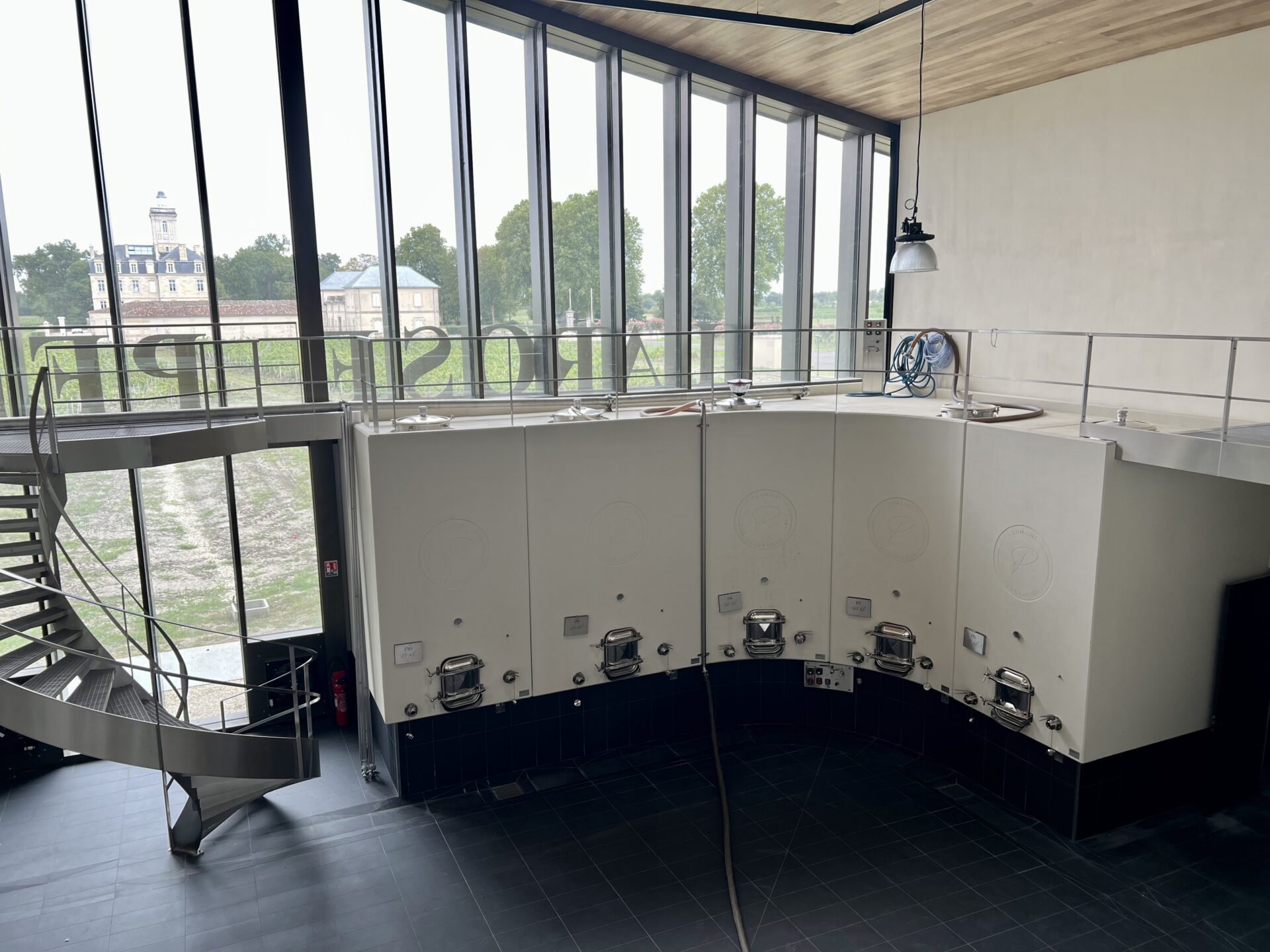
The five beautifully renovated guest rooms are a clever blend of historic and modern that Bordeaux does so well. A private salon, tasting room and dining room look out over the ancient terrace edged by two dovecotes. Cross the bridge over the small moat to a garden designed by Victor Louis, the architect of Bordeaux’s Grand Théâtre. The intimate atmosphere of the château contrasts with the spectacular new cellars dominated by monumental concrete vats and a glass harvest reception room is a perfect venue for a yoga class outside of harvest time!
a welcome tasting at Château Beauregard
On the left bank, Pessac Léognan is a terrific base if you want to explore the length and breadth of this large region. It’s also close enough to the city if you want a shopping break away from the vines.
La Chartreuse de Haut-Bailly, is owned by the Wilmers family, owners of Grand Cru ClasséChâteau Haut-Bailly. They spent three years renovating the property, opening their doors to guests in 2015 with four charming en-suite bedrooms and one suite – perfectly placed just half an hour from the city of Bordeaux, yet in the heart of the vineyards. A large terrace (another perfect yoga venue) overlooks the landscaped gardens and swimming pool. A salon and an elegant dining room host breakfast and dinners. House guests can also visit the fabulous new wine cellars at Château Haut Bailly and, for a change of scene, stay to dine at ‘La Table Privée’ in the family home.
La Chartreuse de Haut-Bailly
For larger groupsLa Chartreuse du Château Le Thil, tucked away in the woods nearby, has nine double en-suite rooms and two suites. Alice and Bertrand Tourbier, owners of Les Sources de Caudalie (the 5* hotel and spa in the grounds of Smith Haut Lafitte) opened Château le Thil as a ‘lodge’ in 2013. Stone stairways at opposite ends of the house lead up to two suites and nine tastefully decorated rooms using finds from local sales. The three ground-floor reception rooms open onto stunning parkland; a small lake and a garden classified as a ‘Jardin Remarquable’. It is a short walk (or bike ride) from the world-famous wine spa at The Caudalie hotel, that also has an excellent cocktail bar if you want a break from wine – it happens!
Château Le Thil, a bucolic setting close to the city
The Médoc has no shortage of prestigious châteaux and here too there are some stunning venues for discreet getaways.
Château Beychevelle in Saint-Julien, is known as the Versailles of the Médoc. The raised terrace (more stunning morning yoga) has an elegant staircase leading down to the gardens that run down to the estuary.
The view from the terrace of Chateau Beychevelle
Built in the classic Chartreuse style, a single-storey building with an ‘enfilade’ of rooms and towers at each end, it originally dated from 1565, then rebuilt in 1757 in its current style as a showcase for the status of its then owner, the Marquis de Brassier. After extensive restoration, the 13 bedrooms and bathrooms are now as deluxe as the château is grand. You can dine in the splendid dining room and sleep in 18th-century elegance.
Inside the elegant salons of Château Beychevelle
The three pagodas of Château Cos d’Estournel dominate the hillside approach to the appellation of Saint Estèphe. This iconic building of the Médoc, famous for its unique oriental architecture, inspired by the frequent voyages of owner Louis Gaspard d’Estournel to Asia in the 18th and 19th century. His obsession for the Orient earned him the nickname of Maharajah of Saint-Estèphe.
The iconic architecture of the cellars of Château cos d’Estournel
Michel Reybier purchased Cos d’Estournel in 2000. He transformed what was previously a museum, into La Chartreuse de Cos d’Estournel. Reybier owns the Michel Reybier Hospitality group, a collection of the luxury Reserve hotels and La Chartreuse doesn’t disappoint. Designed by Jacques Garcia as a family residence, the six bedrooms and two suites are all unique each with Carrara marble bathrooms. One suite even has its own fitness space. Guests have access to the owner’s library, dining room, lounge, terrace, indoor and outdoor heated pools and steam room. It’s perfect in the summer for a dip in the pool and in the winter for the log fires, but it has all year-round appeal due to the unique access to the spectacular cellars and wine tastings of Château Cos d’Estournel.
Inside La Chartreuse de Cos
Les Ormes de PezIn the heart of the Pez hamlet, close to the village of Saint-Estèphe, this XVIII century ‘maison de maitre’ sits next to the Château Ormes de Pez cellars. Surrounded by its tree-lined park, it belongs to the Cazes family, owners of Château Lynch-Bages. It offers five double en-suite rooms and two smaller bedrooms, two living rooms, a breakfast room and a dining room that can host up to 14 guests. Visit between June and September to use the outdoor pool.
The Peyronie family have been making wine in Pauillac since the 1700s. In 1950, Robert Peyronie boughtChâteau Fonbadet, a property dating back to the 1820s. The dynamic fourth-generation Pascale Peyronie took over in 1991, having studied law and oenology. Her latest project is the transformation of her family home into a stunning five-bedroom ‘Chartreuse’.
The feminin energy of Château Fonbadet
No expense has been spared: there’s a spa room, suites featuring solid Carrara marble bathrooms and flooring, (no fewer than 48 tonnes of marble were used), and a park where contemporary sculptures are hidden amongst century-old trees. It’s a clever mix of classic Bordeaux style and ultra-modern luxury, with a very feminine signature. On the edge of the Village of Bages and close to the Pauillac waterfront, it’s a spectacular base from which to discover the northern Médoc.
The newly renovated Château Fonbadet
Spoiled for choice?
Intimate, grandiose or discreet, these architectural jewels, scattered across the region offer the opportunity for unique, private Bordeaux experiences. If you have a small group of friends, family or colleagues keen to discover a world of wine or wellbeing, or both (my speciality!) Let me know which one takes your fancy, we’ll make it happen.
To know more about what’s going on behind the scenes in Bordeaux, sign up here so you don’t miss future blog posts. Please share with any friends and colleagues interested to learn more about the region, its people and of course its wines.
Concerned all this delicious wine might be affecting your liver? I can help: join ‘7 weeks to Liver Friendly Lifestyle programme’ the online course that guides you towards a healthy passion for wine.
I visited some English wineries this year, it felt a little full circle – many (many) years ago when at university, I helped out at an English wine festival. I wish I could remember where exactly – details are buried in my memory and photos in a container somewhere.
For the fun
I do remember it being great fun, slightly eccentric and well, all a bit bonkers. Today, English wine is much more successful and sophisticated, but eccentricity and fun continues to run through many of the properties I visited. Fun is something sadly missing in many areas of the wine world. Wine should surely be fun, shouldn’t it? After all, what more joyful way of bringing people together than over a glass of wine?
English Wine is full of fascinating and diverse characters, each with their own story – you know how I love a story. English Wine Week (June 20 to June 28) seems like a good time to share the places, products and people I met.
Cool climate
On a couple of cool, sunny March days I set off to Kent and Sussex with an intrepid film crew to capture the current spirit and status of English wine. Then, early June, I travelled to Surrey. I came away stunned and slightly overwhelmed not only by the quality of the wines – delicious and diverse – but the quality of the people behind the projects, a range of talent and backgrounds. So many origin stories, united by a passion to ensure English wines succeed and reach a larger audience.
Our intrepid crew in cellars of Segrue South Downs
On the up
WineGB and the Food Standards Agency show the warm and dry growing season of 2025 increased production by over 50% on the ‘difficult’ 2024 harvest reaching 124,377 hectolitres across England and Wales, about 16.5 million bottles from around 5000 ha of vines and over 1000 commercial vineyards. That’s a 500% increase since 2005!
To put it in (a Bordeaux) perspective, that’s about 5% of current Bordeaux production, but Bordeaux is the largest AOC region in France.
Where
English vineyards stretch across England’s “Wine Garden” of Sussex and Kent to the rich clay soils of the Crouch Valley in Essex and the coastal vineyards of Devon and Cornwall. There are producers in Wales, Herefordshire and even further north in Yorkshire.
Sparkling wine brought English wine to most people’s attention with brands such as Nyetimber, Chapel Down and Gusbourne and it still represents almost 70% of production. Now, still wines are stepping up in quality and renown.
Grape Varieties
Almost a third of vines planted in the UK are Chardonnay, closely followed by Pinot Noir and there are now some exceptional quality still Chardonnay wines.
Why now?
The English climate is marginal for viticulture (for the moment as seen in this month’s temperatures), ideal for sparkling wines, giving an elegant acidity and moderate alcohol levels thanks to a long, cool ripening period. Yes, it’s warmer than it was, average potential alcohol levels increased from 9.47% in 2024 to 10.48% in 2025 thanks to higher degree days, but frosts are still a worry – as they are just about everywhere in the Northern hemisphere and certainly in Champagne. Technology is being trialled; I spotted a lot of smudge pots in barns.
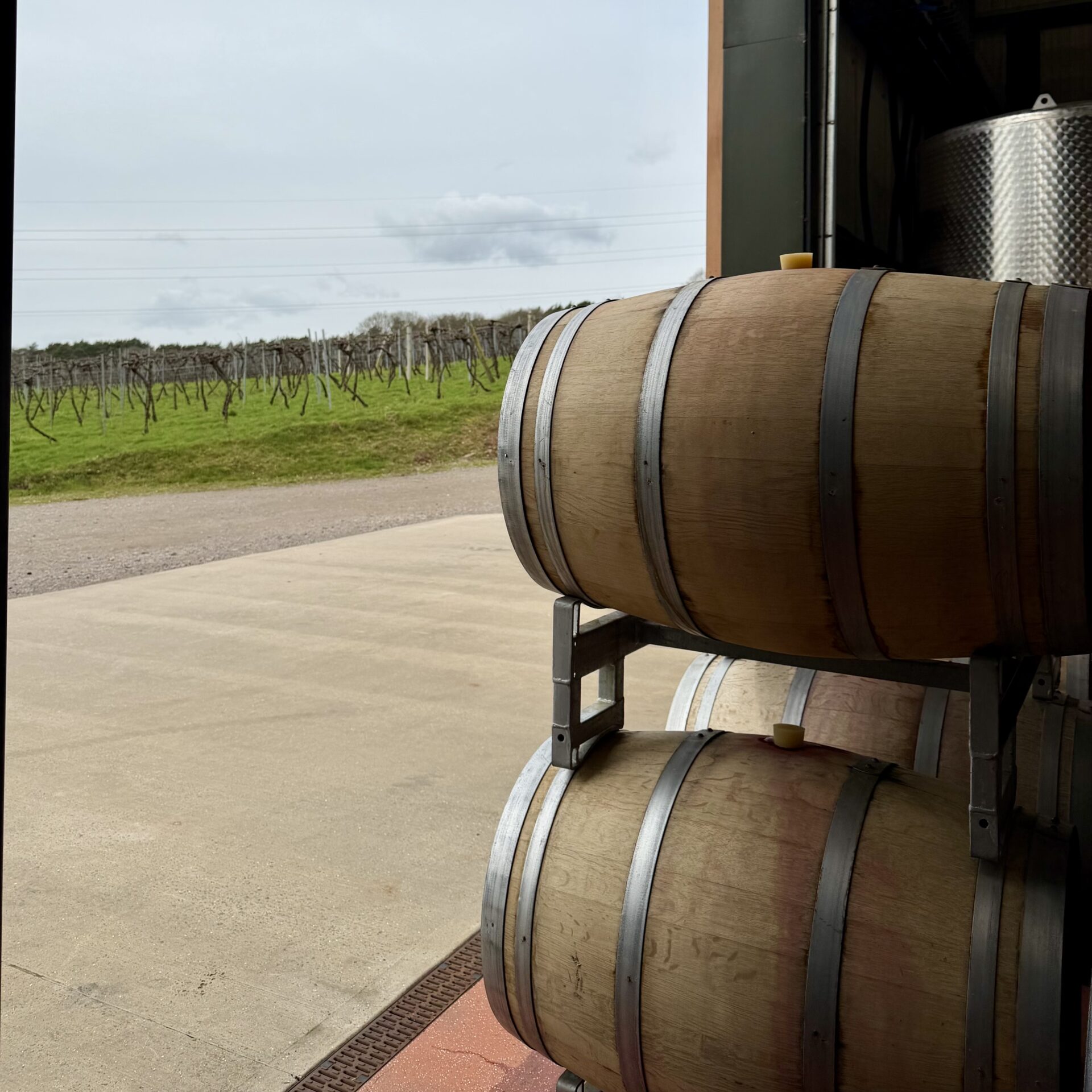
Anti frost measures at the ready at Simpsons Wine Estate
French connection
It’s clear climate change has a role to play but there’s an English spirit that rises to a challenge – ‘anything the French can do …. ‘
Champagne remains a benchmark, many vineyards compare their terroir to the best Champagne can offer. They’re not wrong, England’s North and South Downs are on the same Paris Basin chalk plateau as Champagne. The white cliffs of Dover are made of this chalk. The Kimmeridgian Belt reaches from Dorset’s ‘Jurassic coast’ across northern France and southern Champagne to Chablis, the northernmost part of Burgundy.
Pommery has planted vineyards in Hampshire, but Taittingeris the highest profile French investment with their vineyard Domaine Evremond opened to the public this March. Partnering with UK importer Hatch Mansfield, they invested around £18 million in over 60 hectares of south-west facing chalk slopes for their Classic Cuvée.
The Champagne link is not new, Canterbury and Reims were twinned in the 1960s by none other than Pierre-Emmanuel Taittinger’s father!
Christian Seely, CEO of AXA Millésimes, with properties across France, Hungary and Portugal is a partner in Coates and Seely and the much regretted Steven Spurrier famous for the Judgement of Paris, celebrating its 50th anniversary this year, planted vines in Bride Valley on his wife Bella’s sheep farm in Dorset.
The only way is Essex?
It’s not only Champagne and chalk soils. Essex fruit was on everyone’s lips and Burgundy is reaching across the Channel too. Domaine Duroché announced a joint venture with the Danbury Ridge Vineyard in Essex and Domaine Bernard Moreau is working with Missing Gate Vineyard, also in Essex to produce a new Chardonnay. The Californian Jackson Family Wines recently released its first ‘Essex’ Burgundy and Nick Lane, from New Zealand is making wine at Defined Wine .
From Southern France to Southern England
This year, Charles and Ruth Simpson are celebrating the 10th Anniversary of the first harvest in their Kent winery. They have been producing wines since 2002, but in France, at their 40 ha Domaine de Sainte Rose their Languedoc property.
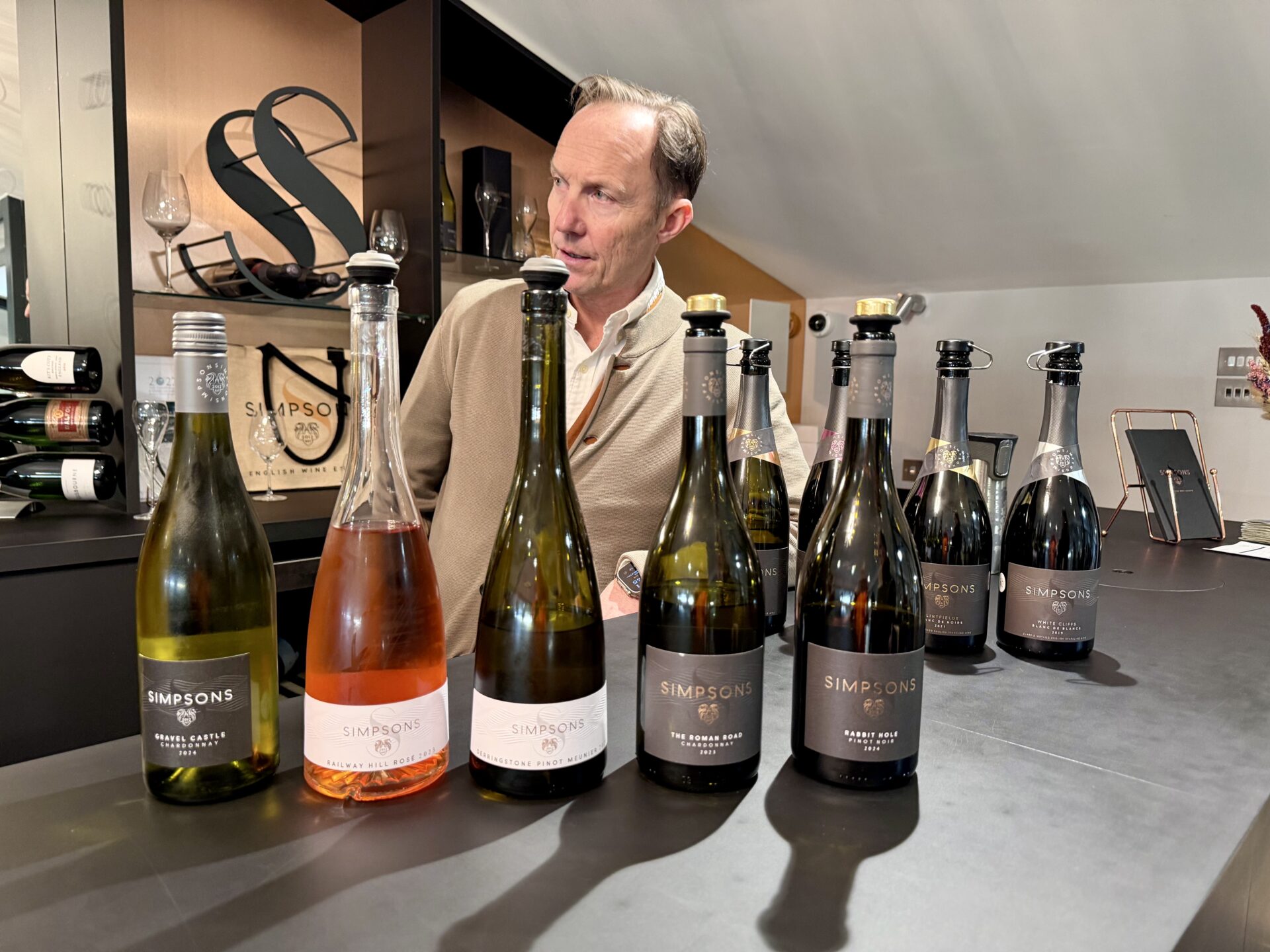
They came to this lime-rich, flinty chalk ridge of Elham Valley on the north downs of Kent in 2012, attracted by the new wine culture as well as potential climate change. They created Simpsons Wine Estatewith a desire to produce world class sparkling English wines. Mission accomplished – it’s a real class act. Today, with 38 hectares of vines, 60% of their production is still wine, with single-varietal Roman Road Chardonnay as their flagship still wine. They opened their new winery In 2016, within walking distance of their three vineyards all in a designated Area of Outstanding Natural Beauty (AONB).
The Simpsons Vineyard in an area of Outstanding Natural Beauty
The first 10 ha of Chardonnay, Pinot Meunier and Pinot Noir vines were planted at the Roman Road Vineyard in 2014. Taking its name from the road the Romans marched on in AD,Romans brought the first vines to the UK, so it seems a suitable homage. Another 20 ha were planted on southern slopes of Barham village in 2016 and 17, on the railway hill vineyard where the Canterbury to Folkestone light railway used to run and then in 2022, they planted 8 ha of Chardonnay clones for still whites at Bonny Bush Hill Vineyard.
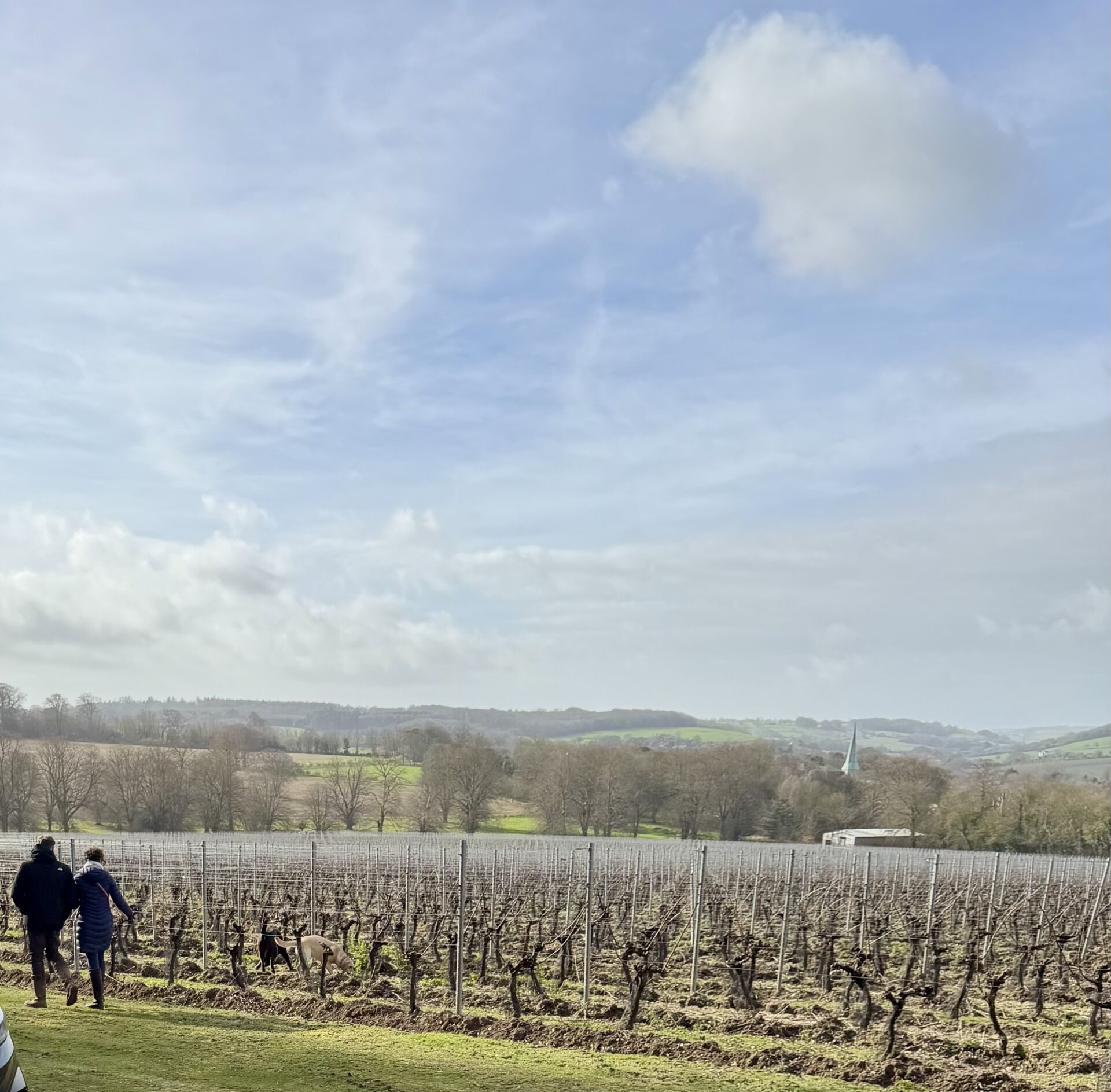
The sheltered slopes are protected from unpredictable English weather by surrounding ancient woodlands and proximity to the coast on three sides, which helps regulate variations in temperature. They are in one of the sunniest corners of the British Isles, and we arrived at their North Downs estate in glorious early spring sunshine (and a bone-chilling wind off the Channel).
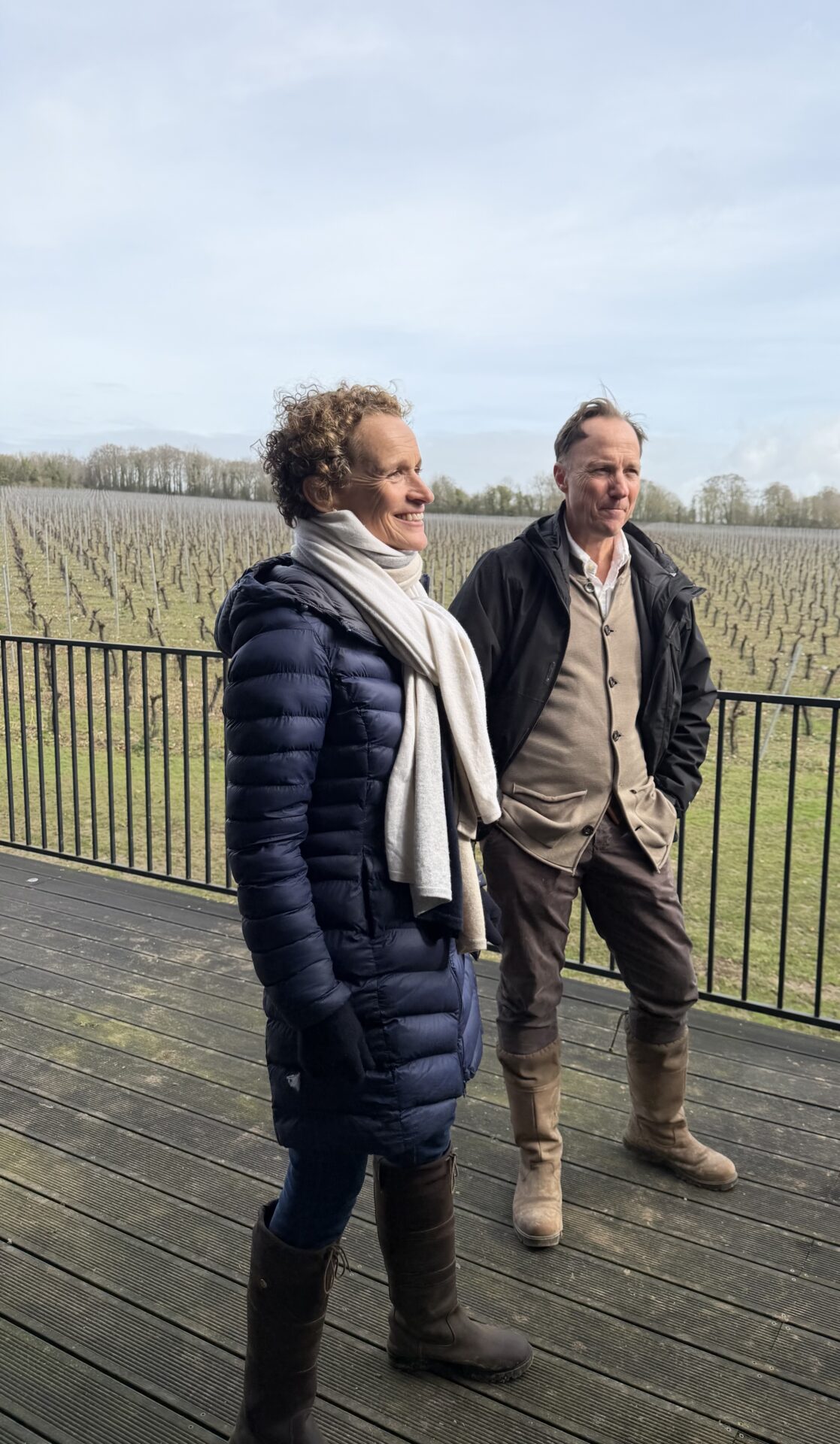
Ruth and Charles Simpson and their vines
Name the place.
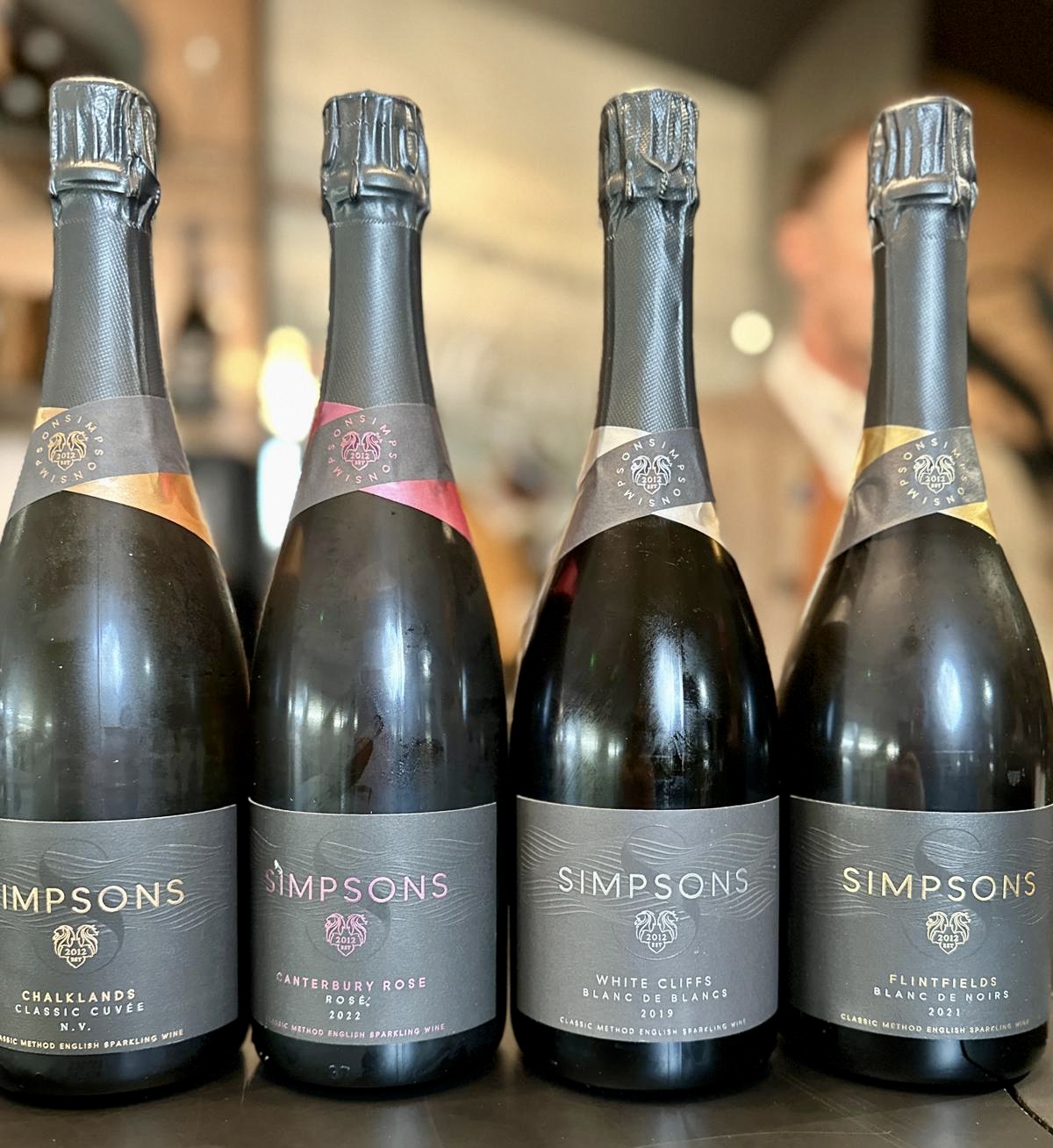
Using only estate-grown grapes for their wines the connection with the terroir – the place, is clear in names like Chalklands White Cliffs (blanc de blancs of course), Flint Fields and Rabbit Hole Pinot Noir. This commitment to place shows in their sustainability programme, minimising their impact on the environment whilst maximising their contribution to environmental conservation and biodiversity.
Since 2021, they are part of The Sustainable Wines of Great Britainscheme as well as theWalpoleSustainability Manifesto that supports, not only the environment but a circular economy through responsible suppliers and traceability. (In 2022 they were named as two of the “50 Most Influential People in British Luxury” on the Walpole Power List).
This broader view of sustainability includes being part of Wine GB’s working groups on viticulture, winemaking and people. The social and community around wineries was something that came up at many properties.
International team
There’s an international feel to many winery teams, Simpsons is no exception. Their own story started when they were living in Azerbaijan and Ruth started a distance learning course in Wine Marketing with the University of South Australia. They have an Estate Manager from New Zealand, one assistant winemaker from Australia and another from South Africa.
From Sparkling to still Charles with some of the Simpsons Estate range
Putting English wines on the map
Their wines have been poured on British Airways, the British Pullman train and at many restaurants across the country. As a founding member of The Wine Garden of Englandcollective, of eight pioneering wineries in Kent, they are committed to creating a world-class wine tourism trail across the county
Tastings are hosted in their The Glass House Tasting Room above the vats, with a ‘fruit chute’ helter-skelter slide taking brave guests (not grapes) down into the winery. Tested and approved by yours truly! They work closely with local producers and restaurants to showcase English wines in pairings.
To celebrate their 10th anniversary, and the end of English wine week, they are organising a food and wine pairing lunch with local chef Bradley Lomas, co-owner of 17th-century Boys Hall who organises wine dinners and Kentish vineyard tours. They also work with THE PIG, another chain heavily invested in promoting local wines, at Bridge Place and the Hide and Fox. This deep connection to the local community and partnership with local companies is something we saw in all the vineyards. There’s a deep sense of community across the industry in suppliers and commercial partners willing to put the wines on their lists.
Westwell – let the fun begin
Husband and wife teams seem to be a theme. At nearby Westwell Adrian and Galia Pike run an ‘experimental winery’, a short distance from the Pilgrims way to Canterbury; here too they enjoy the chalky and flint soil. They make an impressive range of wines with Adrian now known for his innovations, including red, white, and orange, pet Nat and more. Alongside the three classic varieties they have Regent and Ortega (their signature grape) with which they are determined to create a unique and local signature through low-intervention and wild yeasts.
Westwell tasting room
Artistic licence
They both come from the music industry, you can tell there’s Creative Juices at work here. Adrian’s interest in wine goes back to travelling through France to an annual music event in Cannes, visiting Champagne, Burgundy and Rhône vineyards along the way, filling up an old 2CV with wine. But it was tasting one of Will Davenport’s wines in a Soho restaurant in 2014 that inspired him to change careers. He began working for Will and hasn’t looked back since. He still considers winemaking magical,‘you never really know what you’re going to get – I’m loving learning’.
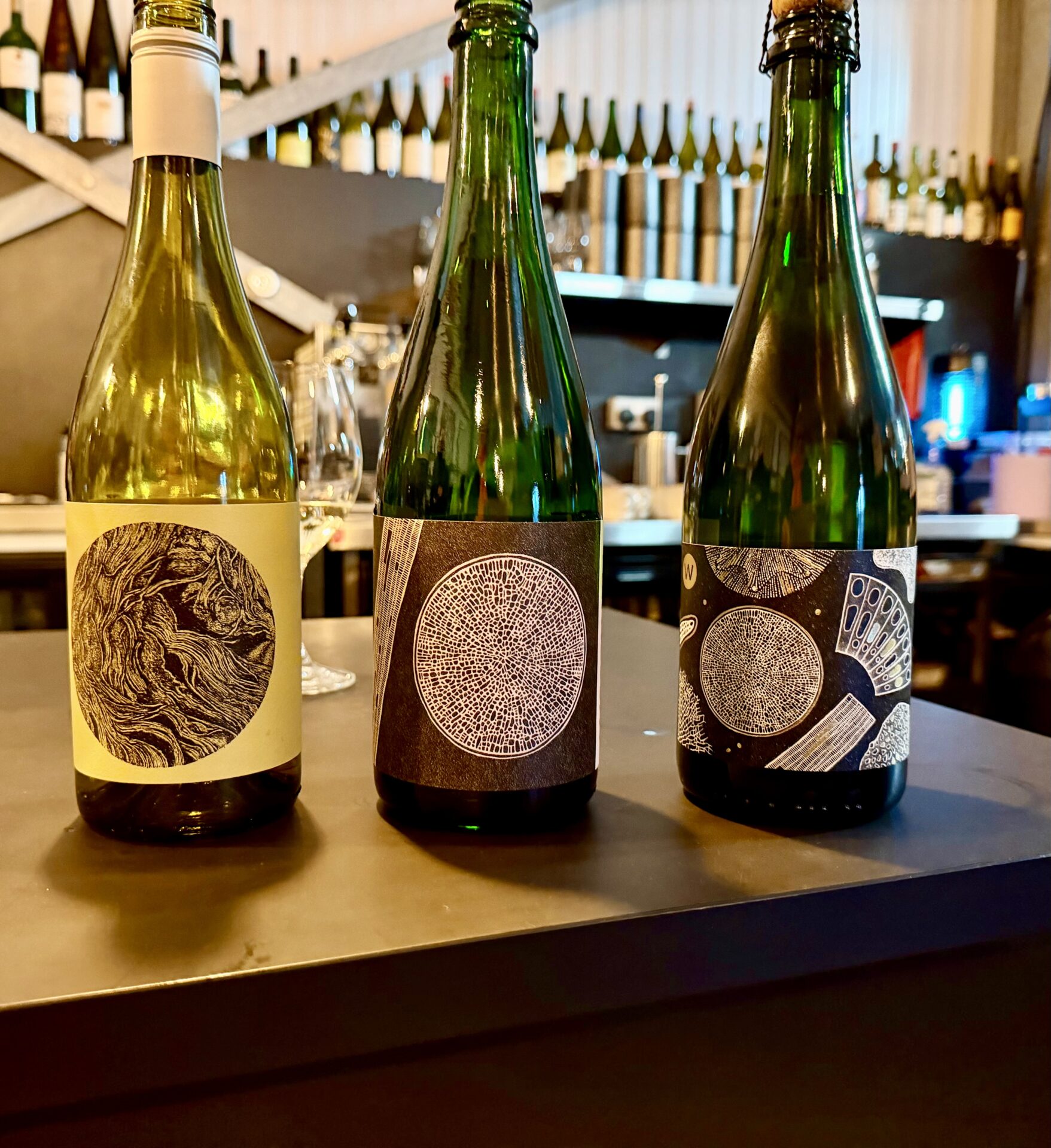
Some of Galia’s label designs
When they relocated to Sussex, Galia, previously a composer, studied at Plumpton College. Galia creates the stunning wine labels with detailed illustrations of vines and the vineyard. They are very invested in the local community, working with local suppliers and sending wine making waste to Pelegrims, for their cosmetics. Locals are constantly onsite, alongside tours, tastings and picnics in the wildflower meadow, there’s a busy programme of events from supper clubs, theatre in the vines, workshops, produce markets and Friday pizza nights, where occasionally Adrian will hit the decks DJing.
Their unique ‘Sun Dirt Yeast Club’ members vote on and influence the wine that the Club produces for them. Decisions are informed thanks to shared wine theory with members learning about wine making step by step with hands-on events throughout the year to build on wine knowledge and blend their own wine.
Bolney
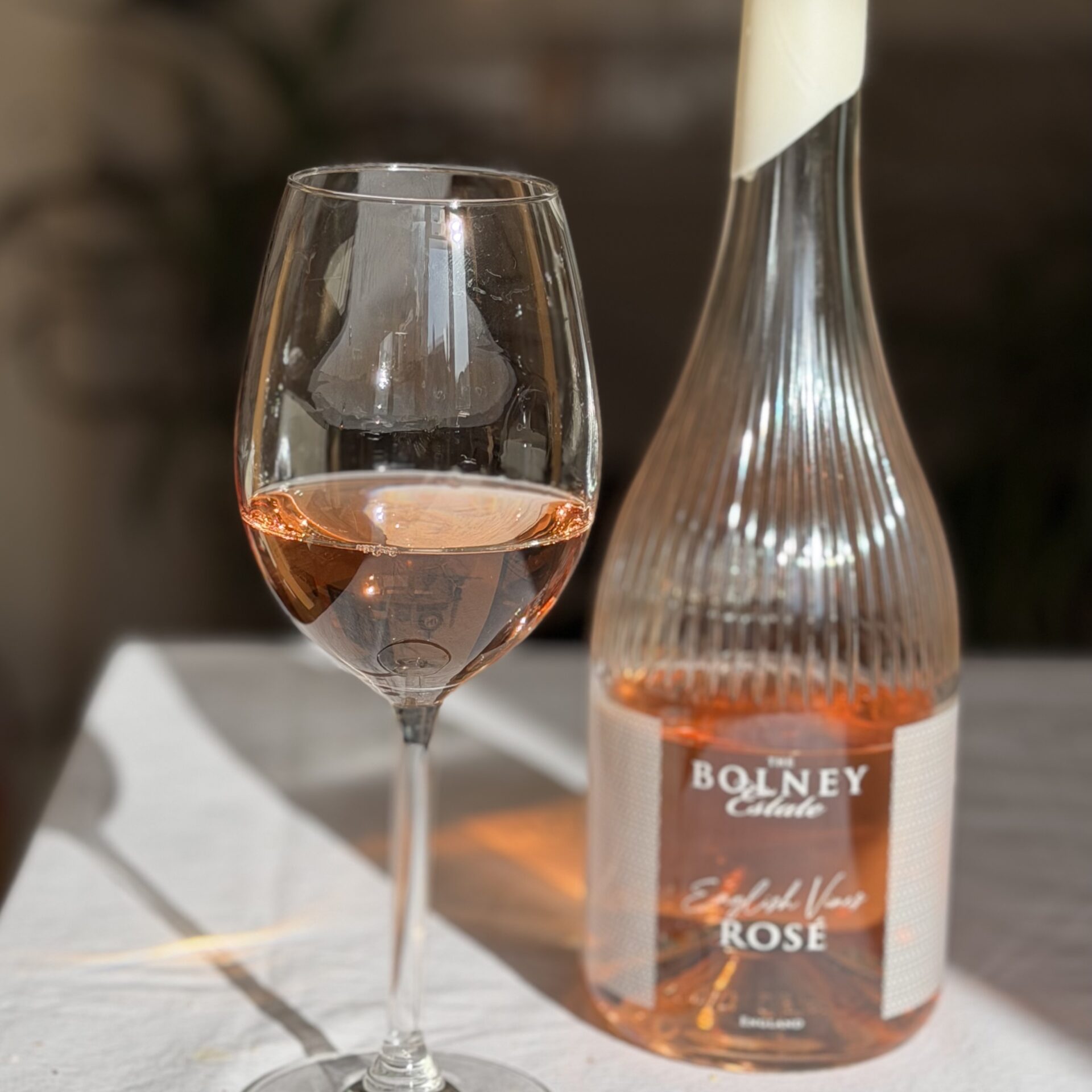
Further West in Haywards Heath, West Sussex, BolneyWine Estate is a bigger and more sophisticated operation, although it too started as a family vineyard. Planted over 50 years ago, by pioneers Janet and Rodney Pratt, they started with three acres of Muller Thurgau in 1972, only the 6thcommercial English vineyard. By 1977 they had doubled plantings, introducing other varieties in 1983 including Pinot Noir and Chardonnay, producing their first still red blend in 1998. In 2002 they planted the south facing Eighteen Acre Vineyard, now their flagship site and built their first ‘proper’ winery in 2005.
View of Bolney 18-acres from the cellar
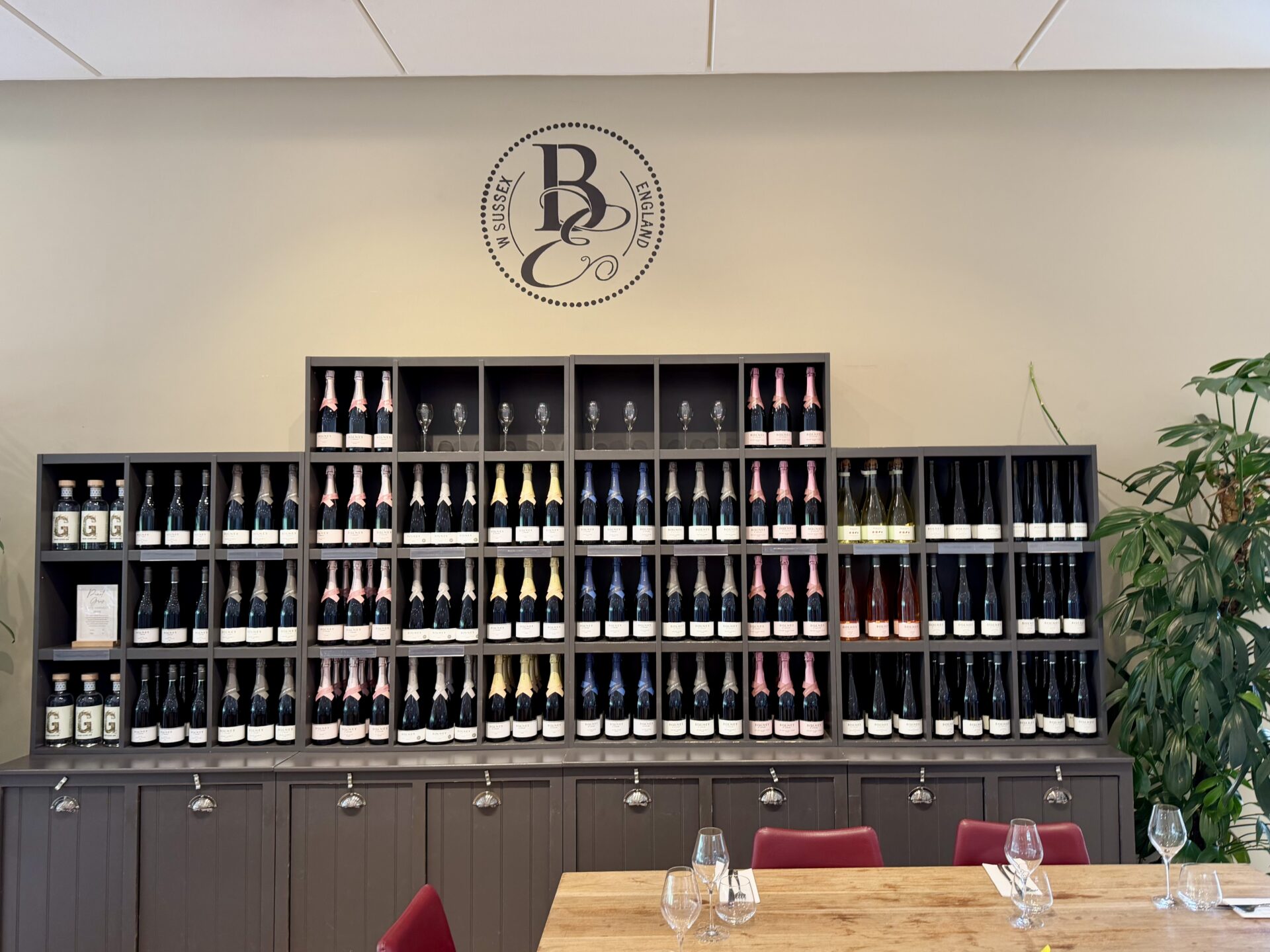
The winery was built with the visitor experience in mind, one of the first UK vineyards to create a successful tourism model. They have the advantage of being easy to access from London, Brighton and Gatwick and are really set up for visitors. The 18-acre restaurant overlooks the vines from the first floor. A ground floor coffee shop is next to the boutique that sells not only their wide range of wines but local produce and gifts, estate gins, vermouths and negronis.
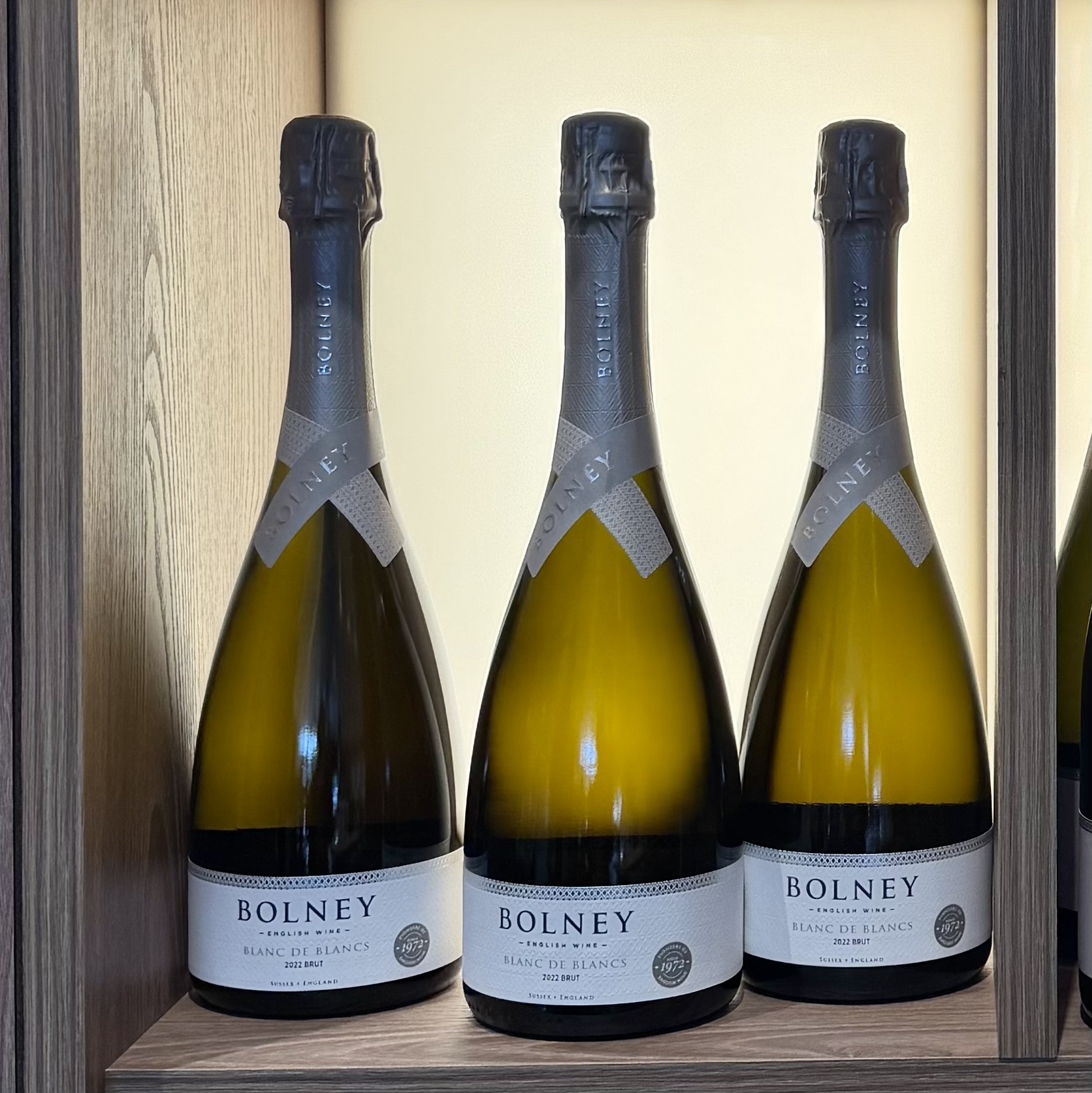
Spoiled for choice, the range of sparkling wines from Bolney Wine estate in the tasting room
In 2022, Bolney became part of Henkell Freixenet, a global leader in the sparkling wine market with a portfolio including Champagne, Crémant, Cava, Prosecco and now an English Sparkling as part of their global portfolio. The strength and support from such a big player within the industry, has had a positive impact on Bolney and English Wine as a whole.
Really love this packaging
Bolney Wine Estate are very invested in welcoming visitors but not all visitors; Vineyard Manager, Phil Grant showed us their new vineyard replanting project explaining the fencing needed to keep the deer out – their biggest pest after botrytis! They find grapes delicious.
Sugrue South Downs
Dermot Sugrue has been making wine in the UK for over 20 years, putting English sparkling on the map at Nyetimberand Wiston Estate whilst also crafting his own wines on the side. Now, he describes himself as ‘free range again’, making wine with his wife and fellow winemaker Ana at their own Sugrue South Downs in West Sussex.
Dermot is Irish and a great storyteller – he has a great story to tell. Originally from County Limerick, he studied environmental sciences in East Anglia then viticulture and oenology at Plumpton. After two vintages in Bordeaux, one with fellow Irish family the Bartonsin Saint Julien, he made wine for the Catholic priests in nearby Storrington. His first vintage didn’t go well, birds ate all the delicious 2008 grapes. Dermot tried again in 2009, making his first Sugrue South Downs vintage named ‘The Trouble With Dreams’ inspired by the priest’s lament after the first grapes all disappeared.
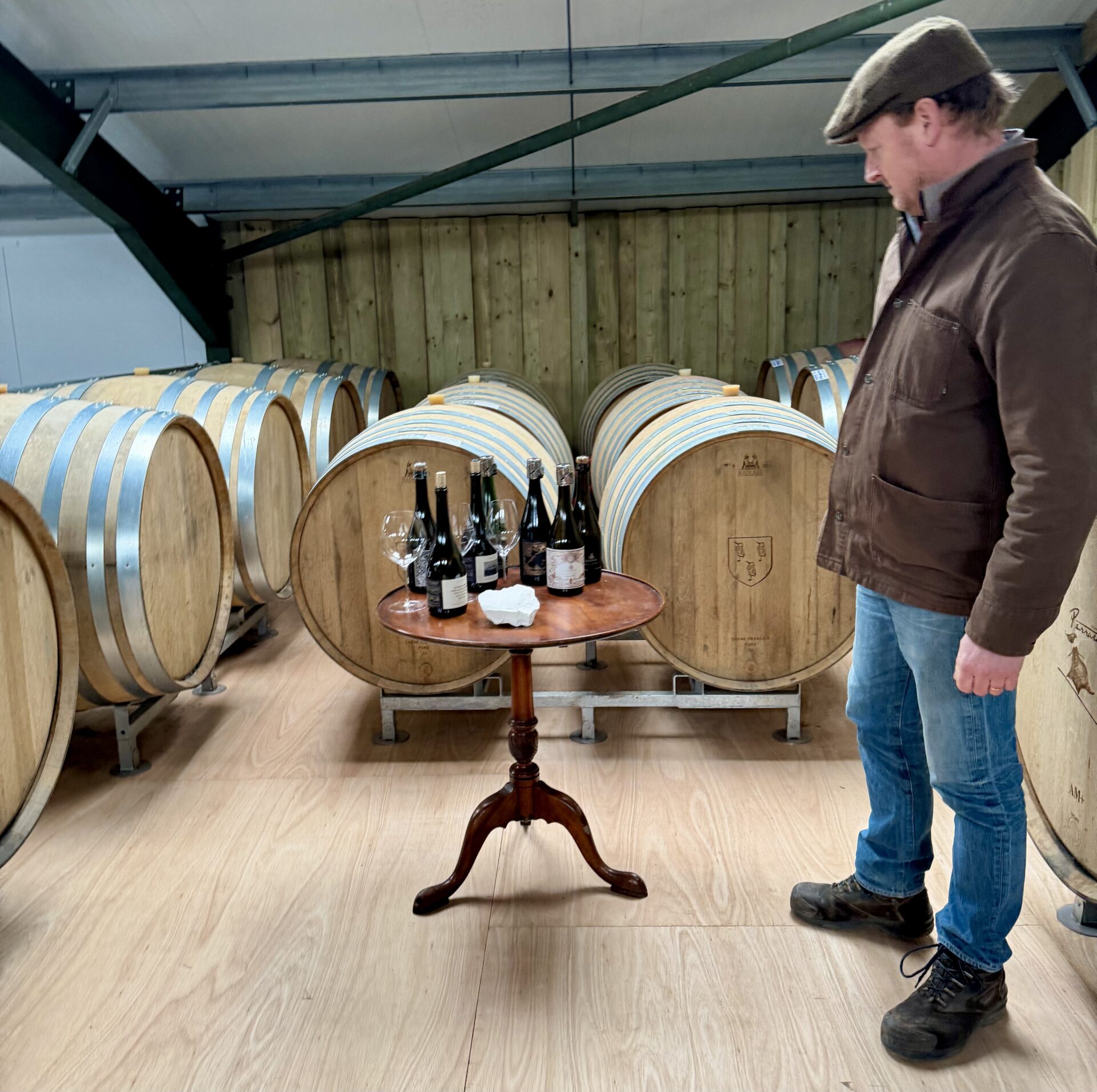
Dermot and some of his creations in the Sugrue South Downs Cellar at the Bee Tree Vineyard
In 2013, he took over Mount Harry vineyard releasing his Cuvée Dr Brendan O’Regan – named after ‘one of the most distinguished Irishmen of the 20th century, and my great-uncle – the founding father of Duty Free and creator of the world-famous hotel school at Shannon Airport’ It was served on BA first class, which is a great full circle. He also released the first ZODO (zero dosage) cuvée after 10 years.
Ana moved to the UK In 2020, joining Plumpton College, as winemaker. After travelling the world from her native Croatia as an independent winemaker. She joined Dermot fulltime in 2021 as sales director and turned Sugrue South Downs into a more ‘grown-up operation’. His words not mine.
Putting the local vineyards on the map
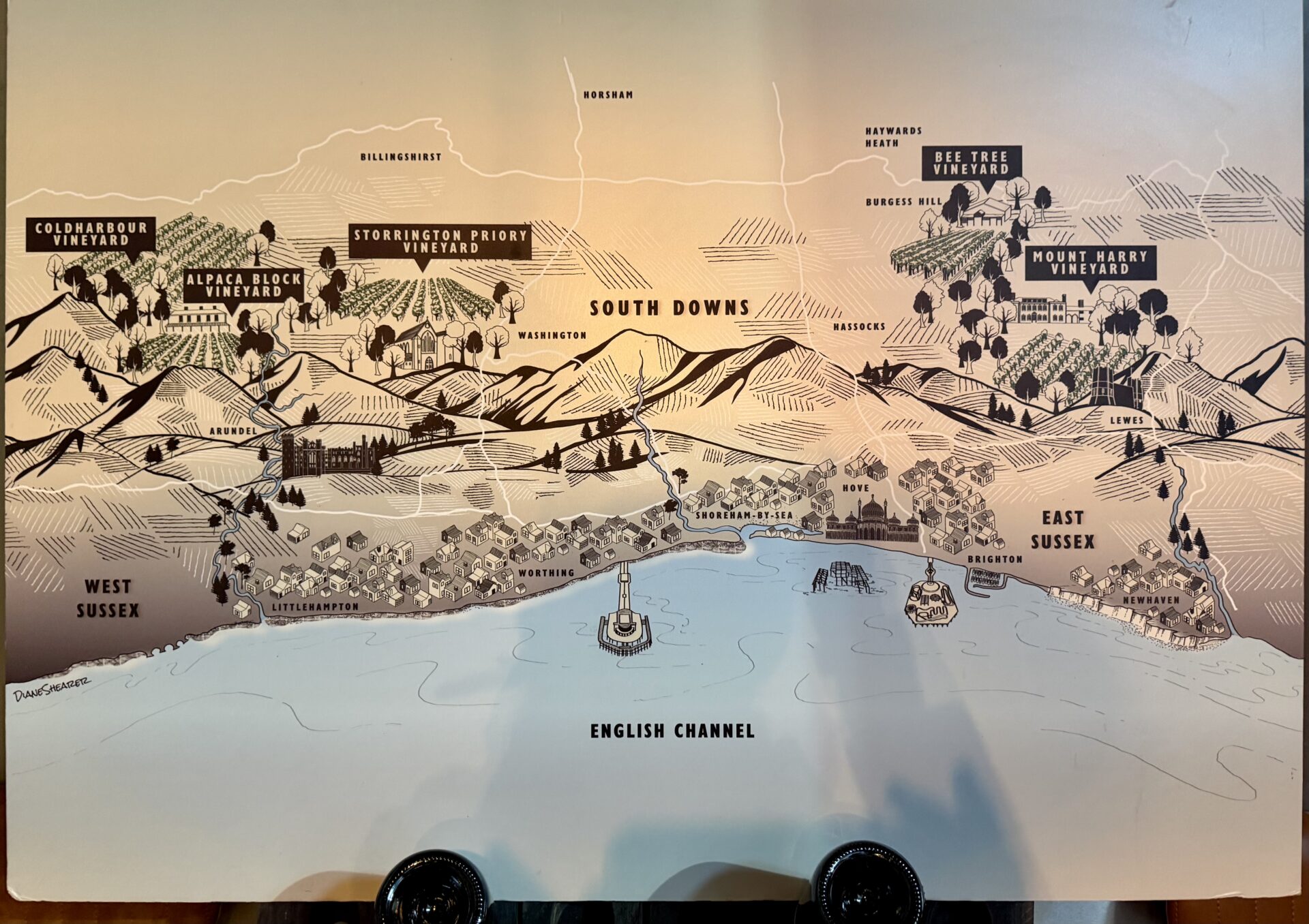
They leased Coldharbour vineyard in West Sussex, Dermot knew the vineyard well, he made sparkling wine from this site for Nyetimber. It became Sugrue South Downs’ second “Grand Cru”. They bought Bee Tree Vineyardin 2023, named after an ancient beehive in a nearby tree, – an appropriate symbol of the biodiversity he champions – with fellow investors, Robin Hutson , actor Hugh Bonneville, and now chef Angela Hartnett.
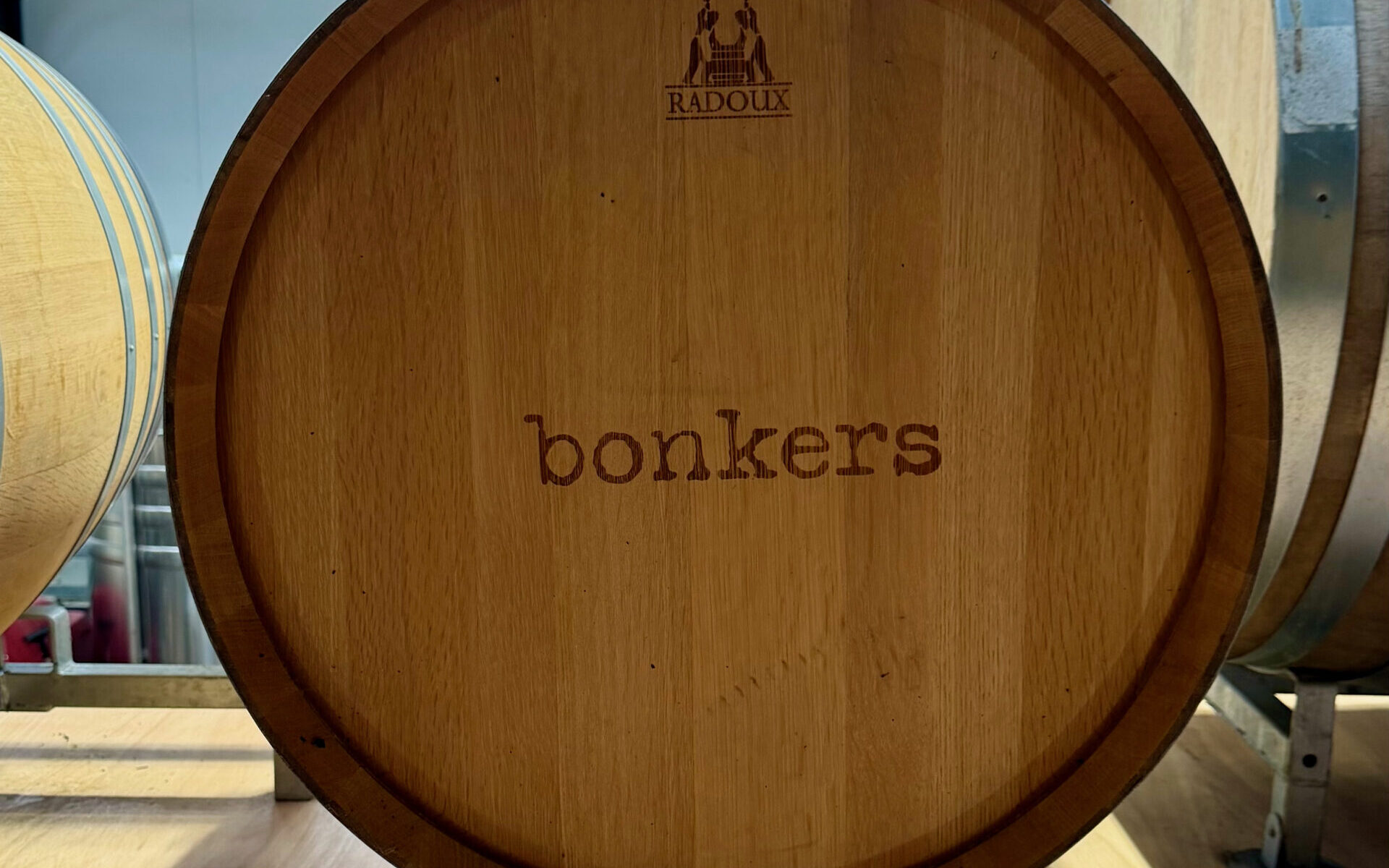
Famous for his sparkling wines, he has successfully turned his attention to still wines launching “Bonkers Zombie Robot Alien Monsters from the Future Ate My Brain (sur lie).” He’s got a thing for names. It’s a solera reserve wine from 2022 and 2023 launched in 2024. Since 2022, he’s been bringing in Pinot Noir grapes in from Mason’s Point in the Crouch Valley in Essex.
His philosophy is pure and simple: low sulphites, sustainable, fermentation in old oak barrels, no malolactic, with an emphasis on long ageing rather than immediacy. It’s a boutique production, (100,000 bottles max) concentrating on direct-to-consumer sales.
Destination vineyards.
He wants to see British vineyards treated as destinations, part of national tourism campaigns. He walks the talk – from the former tractor barn they have developed a cellar door experience, offering guided tours, tutored tastings and masterclasses with local cheese and charcuterie and they encourage people to stay over in local hostelries. They welcome visitors to Sugrue Sundays – a series of alfresco wine lunches with some of the UK’s best chefs.
Angela Hartnett of course, but also Neil Borthwick, Mitch and Ben Tonks, Henry Harris, Mark Hix, James Ferguson, Luke Holder and Richard Corrigan. It’s a stellar line up and underlies his desire to get UK sommeliers, wine bars and restaurants to pour more homegrown wines alongside French and Italian classics. Hartnett is a brilliant ambassador for English wines in her restaurants, she says she learned from one of the best, Robin Hutson, (The Pig Hotels and Limewood) also an investor in Sugrue ‘ he said, it’s not good being piecemeal about it, if you are going to put English wine on a menu, you want to put 10, 12 bottles on. So that’s what we’ve done.’
More celebrations
I visitedDenbies at the beginning of June as part of their 40th Anniversary celebrations. Here’s an estate that has really embraced bringing people to the wine and wine to the people but on a different scale. They welcome over 425 000 visitors a year. Location helps, they’re 15 minutes’ walk from a station on the line from London Waterloo and the whole operation is turned towards tourism, including a 17-room hotel. It works, 65% of their sales are at the door.
Still a family estate, Denbies was originally a livestock farm converted to vines starting with 30 acres in 1986. The winery followed in 1993, producing their first Surrey Gold, still one of the UK’s bestselling English wines. Today with 260 acres planted, Denbies is England’s largest vineyard, producing 1 million bottles pa of which 70% are still wines. (Chapel Down is almost as big at around 200 ha). The chalk and flint slopes across different elevations and sun exposures offer a diversity of plots reflected in their broad range of products and prices, offering affordable and inclusive wines uniquely from estate grown grapes.
Chris White CO of Denbies
Christopher White took over as CEO in 2002, buying the estate with his siblings from their father. Their size and expertise allows them to select and blend white label wines for leading retailers as well as their own brands.
It takes a village
Size also means they are an important local player, employing 180 staff, working with local suppliers. It’s like a village, with an on-site coffee roaster, a gin distillery, a very popular farm shop and even a SHP wellness centre on site – you know how I feel about wine and wellbeing. All this alongside tours and tastings, four food outlets from a takeaway, a café and a sophisticated restaurant. Denbies are a founding member of the Vineyards of the Surrey Hills created in 2019 including seven independent vineyards make up the route,
Open access
Everyone is welcome here, with free parking, EV charging points and cycle parking for people coming to enjoy the eight miles of public paths through the vineyard. A Greenway cycle route runs from here around the county and onto neighbouring national trust land. There’s a Park run every Saturday, and an annual vineyard Bacchus marathon.
All aboard the Denbies train
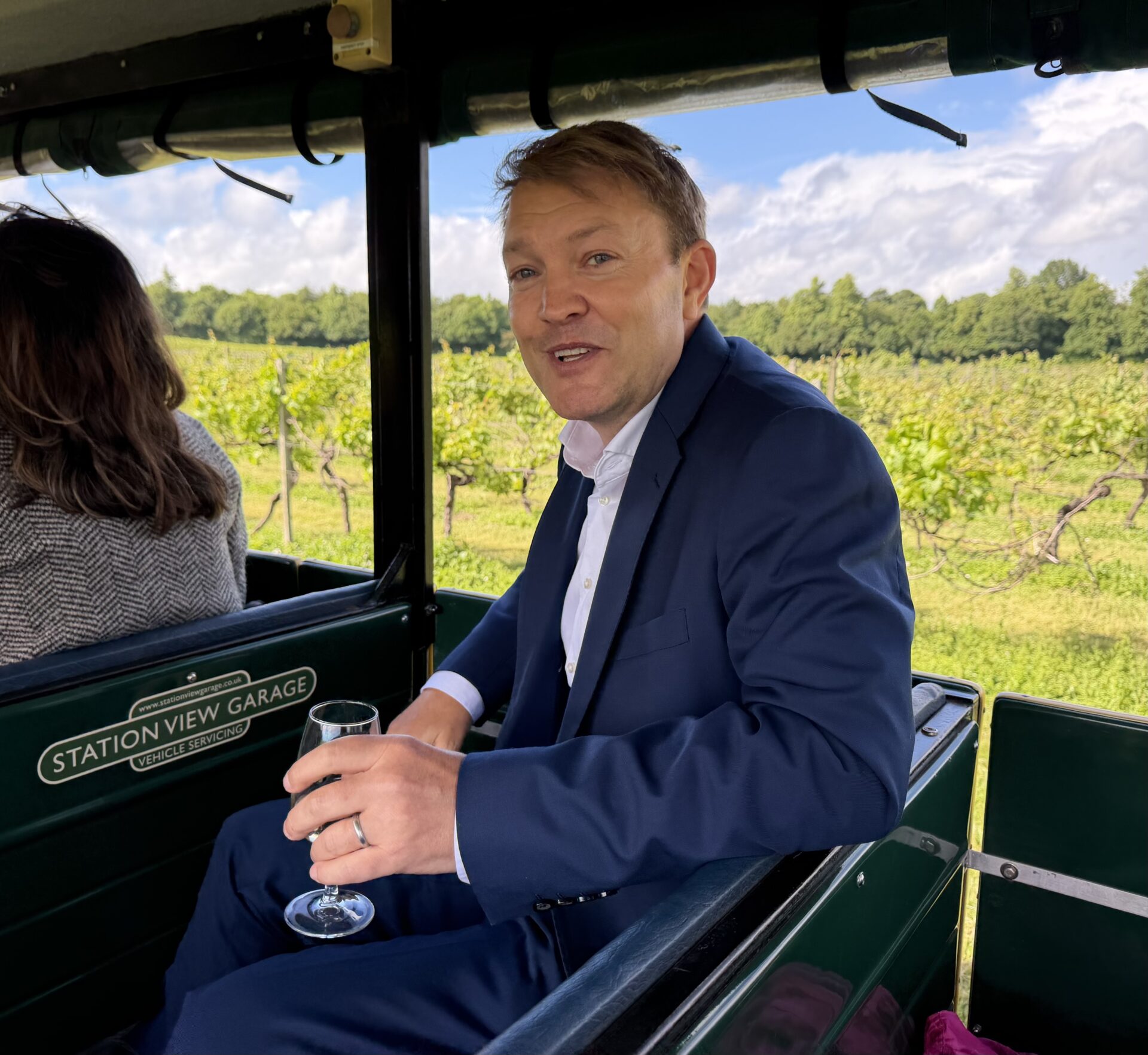
Outdoor tours from March until November take visitors on a ‘train’ ride through the vineyards with some amazing views of the vineyard slopes and the North Downs. You can even sip on a glass of their Sparkling Wine along the way. Indoor visits, start with a film explaining the geology and history of the estate and a year in the vines and cellars and always finish with a tasting. The Biodiversity of the estate attracts visitors, with ten acres of the estate dedicated to wildlife and native vegetation with wildflower rows, reduced mowing, cover crops and the 250 sheep released into the vines each winter. A founder member of Sustainable Wines of Great Britain, they are B Corp certified and the first UK vineyard to have Net Zero status to the UK Carbon Code of Conduct (UKCCC) and won the King’s Award for Enterprise for Sustainable Development.
Stunning views across the vines from the ‘train track’
Diversity also comes from the patchwork of varieties including Solaris, Ortega, Rondo, Dornfelder, Seyval Blanc, Reichensteiner, Seyval and Muscat alongside the classics, including 35 year-old Chardonnay vines for their single variety premium still wine. It is constantly evolving. They champion PiWi varieties to limit spraying against fungal diseases, and added to blends, they reduce the level of alcohol. Oliver Whitfield, the vineyard manager arrived four years ago, another Plumpton College alumni and is obviously passionate about the diversity and experimentation in the vineyard. It’s important, harvest dates are evolving – they used to harvest on 1st October, last year it was mid-September. Climate change is not all plain sailing – they lost 60% to frost damage earlier this year.
Andy Kershaw shares his passion for Denbies
Andy Kershaw, cellar master here since 2013, is excited about the evolution of these varieties. A trial block of Muscaris was made as a single-varietal in 2023, very aromatic, coming in under 11%. With Solaris he is making a skin contact orange wine. It is now ‘truly wild’ with whole berry, carbonic maceration and natural yeast – appealing to different clientele, it adds to the range for people coming to the vineyard. The accessible off-dry Surrey Gold remains their biggest seller alongside their sparkling wines. They even offer a late harvest Ortega.
Wine tourism and locavores
A sense of place, and community runs through all these properties. A strong connection with other local producers and institutions, through association and joint tourism initiatives and close working relationships with local restaurants. Most wineries have embraced wineries wine tourism, they have the advantage of being so close to London and the high population of southern England – there’s a lot of punters on their doorstep and they know how to engage with them.
Trading up
There’s enthusiasm from the UK wine trade too, we spent a day in London chatting with professionals who seem really keen to promote and share these wines with punters. People are buying out of curiosity and patriotism but that’s not enough for success. The wines have to be good – and there are some very good wines indeed. They are not cheap, but that doesn’t mean they aren’t great value. The UK wine scene is one of the most dynamic and diverse wine markets of the world – if you can make it here…..
At a recent tasting for 67 Pall Mall, Richard Bampfield MW explained that it’s easy to put the success of English Sparkling down to climate change but that neglects the increased professionalism, skill and ambition of a host of dynamic owners, growers and winemakers who have driven this revolution. He believes ‘given the extraordinary progress of the British wine business over just 30 years, there is every reason to be positive about the future. ‘
Exciting and adventurous
There is a palpable sense of excitement at all the properties we visited, driven by the dynamism of the producers. They’re reaching out to the trade and slowly, the trade is responding with pockets of very enthusiastic ambassadors. To quote Angela Harnett again, ‘what is brilliant is English wine makers can go a bit off message. A lot of the French Champagnes, Italian Proseccos and Cavas in Spain, are following a procedure they’ve been doing for centuries. They can’t deviate, they know what they’re doing. Whereas there’s a freedom of English wine makers, they can surprise people, try something different, play around. And when they get those gems after experimenting that’s when they can compete with the big boys’.
If you haven’t tried English wine yet, this English Wine Week is the perfect moment to venture forth and discover a vineyard. If you can’t get to the vineyard, choose a wine on a wine list and give these pioneers some encouragement. If you need help starting, I recommend Elizabeth Rose English Wines. Director Victoria Bubb aims to remove hard work, they bring wines from producers all over the country together in one place. As Our Sommelier founder Arlene King said to us, ‘It’s always good to start from home.’
I’ll drink to that
To know more about what’s going on behind the scenes in Bordeaux, and further afield, sign up here so you don’t miss future blog posts. Please share with any friends and colleagues interested to discover more.
Monumental, sums up the new Sources de Caudalie adventure in Burgundy. A huge, historical monument brought back to life thanks to a brilliant team led by Alice and Jérome Tourbier.
It’s daring, not only crossing from Bordeaux to Burgundy but, also taking such a huge property, that could easily be austere, and making it into somewhere welcoming and comfortable.
The original Sources in Bordeaux is now classified ‘ Palace’ since 2016, whereas Les Sources de Cheverny feels more homely but all three offer five-star accommodation and service and enjoy the same clever blend of sustainability and discreet luxury. Although with less rooms than Bordeaux, Les Sources de Vougeot feels more ambitious.
Perfectly placed
I first stayed at the Château de Gilly back in 2008 with French Wine Explorers. We used it as a base to discover the vineyards of the region. It is perfectly placed for wine tourism, in the village Gilly-lès-Cîteaux at the heart of the Grands Cru vineyards of the Côte de Nuits. Midway between Beaune and Dijon and just 25 minutes from the Dijon high speed TGV train station, making it three hours from Paris. Les Sources de Vougeot is perfectly placed to discover the vineyards of the Côte d’Or base for visiting the vineyards of Burgundy.
Signature style
The impressive monastic architecture is softened by the Tourbiers’ signature style – wine and regional books are scattered around the rooms and, working with interior decorators A S L, an eclectic choice of furniture gives the impression of someone’s (rather grand) family home rather than a formulaic hotel.
Welcome to the new Sources Hotels adventure
Welcome
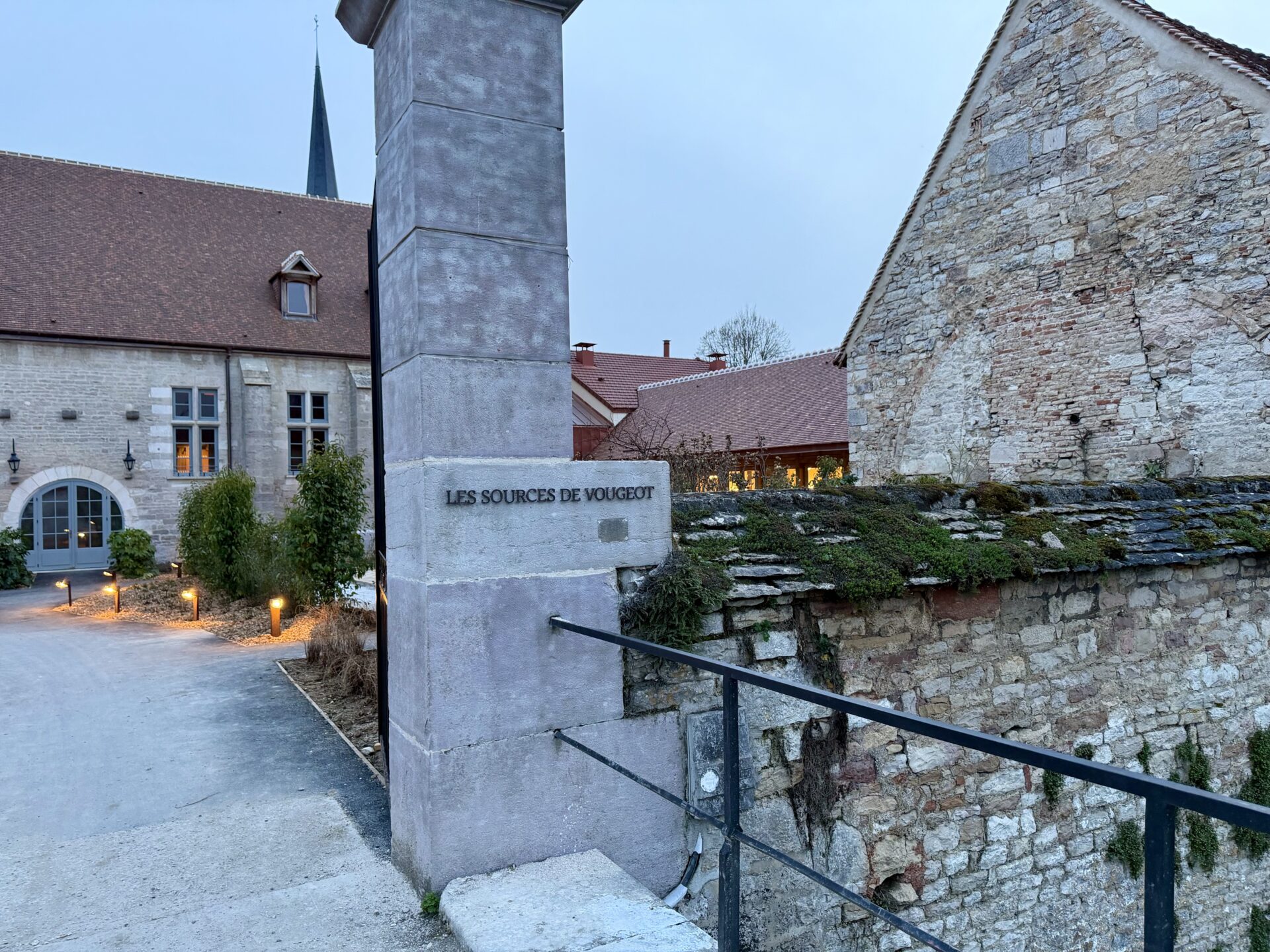
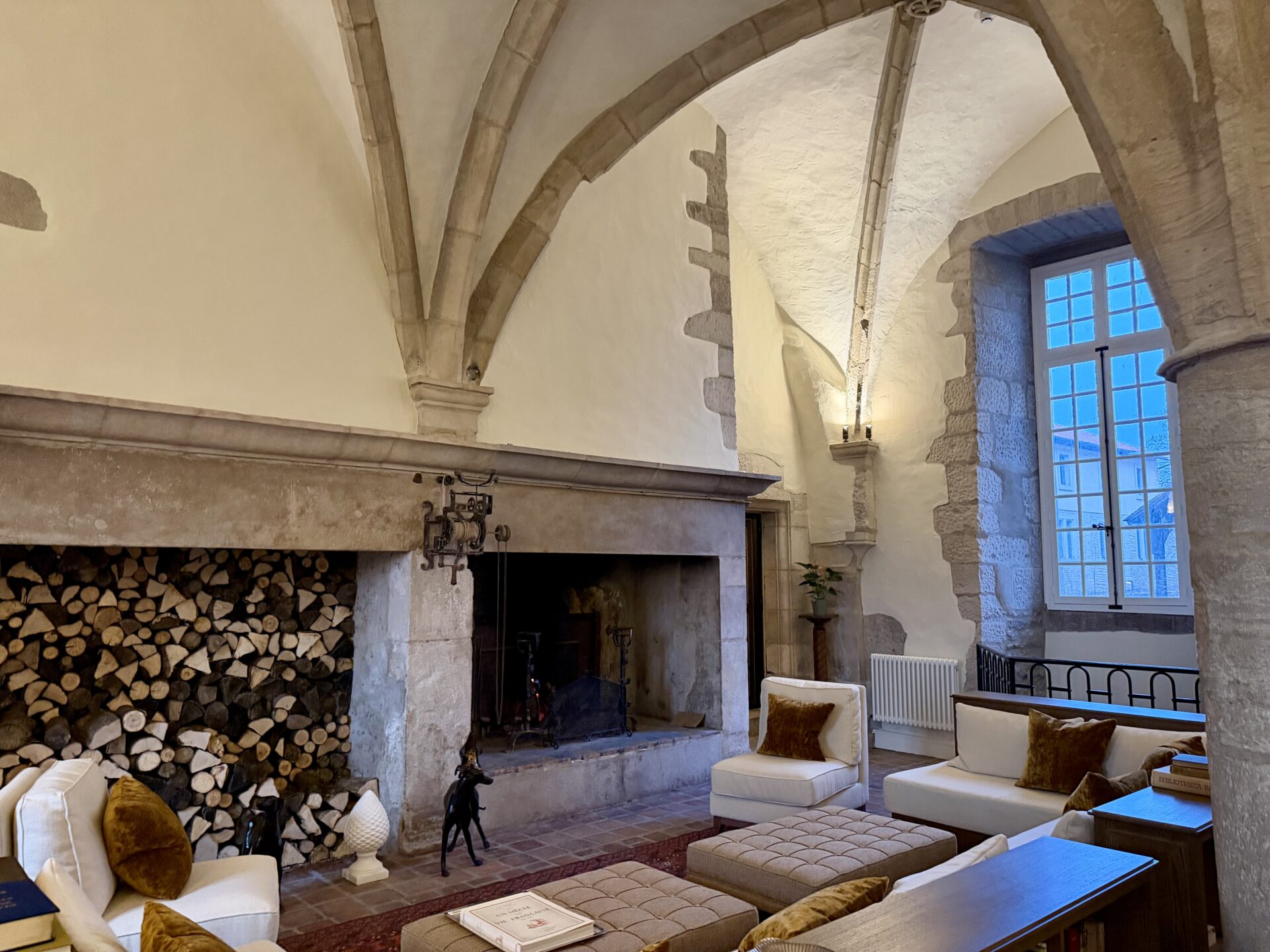
You enter the property from the village via a stone bridge over the old moat into a courtyard dominated by the church. The hotel entrance is a surprisingly small, almost secret, ancient oak door which opens into a spectacular lobby. This vaulted space sets the tone: once the priory’s kitchen, it is dominated by a huge double fireplace with a welcoming fire and huge sofas between the thick stone columns.
A warm welcome
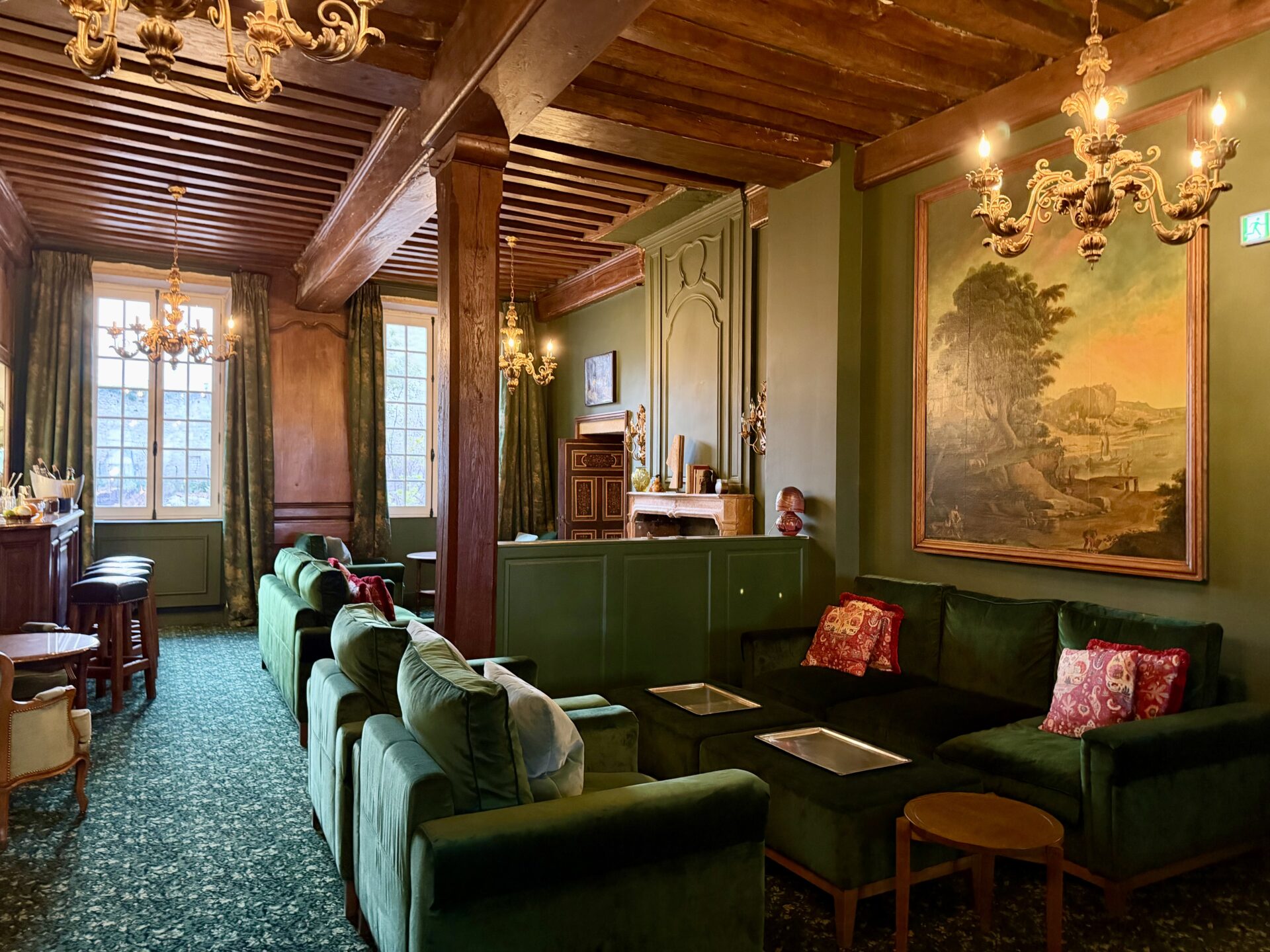
The Chateau Bar, just off the reception, is draped in green velvet, a cosy setting for a glass of local wine from an interesting Burgundy by-the-glass selection.
The Château Bar
The rooms
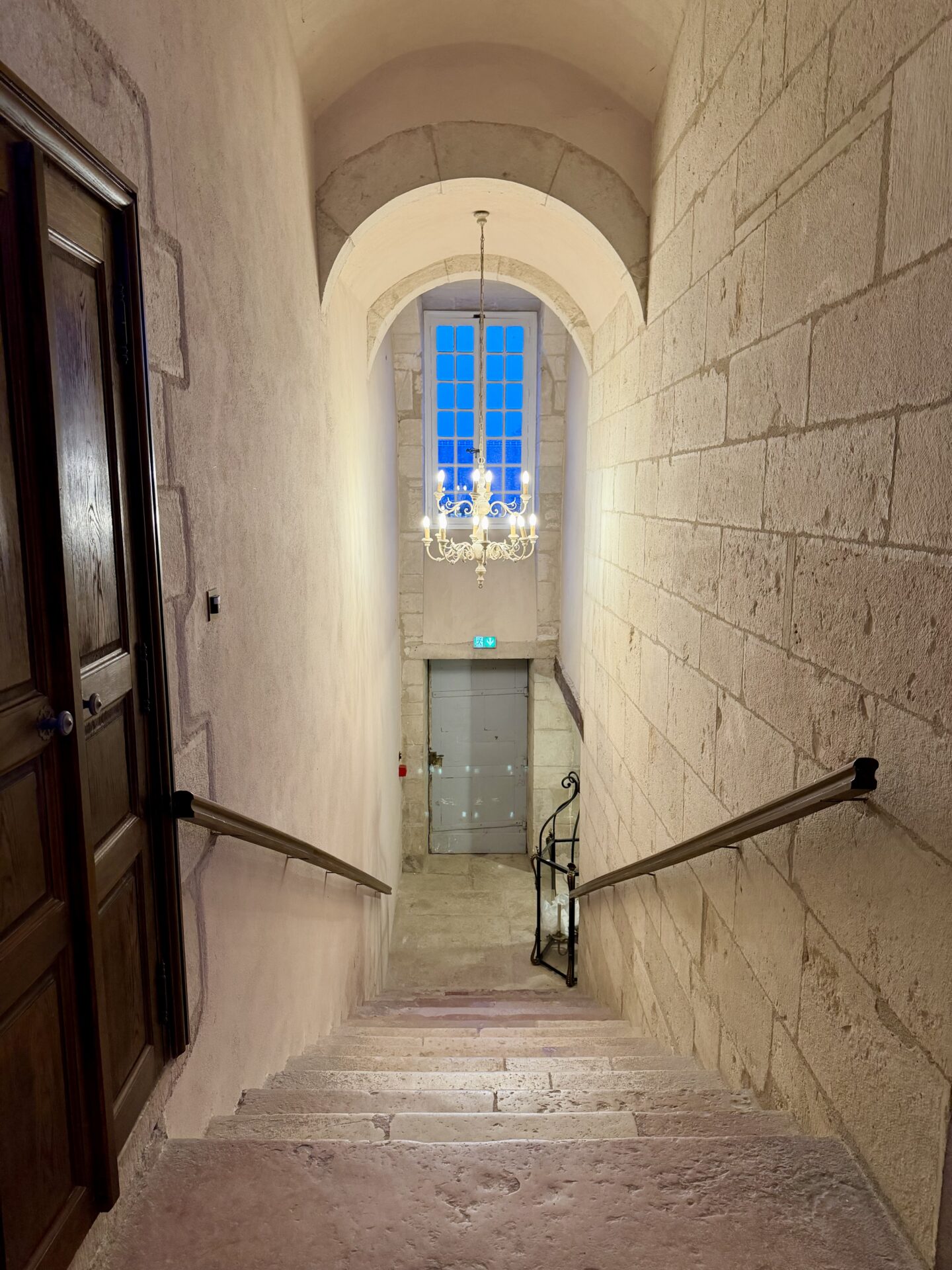
The 49 bedrooms and suites are shared between the main château and ancient former outbuildings across the site. One side of the Château is serviced by a lift, not the other. The ancient stone stairs, may be atmospheric, but might be challenging for some, do let them know if you can’t manage.
Monumental stairs
Our room under the eaves, had lovely, exposed beams with a mix of old charm and modern comfort. The bathroom married classic style with function, I do love a heated bathroom floor. lovely linens – and those signature slippers.
Signature slippers
Food and wine
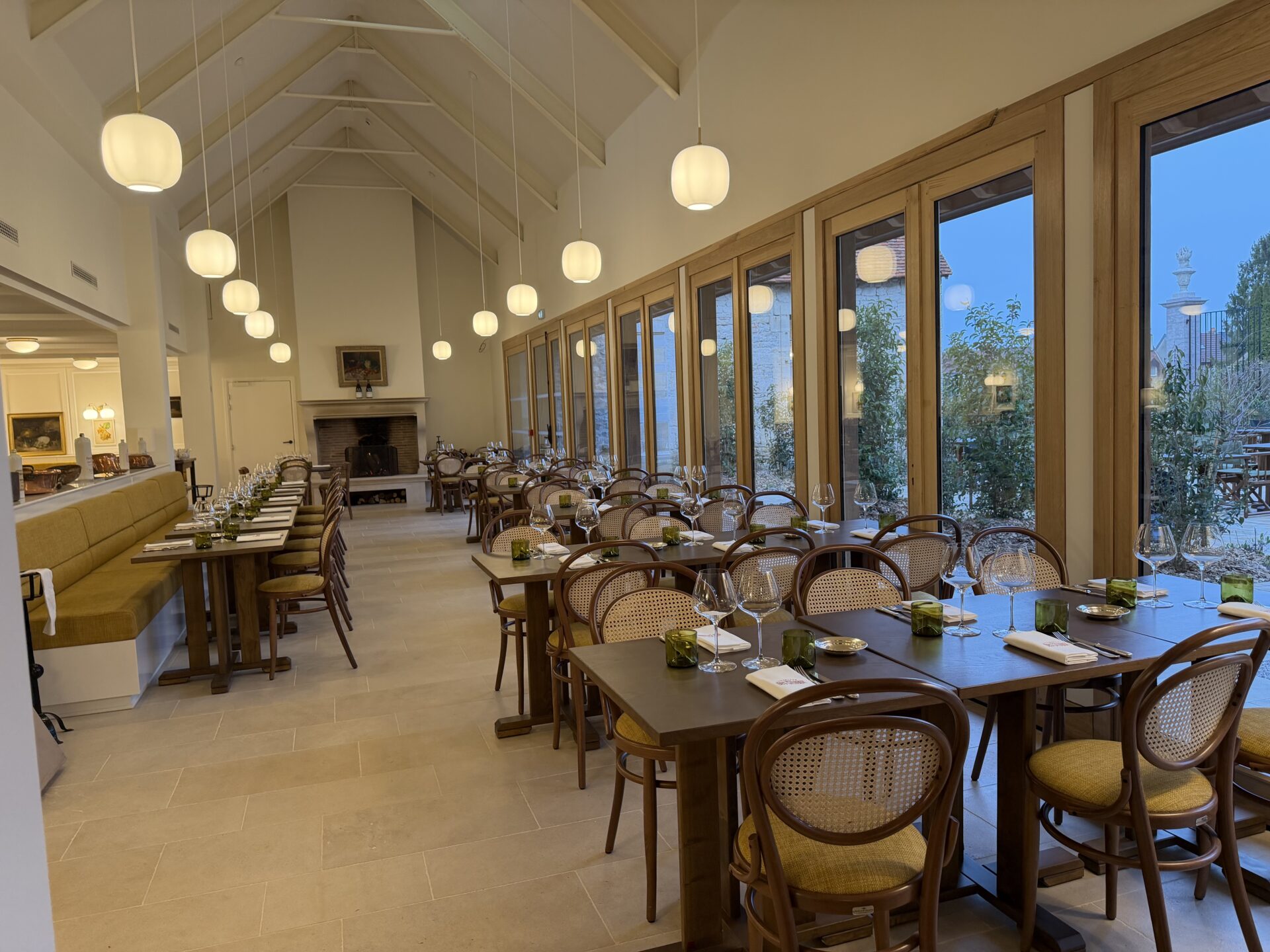
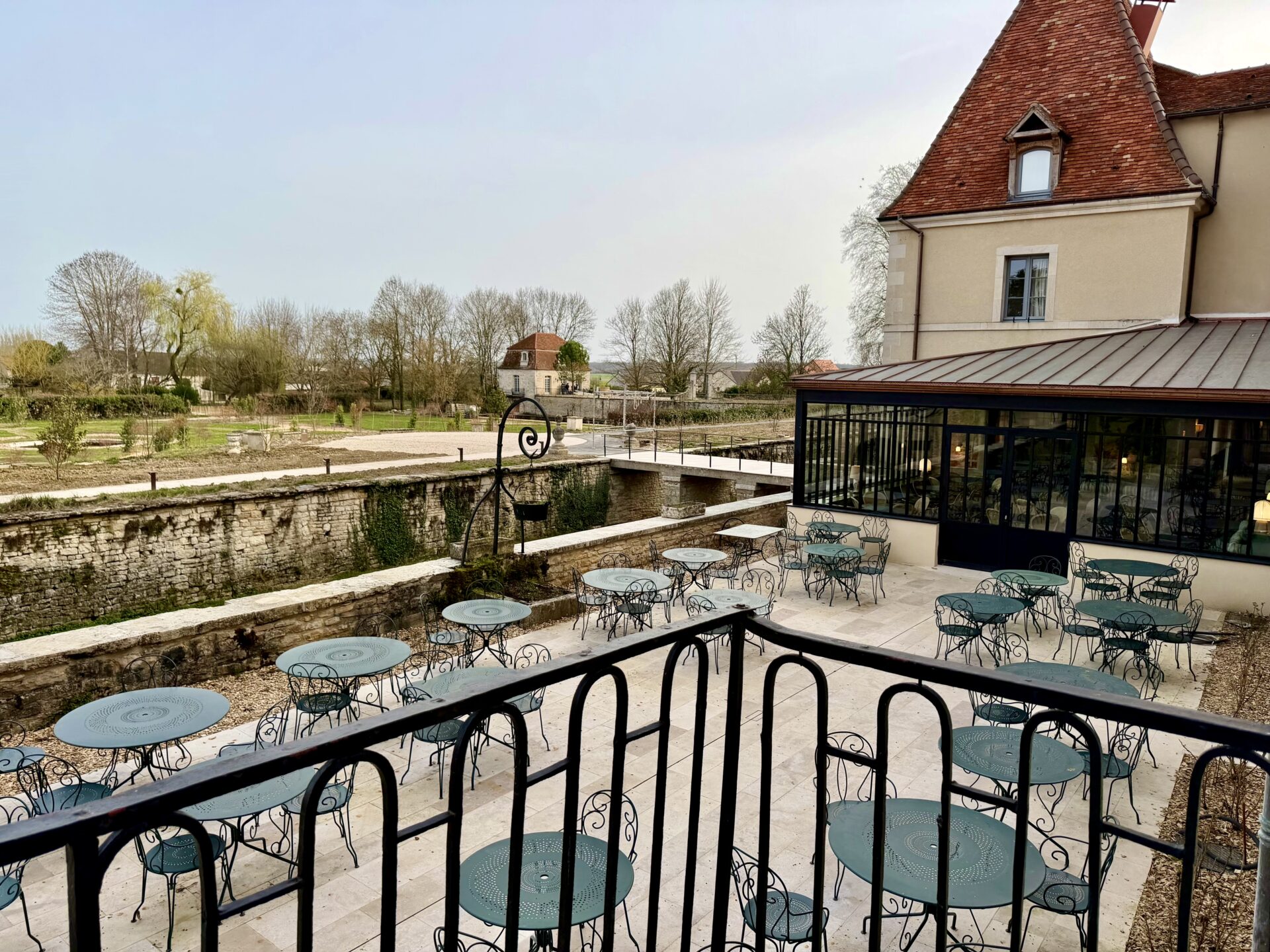
Across the courtyard, the two restaurants are overseen by Burgundian Chef Julien Martin, who honed his expertise at both Les Sources de Caudalie and Les Sources de Cheverny: The fine-dining ‘gastronomique’ restaurant is Le Clos de la Tour and the more relaxed brasserie L’Auberge des Cîteaux. The Brasserie was buzzing when we were there, lots of curious locals coming to discover the new offering alongside hotel guests. There’s clearly a lot of local goodwill. With open kitchens and floor-to-ceiling windows it overlooks a terrace in the courtyard for warmer days. Between the two, Le Comptoir offers another option for a glass of wine before lunch or dinner. The remarkable local wine list, includes an excellent selection of wines by the glass.
l’Auberge des Citeaux
Breakfast is served in the sun-drenched, east-facing glass Orangery overlooking the formal gardens. From here you can walk across another stone bridge over the moat to discover the formal gardens at the back of the property.
View across the gardens and the Orangery
Grounds for discovery
The setting is idyllic, the Vouge River runs alongside the château, bubbling over weirs and past the charming old mill (now a private suite). It makes for a lovely walk. They were still putting finishing touches to the property when I was there. I’m sure the wet winter hasn’t helped the garden project, but it will be spectacular. Flanked by ancient stone basins there’s a pool and tennis court tucked away behind a high hedge at the bottom of the grounds. Nearby ‘Le Pavillon des Jours’ has several bedrooms acting as a private residence in the elegant park.
Bicycles were being delivered as I left. I can see guests enjoying the region ‘à bicyclette’
Wine and wellness
The original vaulted wine cellar, previously the restaurant, is now home to the Caudalie spa. Twin pools between stone columns offer the option to swim lengths or enjoy the massaging water jets as you gaze up at the impressive, vaulted ceilings.
The impressive Caudalie Spa
Upstairs, a warm, wood-panelled relaxation salon leads to treatment rooms that dispense the signature grape based and polyphenols infused treatments.
The service was excellent, the staff are terrific, keen to share their local knowledge and all clearly thrilled to be part of this new adventure.
Next ?
Hardly finished with this project, the Tourbiers are already embarking on the renovation of their next property – Le Château d’Isenbourg near Colmar in the wine region of Alsace.
If you want to test drive The Sources de Vougeot, now is the time; there’s a special opening offer until the end of April. For more information – www.sources-vougeot.com Tel + 33 (0)3 80 23 22 22 reservations@sources-vougeot.com
Thanks for reading, if you find this useful and think other wine lovers would too, please share especially with anyone planning a trippy to Burgundy. Sign up here to receive future posts directly to your inbox. For more about Bordeaux read the new Green Edition of Bordeaux Bootcamp, and explore Wine and Wellness, with The Drinking Woman’s Diet or just say hi here.
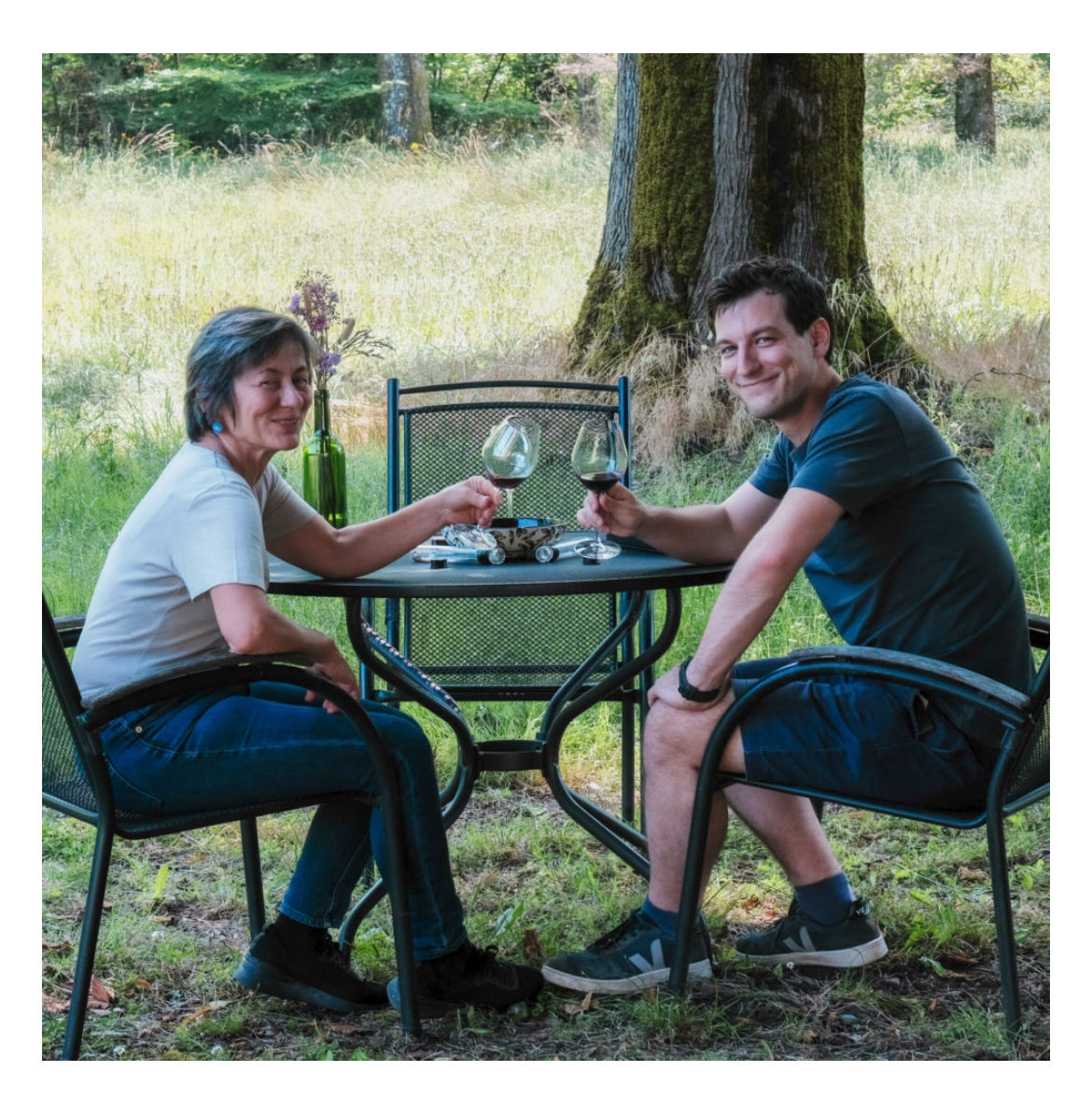
You’ll know by now I champion the many dynamic women in Bordeaux, and a few familiar names pop up regularly. One of them is Marie-Laure Lurton. Marie-Laure first appeared on the blog in 2019, when I was interviewing women in Bordeaux about their approach to wine and wellness for the launch of The Drinking Woman’s Diet. She’s a shining example, thanks to her passion for running, and it helps that she’s married to a doctor.
Marie-Laure is a member of the Lurton dynasty, a name you can’t escape in Bordeaux. She is one of 11 siblings, almost all of whom are in the Bordeaux wine business. An oenologist by training, today she owns and runs two Médoc chateaux: Château La Tour de Bessan in Margaux and Château de Villegeorge in Haut-Médoc. After graduating as an oenologist in 1984, she worked with her father, Lucien, and in 1986 with her brother Henri, now at Château Branne Cantenac before taking over sole responsibility of her own vineyards in 1992.
More recently I shared how Marie-Laure opened her tower in 2021, the ‘Tour’ that gives its name to her Margaux property. The tower was built in 1250, when Aquitaine was under English rule, and they built defences against the French along the Gironde Estuary. The tower is in Soussans, the most northerly village of the Margaux appellation. Abandoned for years the tower was bought by Lucien Lurton along with the vines in 1972.
In 2020, Marie-Laure renovated the tower, the rooftop terrace now offers views across the woods to the water – a place to discover the biodiversity in Margaux, something the appellation is keen to preserve with the ‘Margaux, Terroir de Biodiversité’ initiative. Renovation included the preservation of the natural environment surrounding it, one example of Marie-Laure’s commitment to sustainability. She obtained Terra Vitis sustainable agriculture certification in 2003 and, since 2017, both properties are certified HVE3.
Ancient history to ultra-modern
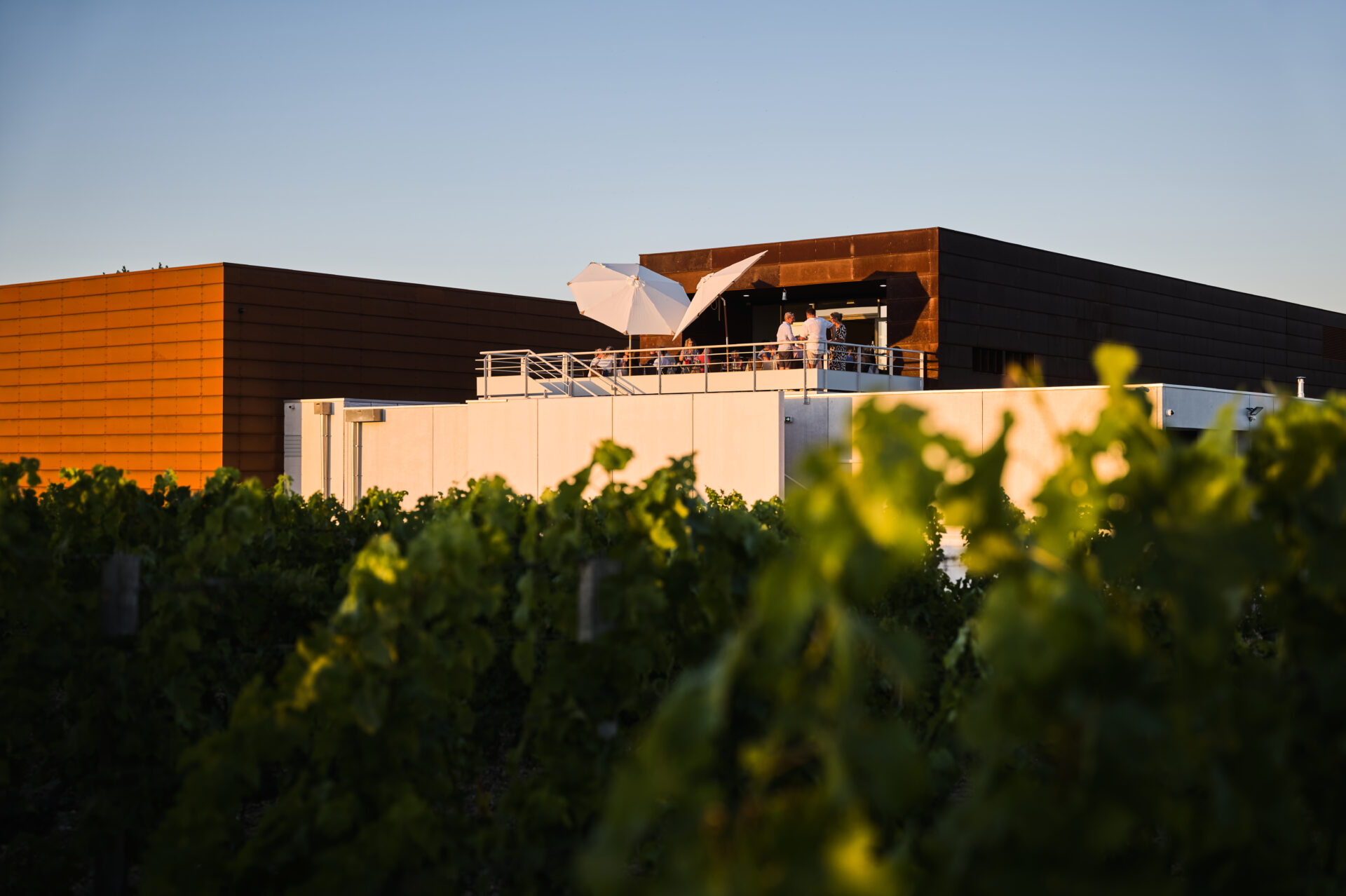
Marie-Laure’s initiatives aren’t limited to ancient buildings. When she took over the two properties, Château La Tour de Bessan didn’t have an independent wine making facility. In 1999, to remedy this, she worked with architect Vincent Defos de Rau to transform a disused 1934 telecommunications building. Together they created a striking metallic structure that contrasts brilliantly with the more traditional chateaux of the appellation.
By 2022, Marie-Laure was thinking about renovation again, always looking to improve wine quality while embracing more efficient wine making techniques, improving working conditions for the team and making more sustainable use of water and electricity.
They moved into this new cellar for the 2024 harvest, after ten months of working closely with local companies and craftsmen, once again under the supervision of Vincent Defos du Rau (his last project before retiring).
Doubling the foot print of the cellar, the 16 stainless steel and 34 cement tanks are easier, safer and more efficient to work with, also allowing more precise, plot-by-plot vinification. Air pulse replaces pumps for a more delicate extraction, while using less manpower and electricity. The stainless steel vats have a polished mirror finish that saves water during cleaning and a clean, efficient sampling system – the devil is in the detail.
Stainless steel and concrete under daylight
Always sustainability aware, materials were salvaged from the previous cellars and a long sky-light brings natural light into the cellar. The new building blends perfectly with the original, thanks to the metallic facades designed to gently rust, giving an industrial chic feel. I’m thrilled she kept the stunning electric blue of the original cellars too.
The stunning original blue signature
A taste of place
Despite the ultra-modern appearance of the new cellar, the property is deeply imbedded in the history of the appellation and in the typicity of the Margaux style. The 36ha are spread across three different ‘communes’, or villages, of the Margaux appellation: Soussans, Arsac,- and Cantenac, adding complexity and diversity through deep gravel and clay ‘terroir’, with grape varieties and rootstock adapted to each plot. Planting is dominated by Merlot at almost 60%, alongside Cabernet Sauvignon and a small plot of Petit Verdot planted in 2012.
Open doors
The new cellars opened to visitors just before the harvest in August 2024. The property has always been open to visitors, they were among the first to introduce wine and chocolate pairings, working with local Mademoiselle Margaux. Marie-Laure also introduced blending workshops and worked with neighbouring women-led properties Château Prieuré-Lichine, Château Kirwan and Château Rauzan-Gassies to create Une Journée Gourmande à Margaux back in 2012.
The renovation offers a new opportunity to welcome guests. The platform, previously the first floor of the old vat room, is now an elegant reception room running from front to back of the winery, with beautiful oak floors and a terrace offering stunning views across the vines. The space hosts ‘after-work’ drinks throughout the summer, regular art exhibitions, private functions and even a Christmas market
Oak floored reception room high obve the cellars
You can visit without an appointment from 10am until 5pm, Monday to Friday, to discover the new cellars, taste not only the wines of Château La Tour de Bessan, but also those of her Haut-Médoc property, Château de Villegeorge.
The terrace, perfect for late afternoon drinks
Keeping it in the family
Just as Marie-Laure Lurton learnt from working with her father, Lucien, she now works with her son Gabriel, who helps manage the team. They must be doing something right as their cellar master, Jean-Luc Brégille, has been with them since 2000.
Château la Tour de Bessan is a wonderful example of how Bordeaux blends the old and the new, and Marie-Laure is living proof of how a traditional family can, and does, innovate within a very traditional appellation. I highly recommend discovering the new cellars on your next Bordeaux visit. Prepare to be surprised
My little black book
As some names do pop up on the blog, I’m curating a ‘A Little Black Book’: a directory of some of my favourite winemakers, wineries, wines and places to visit, stay and dine.
I hope this will save you scrolling through blog posts looking for that thing/wine/place/person you vaguely remember reading about. I’ll also reference the relevant blog posts to understand why they merit a mention. If you haven’t signed up for the blog yet, please do and I’ll let you know when it’s published.
If you think I should broaden my reach, or if there’s somewhere you think I should visit, a wine I really should taste, or something I should do a deeper dive into, do let me know. Bordeaux is constantly offering opportunities for new discoveries – I’d hate to miss anything!
In the meantime, please this share with friends keen to learn more about what’s new in Bordeaux.
A week in Bordeaux with global wine tourism leaders was the most uplifting time I’ve spent with wine industry professionals for a while. Despite current pressures on the industry, the atmosphere was optimistic, with a joint sense of purpose around positive actions wineries can take. Good to know that despite the current morose climate, wine is not a lost cause.
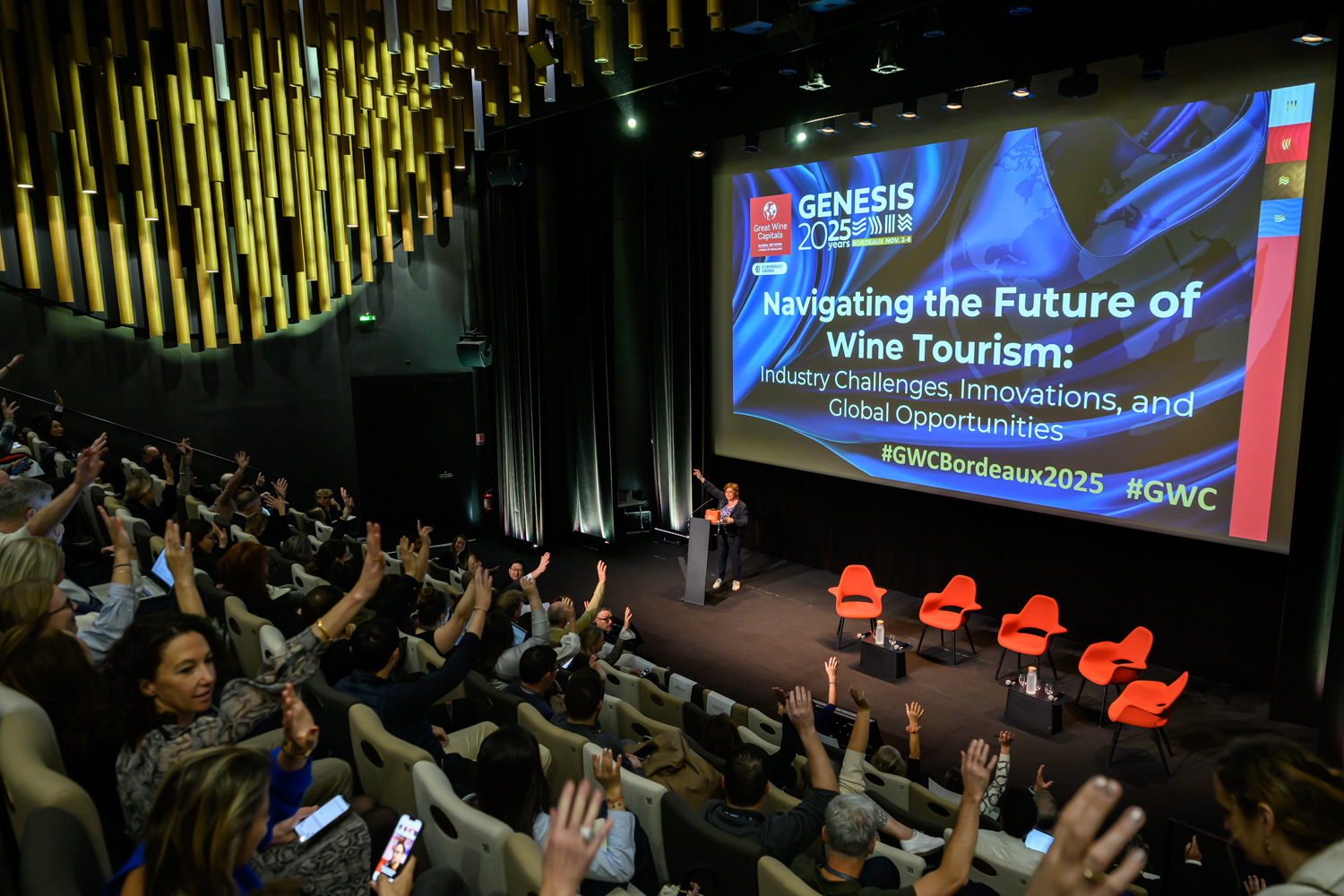
Bordeaux was the venue for the 25th-anniversary celebrations of Great Wine Capitals (GWC).The initiative started here at the Bordeaux Chamber of Commerce, with The Best Of Wine Tourism competition launched to highlight and reward wine tourism initiatives. Today, the network includes 11 wine cities worldwide: Adelaide South Australia, Bilbao/Rioja Spain, Hawkes Bay New Zealand, Lausanne Switzerland, Mayence/Rheinhessen Germany, Mendoza Argentina, Porto Portugal, San Francisco/Napa Valley USA, Valparaiso/Casablanca Valley Chile and Verona Italy.
All together
The week brought together wineries and tourism professionals from these regions to share initiatives and experiences. Technical visits across Bordeaux from the Médoc to Sauternes and Saint-Émilion, showcased different approaches, with dinners and lunches in properties, a tasting of wine from the 11 member regions in the stunning Bassin des Lumières and a day of presentations and discussions in the amphitheater of la Cite du Vin.
From doom and gloom
Listening to the opening overview of the global wine industry by Rodolphe Lameyse, CEO ofVinexposium, was painful. His data showed global wine sales slumping dramatically compared to beer and spirits. Stocks are still blocking pipelines, the high cost of money is leading to ‘just-in-time’ stock management, banks are withdrawing support and tariffs and other economic uncertainties are leading to delayed payments. So far, so depressingly familiar. He did highlight some areas of growth, white over red, corners of Asia and perhaps a slight uptick in parts of Europe. His conclusion that ‘the invisible hand of the market’ is reducing and reorientating production, leading to fewer producers and consolidation, was not great news for most of the audience.
To a ray of sunshine
Brigitte Bloch, President of Bordeaux Tourism and Congress and Vice-President of the Wine Tourism Centre at Atout France, raised spirits with a French and largely Bordeaux perspective. Tourism contributes between 3% and 8% to the French economy (depending on definition and measurement). Wine is a major attraction: one in two visitors associates wine with France (I’d love to know what the others had in mind) and one in three cited wine as a motivation to come visit.
France welcomes 12 million wine tourists a year, of whom almost half are international; and they spent 5.4 billion euros, of which 1.8 billion goes directly to wineries. It’s an important revenue for rural economies. Research (see below) shows wine tourism numbers are rising in Europe, although less so overseas, with google searches up 20% a year.
The future of wine tourism is bright
As well as congratulating and promoting the winners for the excellence of their wine tourism initiatives, the GWC finances education and collaborates in research. Dr. Gergely Szolnoki, Professor of Market Research at Geisenheim University, presented the first 2025 Global Wine Tourism Report, produced with UN Tourism, the OIV, the Great Wine Capitals Global Network, and WineTourism.com.
The data
Two-thirds of the wineries interviewed reported wine tourism was a profit centre, generating around 25% of total winery revenue (including on-site sales). Although the core audience remains 45–65 years, younger traveller numbers (25–44) are growing and they are focused on education, sustainability and gastronomy – all things that wineries do very well. This is an opportunity to reach a generation losing interest in wine.
Good times
Not every wine tourist is a wine expert – nor wants to be. 80% of winery visitors come as part of a holiday; they just want to have a good time with family and friends. But they are potential new wine consumers, and wine needs more of those. Cellar and/or vineyard tours and tastings are still the main offer, but this is no longer enough to seduce this population, who want authentic experiences, personal connection and culinary, eco-friendly and nature-based experiences.
If the price is right
A GWC research grant recipient, Magalie Dubois, Assistant Professor at the Burgundy School of Business in Dijon, used a “pay what you want” option in Bordeaux, Lausanne and Napa to discover just how much visitors are prepared to pay for these experiences. Her conclusions show most European wineries aren’t charging enough, with guests happily paying more than 15% above the fixed fee in Europe, although less than requested in Napa. She encouraged wineries to run their own pricing experiments to understand the real value of the experiences they offer.
Wine and Wellness
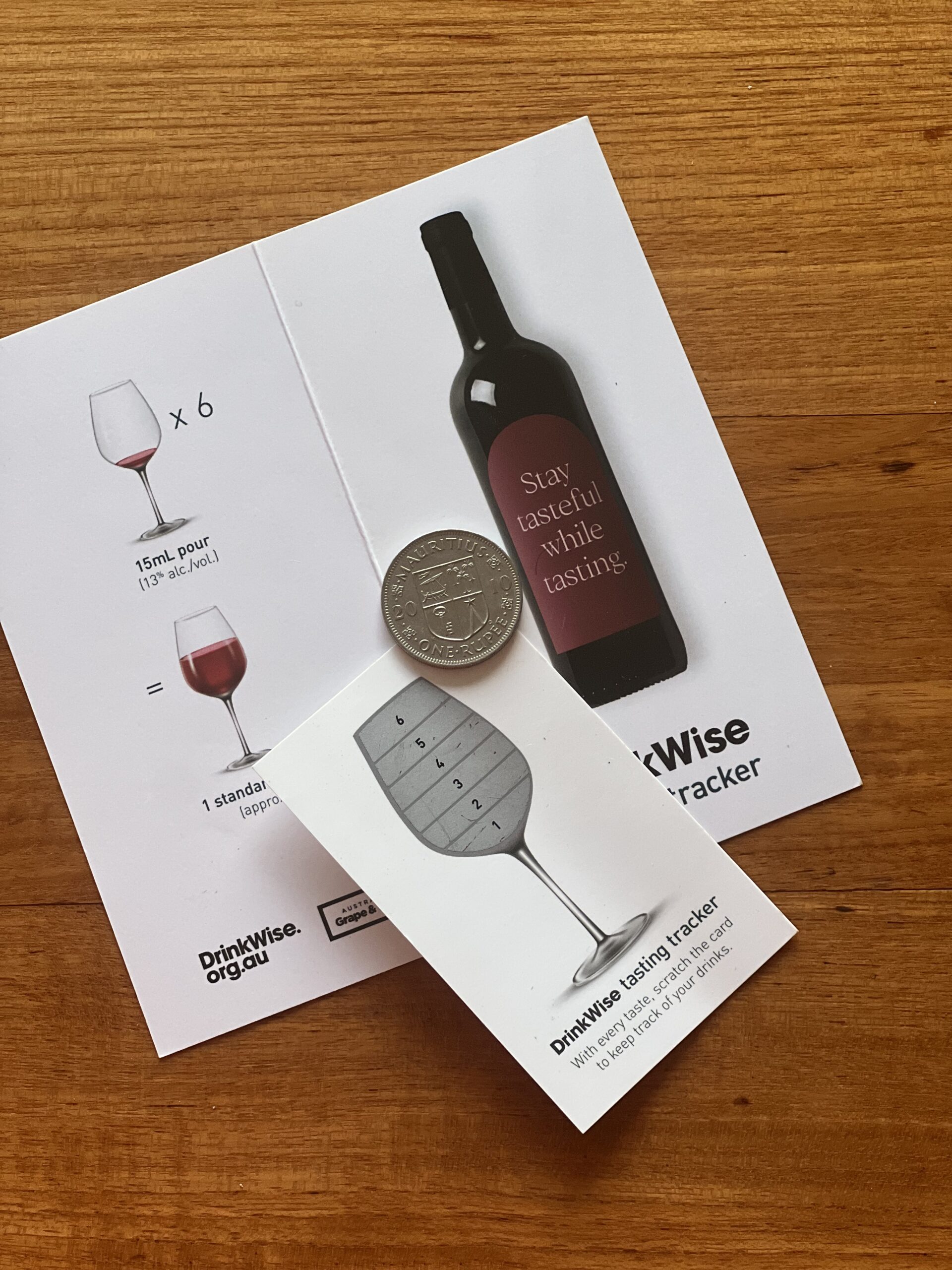
Felicity Carter, Founder of Drinks Insider, approached the thorny topic of wine consumption and health in her inimitable way. Questions around safe alcohol consumption and the growth of the wellness sector are contributing to declining alcohol consumption among all generations. She highlighted the challenges currently facing the image of alcohol, thanks to the temperance movement. Using the example of the brilliant scratch cards by Drink Wise Australia (see below) to illustrate how the industry can and should work together.
Panel experience.
Which bring me neatly to why I was there, I was moderating a panel of four innovators rising to these challenges. Simon Strahan, CEO of Drinkwise, joined Caroline Decoster from the La Maison Cardinale, Saint-Émilion Grand Cru Classé; Kim Thorpe, co-owner of Black Barn Vineyardsin Hawke’s Bay, New Zealand; and Paulo Medina, head of Grape Ideas, the tourism arm of Sogrape,the largest Portuguese wine company, home to such famous names as Sandeman and Mateus Rosé.
Their consensus was that wineries must join the “experience economy”: consumers want connection, not consumption. From his experienceat Saatchi and Saatchi, Thorpe was ruthless in his message that innovation is vital – adding on a picnic to a wine tour and tasting just won’t cut it. He shared how wine is no longer the unique priority of the wine tourism business at Black Barn: they define themselves as ‘experts at giving people a good time’, with 17 luxury lodges, and a full summer events season, attracting a different audience and encouraging longer stays.
Decoster also advocates an original approach, simplifying the often inaccessible language and experience of wine, through music, ‘les arts de la table’ and virtual reality, an initiative that won the Gold Best of Wine Tourism Award for 2026.
Tourism is becoming economically sustainable outside of wine sales. Medina explained as the B2C arm of the wine company, wine sales are not their prime motivation for Grape Ideas, the tourism activity is financially independent from product sales. The attraction is the combination of the past and future, from in their ancient cellars in Porto to self-guided biodiversity treks through their vineyards in the Douro.
The clever Drinkwise Scratch cards
Which brings us full circle to Strahan at Drink Wise, and Felicity’s warnings of neo-prohibition movement. Their whole-community approach includes government, industry, media, sports – in fact, anyone who contributes to the responsible consumption of alcohol. Embracing this healthier approach to drinking makes the wine industry more accessible to a broader and a younger audience.
Can wine tourism save the wine business?
Not alone, but it can help – it’s no longer a net marketing cost but can supplement revenue, creating closer bonds with customers, seducing new clients, reinforcing brand recognition and allowing winemakers to understand exactly what their consumers are looking for and how much they’re prepared to pay for it.
The outlook is good. Half of wineries interviewed in the research plan further investment; most anticipate growth and see wine tourism as a resilience tool. Despite what nay-sayers would have us believe, it appears people still love wine and the lifestyle. They want experiences, not just product, and are prepared to pay for them. The challenge for wine professionals is to create innovative and accessible – and give people a good time – which might be better value for everyone that we thought.
Go visit a vineyard!
The Best of Vineyards to visit: if you need inspiration for future trips, the winners of the Gold Best of Wine Tourism 2026 awards, one from each ‘Capital’, were announced on the last evening of the conference:
Thanks for reading, sign up here to receive future posts directly to your inbox and do share with anyone interested in discovering more about Bordeaux. Read the new Green Edition of Bordeaux Bootcamp, and explore Wine and Wellness, with The Drinking Woman’s Diet . I also share my healthy passion for Bordeaux (and more) in other wine publications and with online classes. Contact me here to learn more or just say hi.
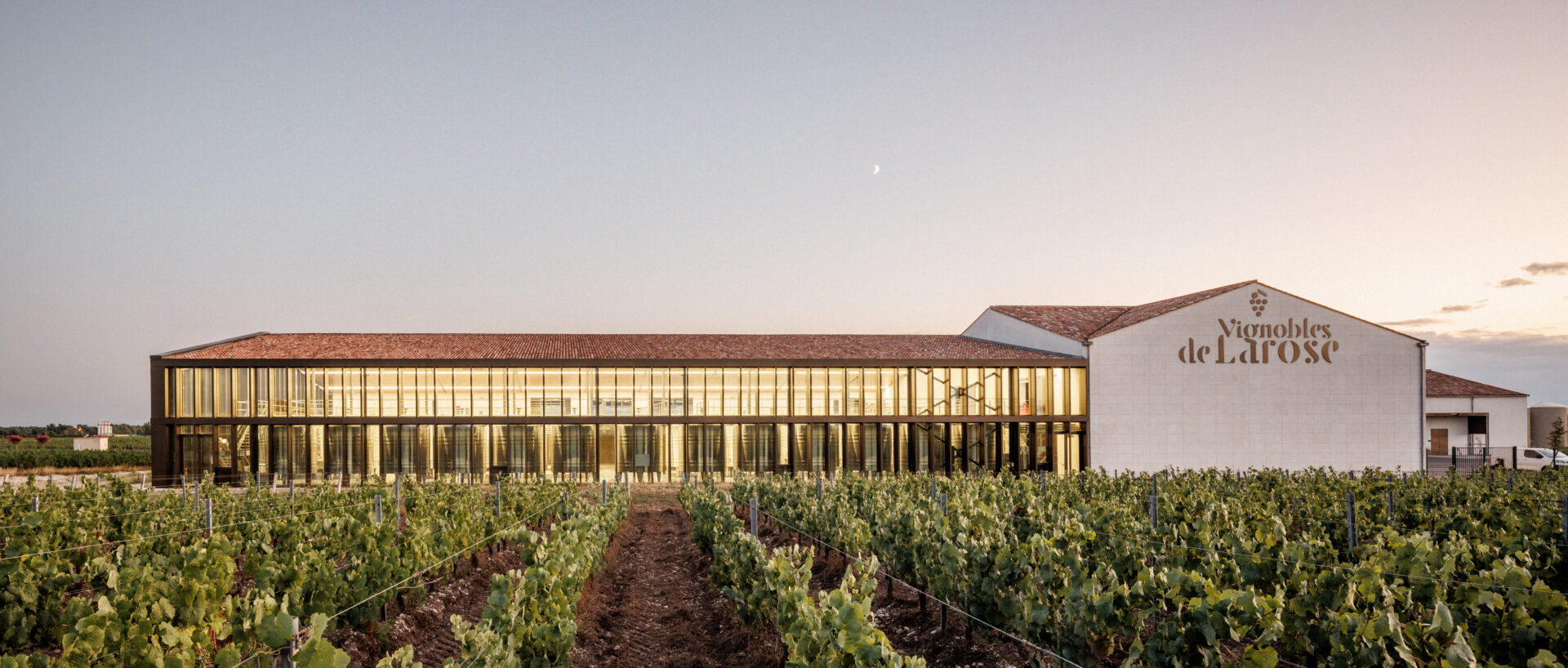
Five years and 25 million € of investment have transformed Les Vignobles de Larose. This huge property covers four chateaux, three production sites and 255 ha of vines across the Haut Médoc and Saint Estèphe totaling an average production of 1.2 Million bottles a year.
Value, volume and accessibility
Their wines have always been excellent value for money and, thanks to their size easy to find across many markets. They try to emphasis this ‘easy access’ in the style of wine they produce – pure, precise and fruity. Exactly what the market seems to be looking for right now. You’re very likely to find a bottle near you and I recommend looking out for one.
A pioneering lineage
This investment is the latest chapter in the history of a property that has embraced change and innovation since 18th century. Vines were planted at Domaine Perganson in 1719, a little later at Larose Trintaudon in Saint-Laurent-Médoc. More planting in the 1800s made this the largest vineyard in the Médoc, at the time when French and international retail markets were opening up. The Chateau was built under the ownership of Comte Ernest de Lahens, who also brough railways to the Médoc. It’s iconic tower is still visible today from miles around.
A history of firsts
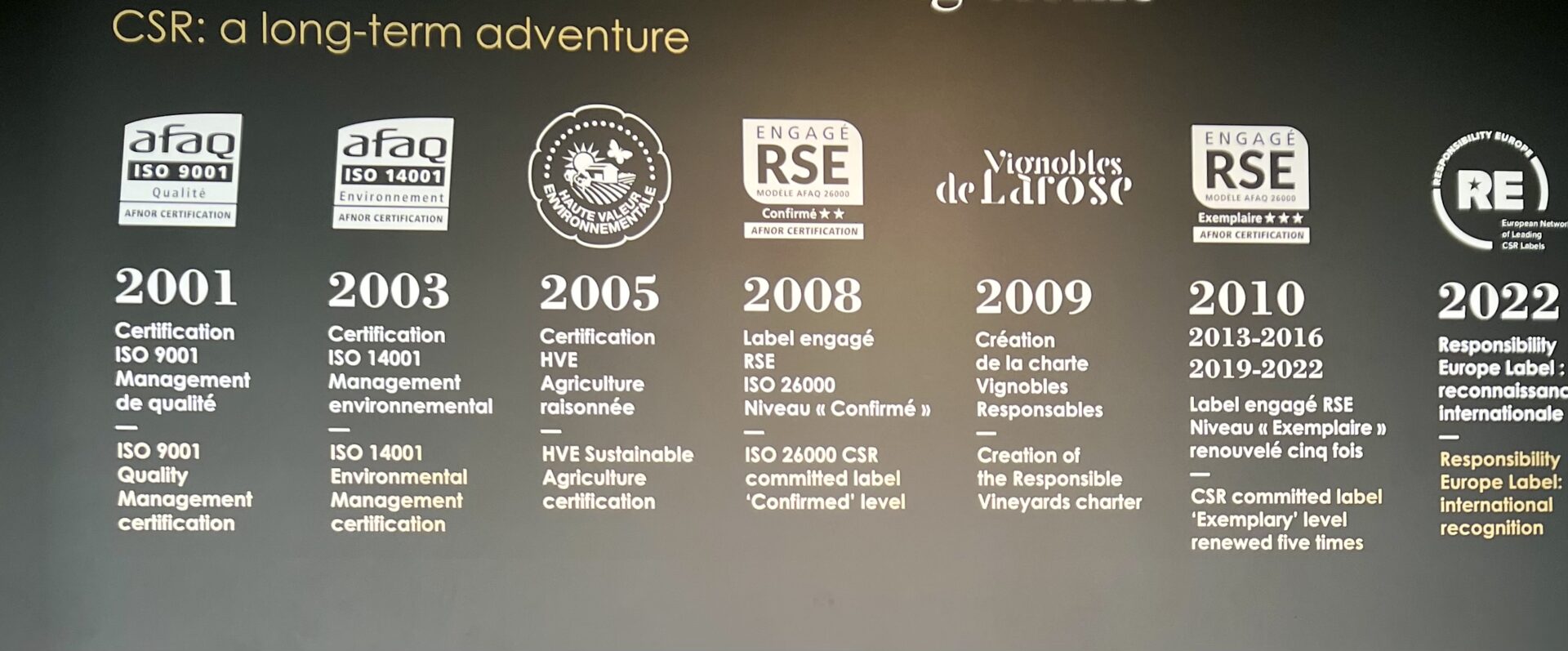
The property is also a pioneer of certification, unsurprising perhaps as the current owners are the Allianz insurance Group, who bought the property in 1986. They believe third-party certification mitigates risk and is objective proof of their commitment to quality, the environment and social responsibility.
They are pioneers, Larose was the very first vineyard to obtain ISO 9001 certification in 1999 and by 2003, the first French vineyard to obtain both ISO 9001 & 14001. In 2008, they were effectively guinea pigs for the AFNOR certification Engaged CSR (Corporate, Social Responsibility) – the first European vineyard and first Aquitaine company to qualify. By 2022, they were rated as ‘exemplary’ by AFNOR for the fifth time – a first for a European vineyard in the history of the certification. They will be reassessed for the sixth time at the end of this November.
Sharing their commitment to certifications with visitors
Aligned with the vision of the United Nations Sustainable Development Goals in 2007, they created the brand ‘Vignobles Responsibles’ (Sustainable Vineyards). They wanted a definition of sustainability that embraced production, employment and business. A property can’t be sustainable if it’s not making money. Something ringing very true in Bordeaux right now.
Global Sustainability
No weed killers or synthetic pesticides are used in the vines and 36% of the estate is dedicated to the preservation of flora and fauna. In 2022,working with Bordeaux start up Net Carbonthey were the first vineyard to measure their carbon captureusing infra-red and satellite images, right down to the calculating the contribution of each hedgerow planted for wild life.
Inside sustainability
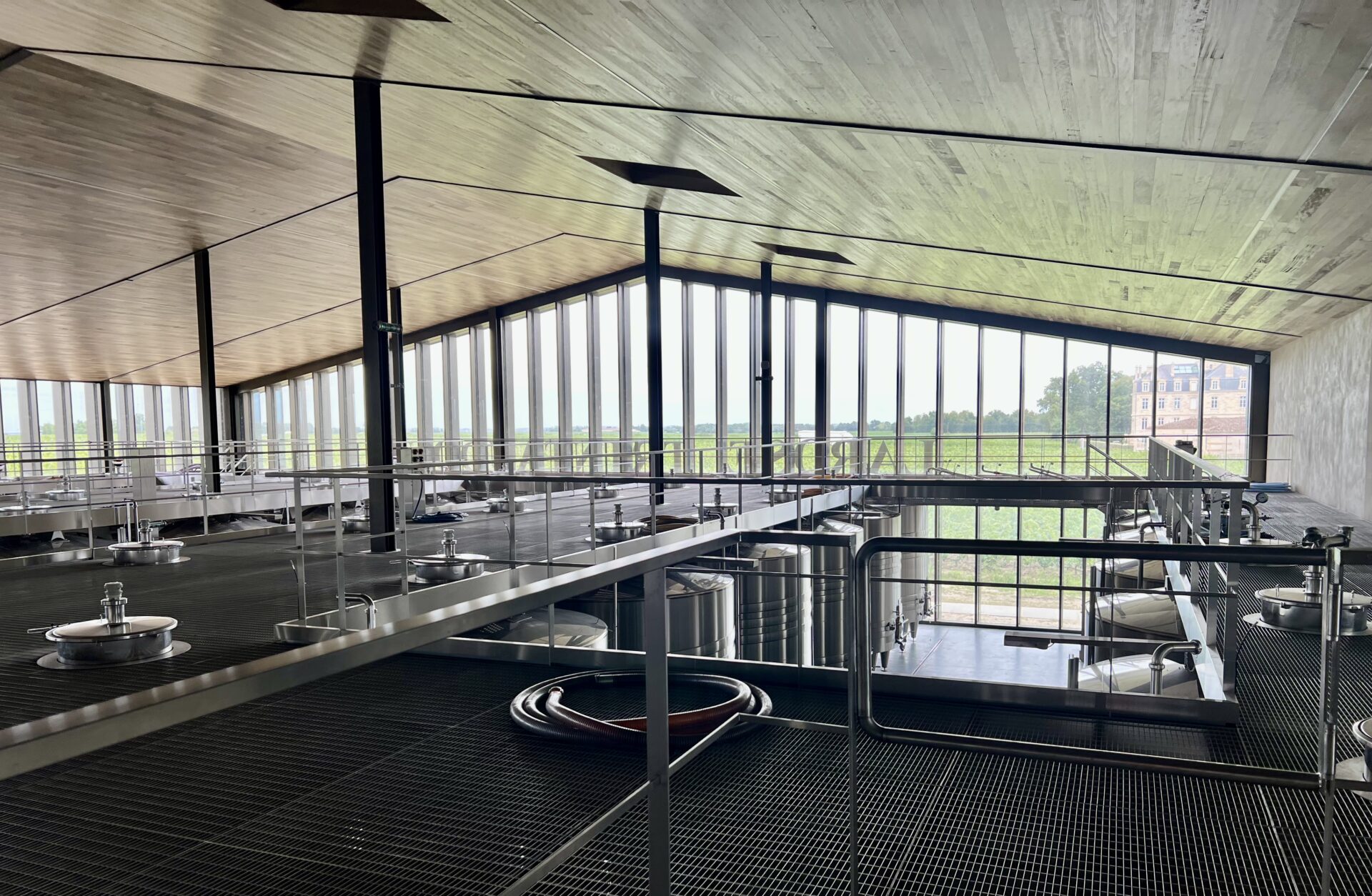
The new cellar project was an opportunity to bring this sustainability philosophy inside, optimising electricity and water consumption. Innovative building materials increased insulation capacity 25 times compared to classic breeze blocks, large bay windows maximize natural light, (and the view for workers – it’s very cool) and 1850 m2 of solar panels now supply 60% to 70% of electricity consumption during harvest, and 100% the rest of the year.
Safe working platforms and a cellar with a view
A 200 m2 water treatment plant provides recycled water for cleaning of agricultural machinery (they have the largest tractor garage of the region), reducing water waste to half of current standards. Green spaces have been redesigned, reducing lawns, favouring flowering shrubs to encourage bees to visit their beehives. Abandoning automatic sprinklers in the summer has reduced water consumption by half.
Two cellars, two chateaux
Delivered in 2023, there are two dedicated vat cellars in the new build, one for Château Larose-Trintaudon, the other for Château Larose Perganson.The new vats are less than half the size of the old, reducing plot size at Larose-Trintaudon from 7 to 2.5-hectares across the 190 hectares of vineyard and down to 1.7-hectare from 5 hectares for all 20ha of Larose Perganson.
The new cellar of château Larose Perganson with a view of Château Larose-Trintaudon
Upcycle
Nothing is wasted, the older, larger vats are now used for blending. Even the glazed paper support from self-adhesive wine labels is collected and recycled for insulation – another first.
Taking the temperature
Adapting to climate change means managing rising temperatures, they can now chill all 190 hectares of harvest, by more than 10°C between sorting and vatting, even when grapes come in at around 30°C. No more night harvesting for workers, their signature freshness is preserved, and sulphur use reduced to 65 mg /litre – less than biodynamic certification. CO2 recovery during vinification and their own nitrogen production protects the fruit, and two large (of course), air-conditioned barrel cellars help microbial stability during ageing.
Future forward
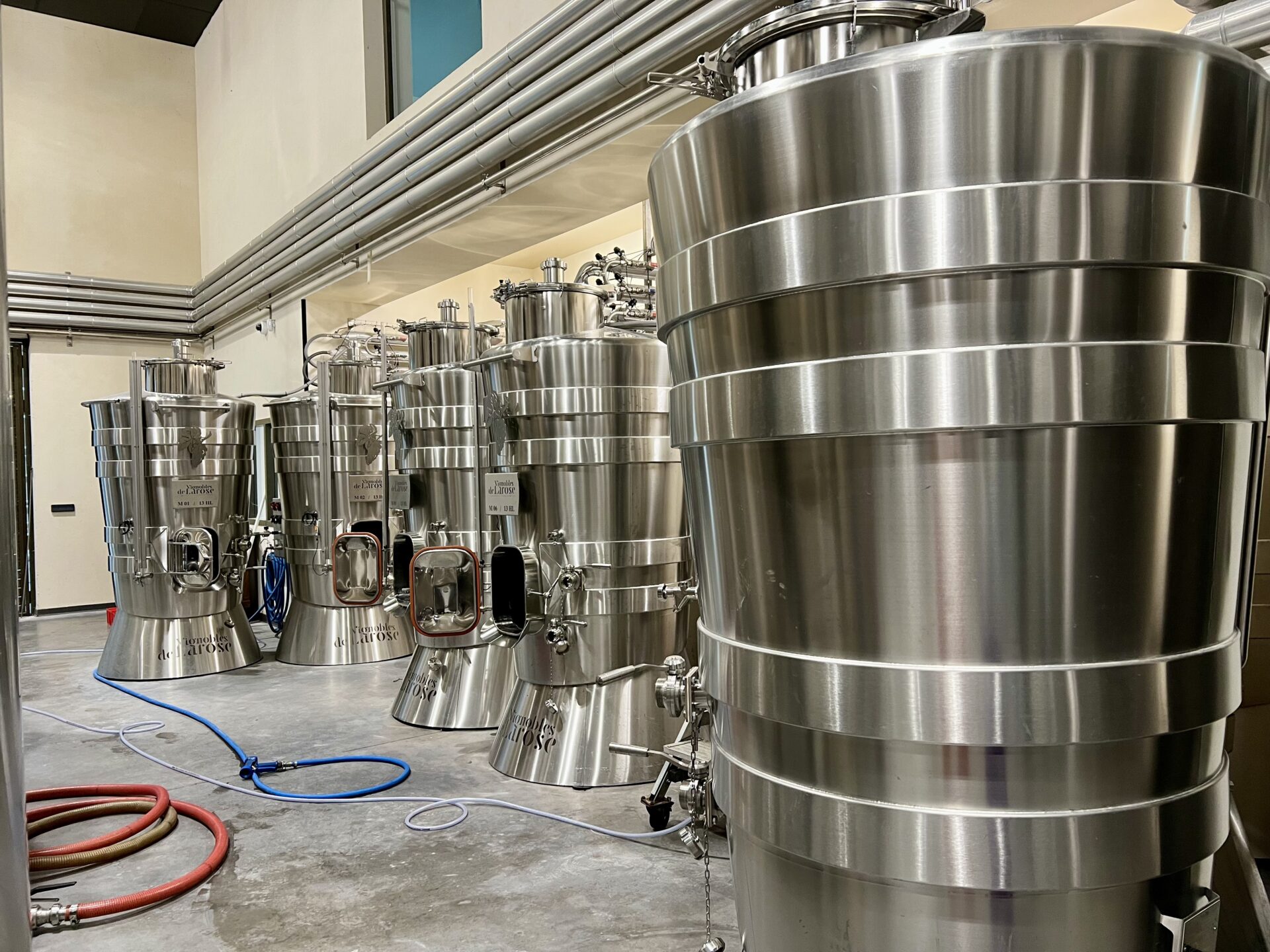
A smallvat house with ten temperature controlled 13-hectolitre ‘cute cuves’ is devoted to experimental micro vinifications. They have also introduced new grape varieties. 2025 is the first vintage of their whiteChardonnay, Semillon, Viognier blend, all grafted onto Merlot rootstock. It will be released next year as a Vin de France as these varieties chosen with rising temperature in mind don’t all fit into the new White Médoc appellation. The in-house bottling line is sound insulated and wine is shipped in lighter 410g glass bottles sealed with technical corks.
The experimental cellar with those ‘cute cuves’
People and place
The cellar was designed by for the technical team, and you can tell they are proud of the new cellars. As well as having fun with innovation, ease of production and safety were a priority. Walkways are replaced by work platforms, water and power sub meters through the vat rooms mean no lugging and pulling pipes and tubes as well as gaging consumption, CO2 detectors and automatic ventilation all enhance safety.
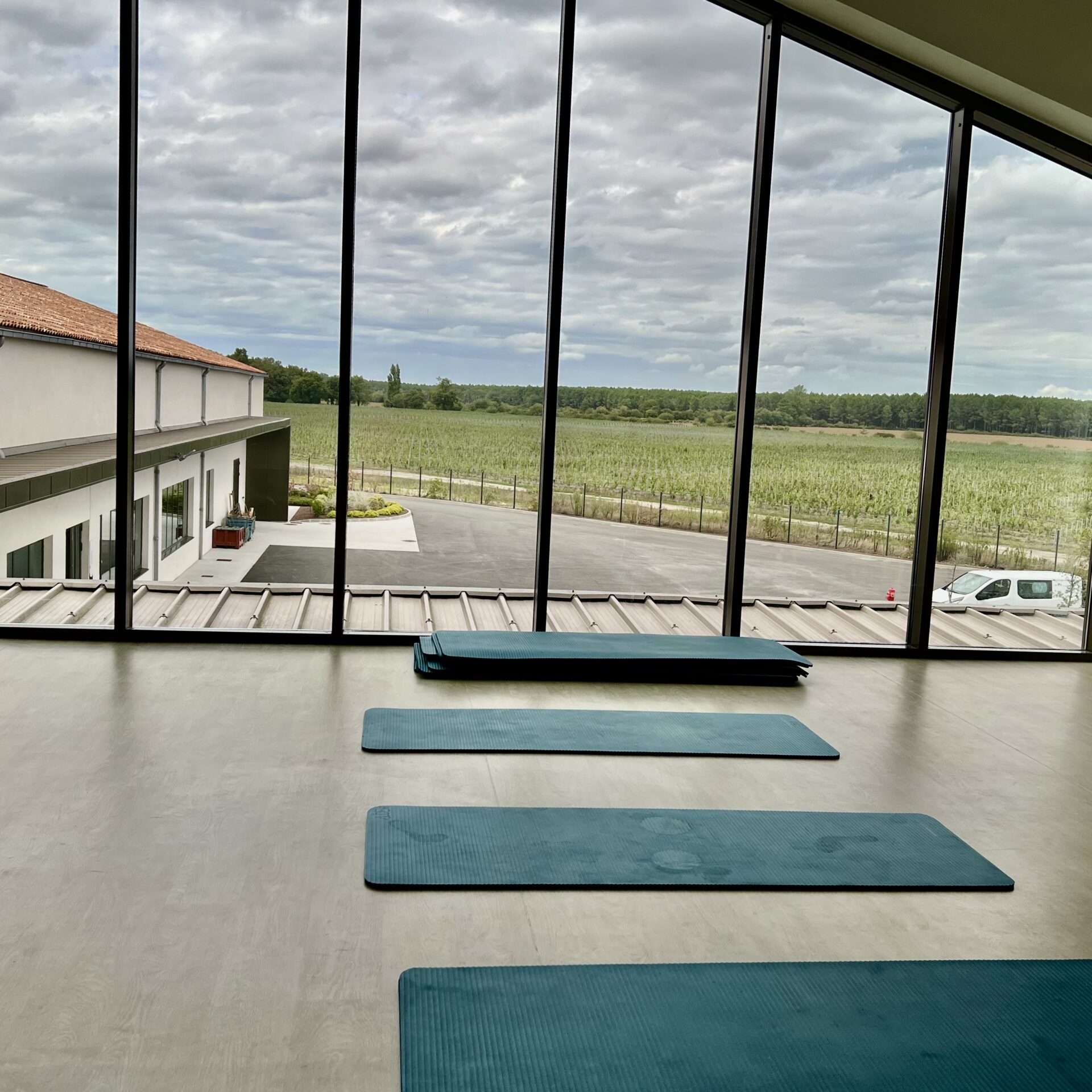
There’s a staff sports and leisure room where a personal trainer offers bi-weekly classes keeping workers in shape. Wine making is physical work both in the field and the cellar. It‘s also an opportunity to create and reinforce community, although there’s a staff room for meals and more relaxed breaks and electric charging stations for staff cars.
Ready for a workout
Ongoing training
Training isn’t limited to physical fitness, there’s on-going professional training, leading to professional certifications. 100% of the vine workers have the ‘Diplôme Universitaire de Taille et d’Épamprage (university pruning qualification). The scheme is so successful their staff often get poached.
Size matters
They take their situation as the largest local vineyard seriously, very aware of their role as an economic actor of the Médoc. Aiming to grow in and with the region, over 75% of all purchases are made locally, and a partnership with the social inclusion agency Ares Coop has already led to five permanent jobs
Visitor Transformation
The chateau seized the opportunity of the new build to re think the visitor experience. Opened mid 2025, the wine tourism centre is open all year round, including Saturdays in the high season. It is open to all thanks to Tourism Handicap Label (yet another certification)
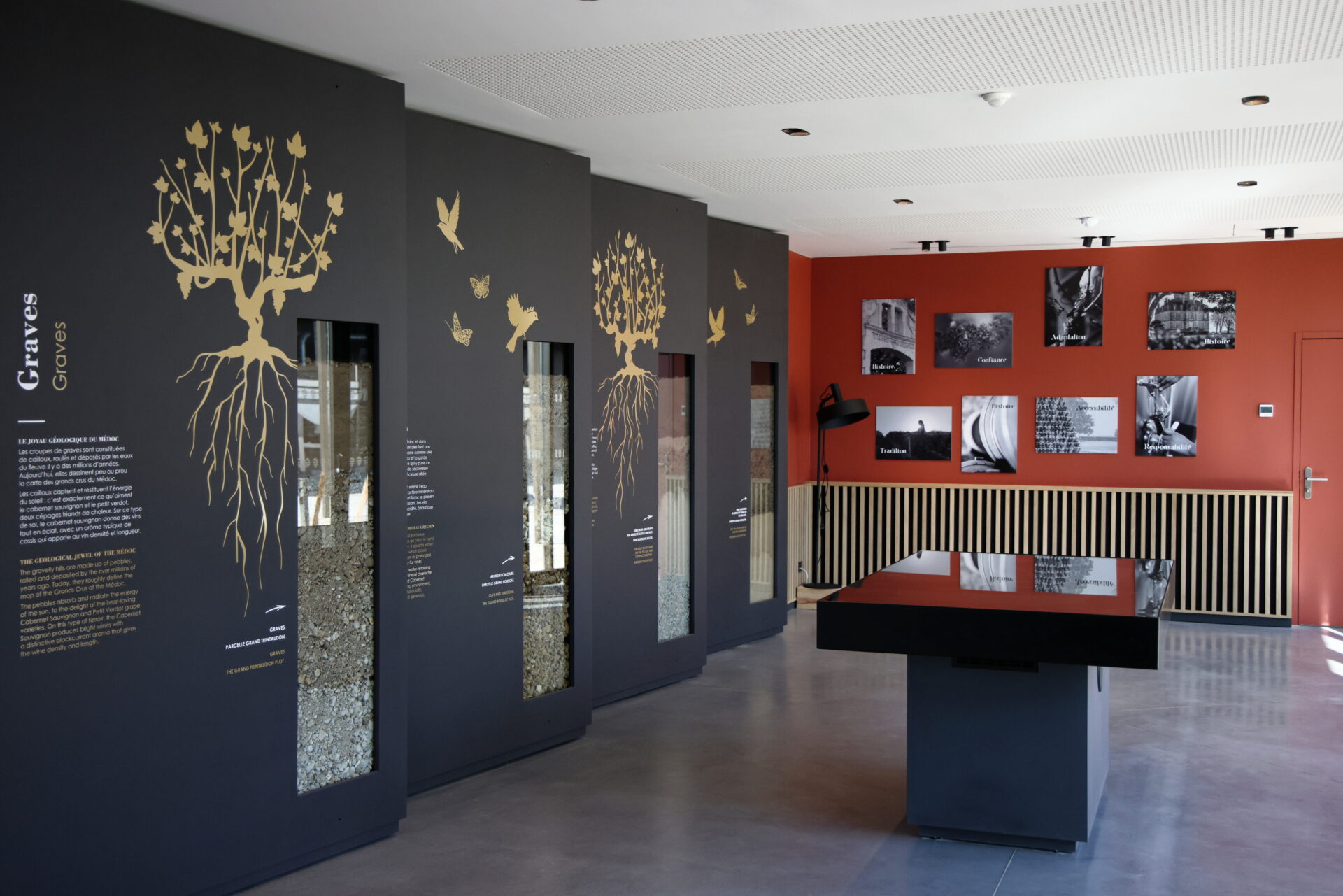
Aware that not everyone wants a full-blown wine tour, they encourage people to pop in for a self-guided immersive experience, no appointment needed. It’s accessible to all regardless of their level of wine knowledge and time constraints. It allows guests to visit at their own pace, short or long, depending upon their level of interest. They discover the history, seasons and terroir of the property thanks to clever scenography and videos before enjoying a tasting. In July and August visitors can also enjoy a bite to eat on the terrace or inside, all without an appointment.
The interactive visit open all year rond for drop ins Cr @11h45 Florent Michel
For enthusiasts who do want to dive deeper they cellars tours are available by appointment. Also designed to be accessible to all, lifts to raised walkways allow guests access to the impressive new cellars and views across the vineyards, even during the busy harvest time. There’s an opportunity to taste wines from all four properties of the group. The wines from the range are available to consume on site or take away and there’s an IRL/online combo to pre-order.
This new initiative, that shares their history of sustainability led them to win this year’s Best of Wine Tourism Award for Sustainable Tourism at the Great Wine Capitals AGM in Bordeaux this November.
Forward thinking
Their broader vision of wine tourism includes being part of ENOTOUR, a European joint venture that offers online wine tourism training leading to certification (again!). They are the only French vineyard out of 18 partners across 4 countries, Spain, Italy, Portugal and France that brings together universities, vineyards, hotel schools and institutionals to raise the quality of wine tourism. Bordeaux partners are the ISVV (Université de Bordeaux), the Lycée de Gascogne and the CCI de Bordeaux (also at the origin of the Great Wine Capitals best of Wine tourism Awards).
View of Château Larose Trintaudon from the terrace above the vat cellar
This year they finished the renovation of the 18th century Larose-Trintaudon Chateau with eight bedrooms, reception rooms and that famous tower.
Big and beautiful
Vignobles Larose is theCSR market leader with the certifications to prove it. It reflects a desire to make their wines accessibility to as large a public as possible but also to share their sustainable responsibility. They want to prove that big can be beautiful in terms of wine quality and price point whilst still protecting the environment and the people who work in it.
Thanks for reading, please share with anyone interested in discovering more about Bordeaux. Sign up here to receive future posts directly to your inbox. Read the new Green Edition of Bordeaux Bootcamp, and explore Wine and Wellness, with The Drinking Woman’s Diet or just say hi here. I also share my healthy passion for Bordeaux (and more) in other wine publications and with online classes. Contact me here to learn more.
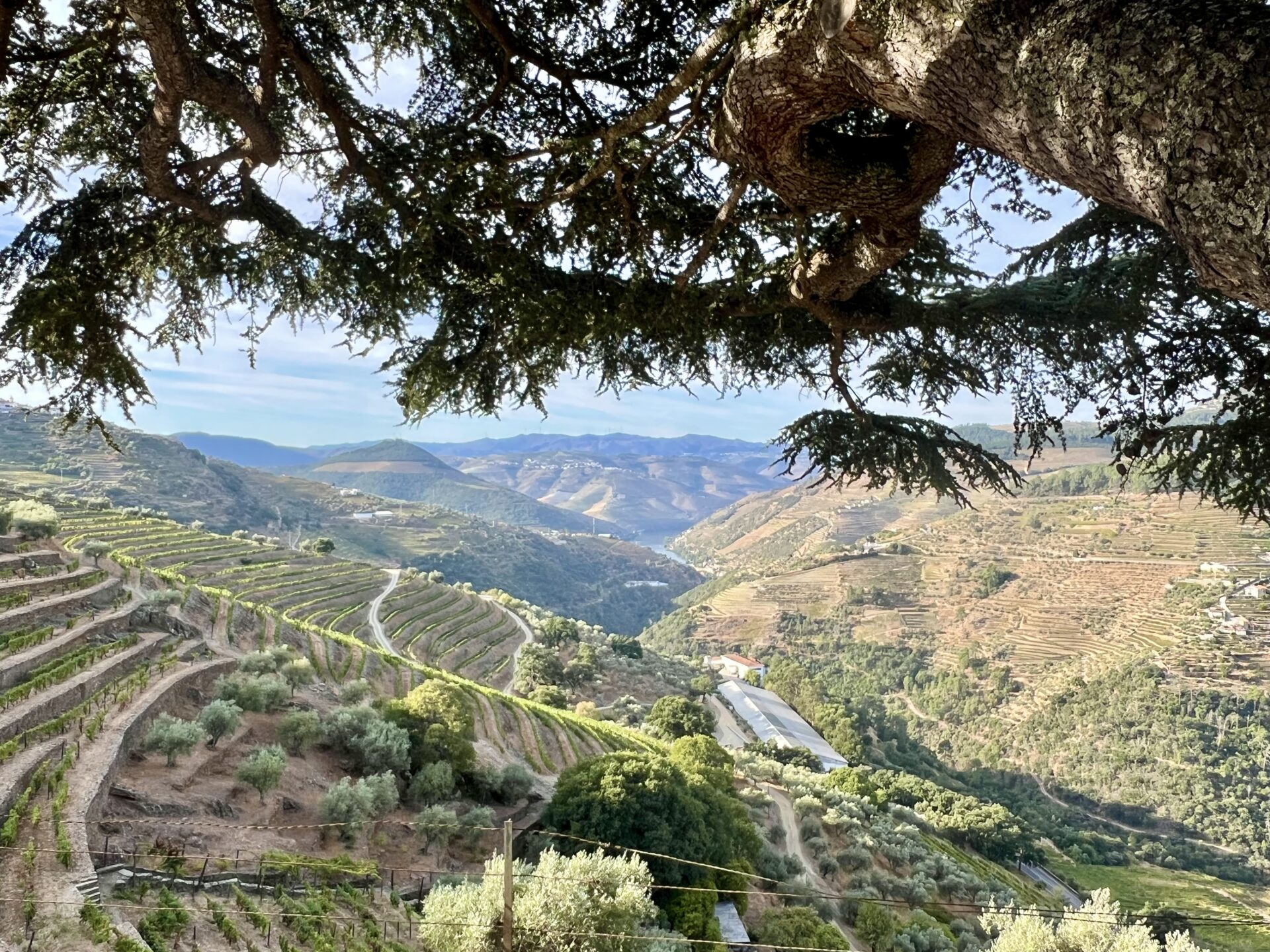
The Port vineyards are in the Douro, 80kms inland to the east of the city of Porto, They start on the eastern side of the Serra do Marao, the mountains that shield the vines from the Atlantic influence we felt so keenly in the city. The resulting hot and dry continental climate is a stunning contrast, it feels like a different country.
The further east, the hotter and dryer the vineyards become, with only altitude mitigating the high temperatures. We stayed near the Vale do Inferno – the name says it all.
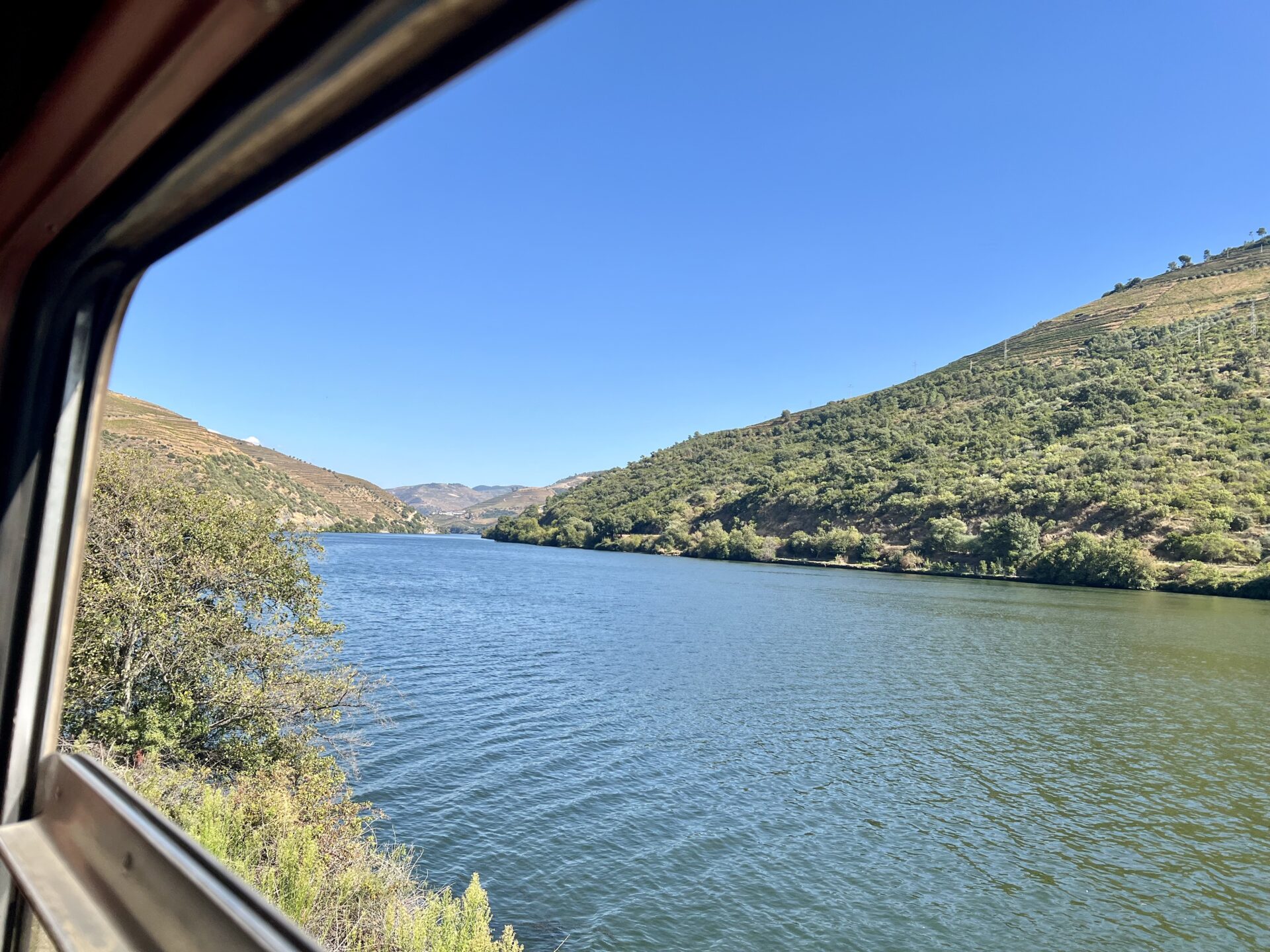
A noisy diesel train took us out of the city, it chugged up the hills, emerging from a tunnel into the sunshine of the eastern flanks of the Sierra do Marao. From here it runs along the right bank of the Douro all the way to Pocinho. You need your wits about you, there are few signs or announcements, but the locals are friendly and helpful, fortunately my intrepid travelling companion Nicola speaks Spanish, so we (or rather she) muddled through.
First view of The Douro from the train
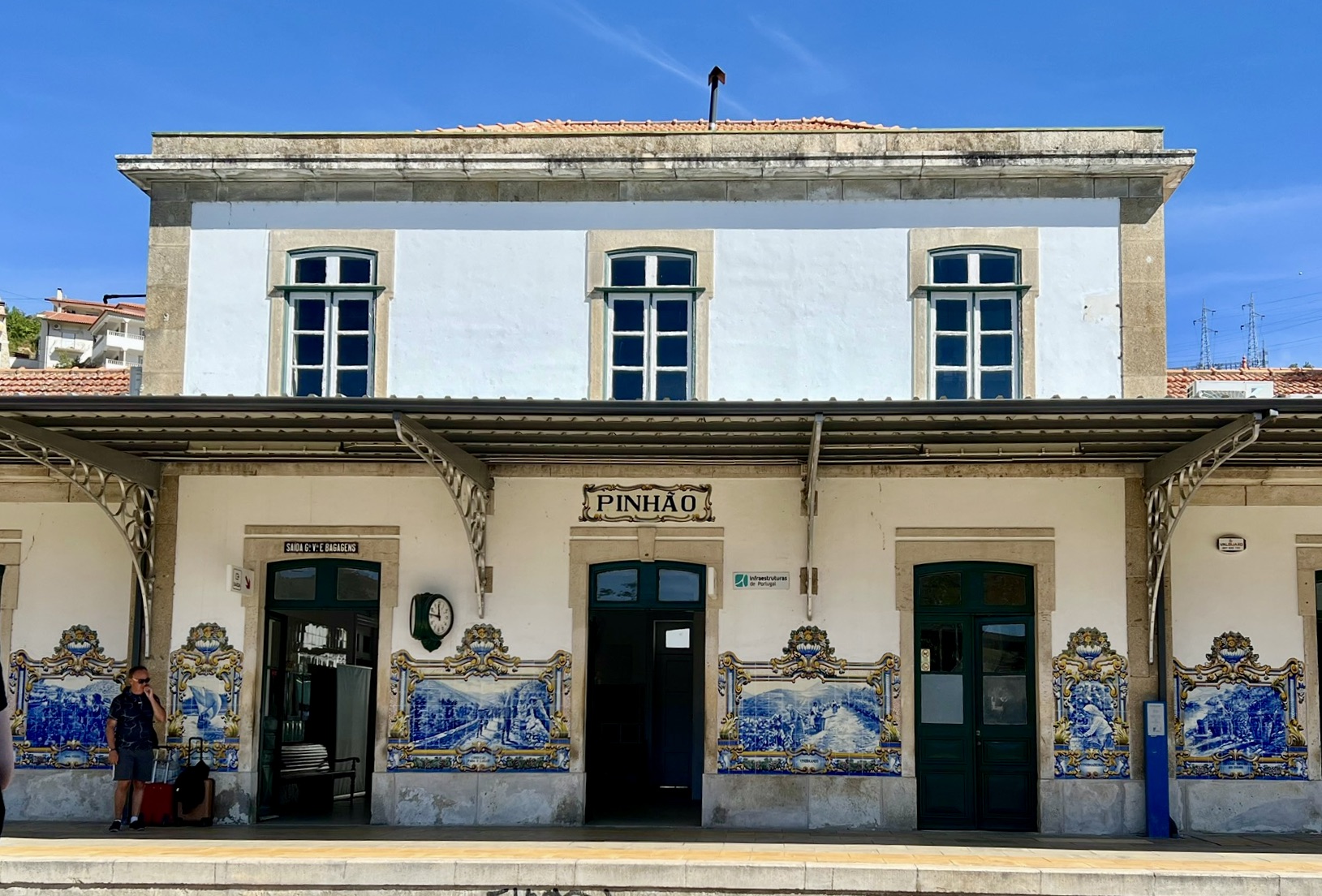
We stopped about two thirds of the way up, in the small town of Pinhao, where the Pinhao Valley runs into the Douro Valley. A region known for the excellence of its steep vineyards. The magic of ageing might happen in the cellars of the city, but the seduction of the natural environment is right here amongst the vines reaching high up above the Douro River.
The gorgeous station at Pinhao
Mountain viticulture and micro climates
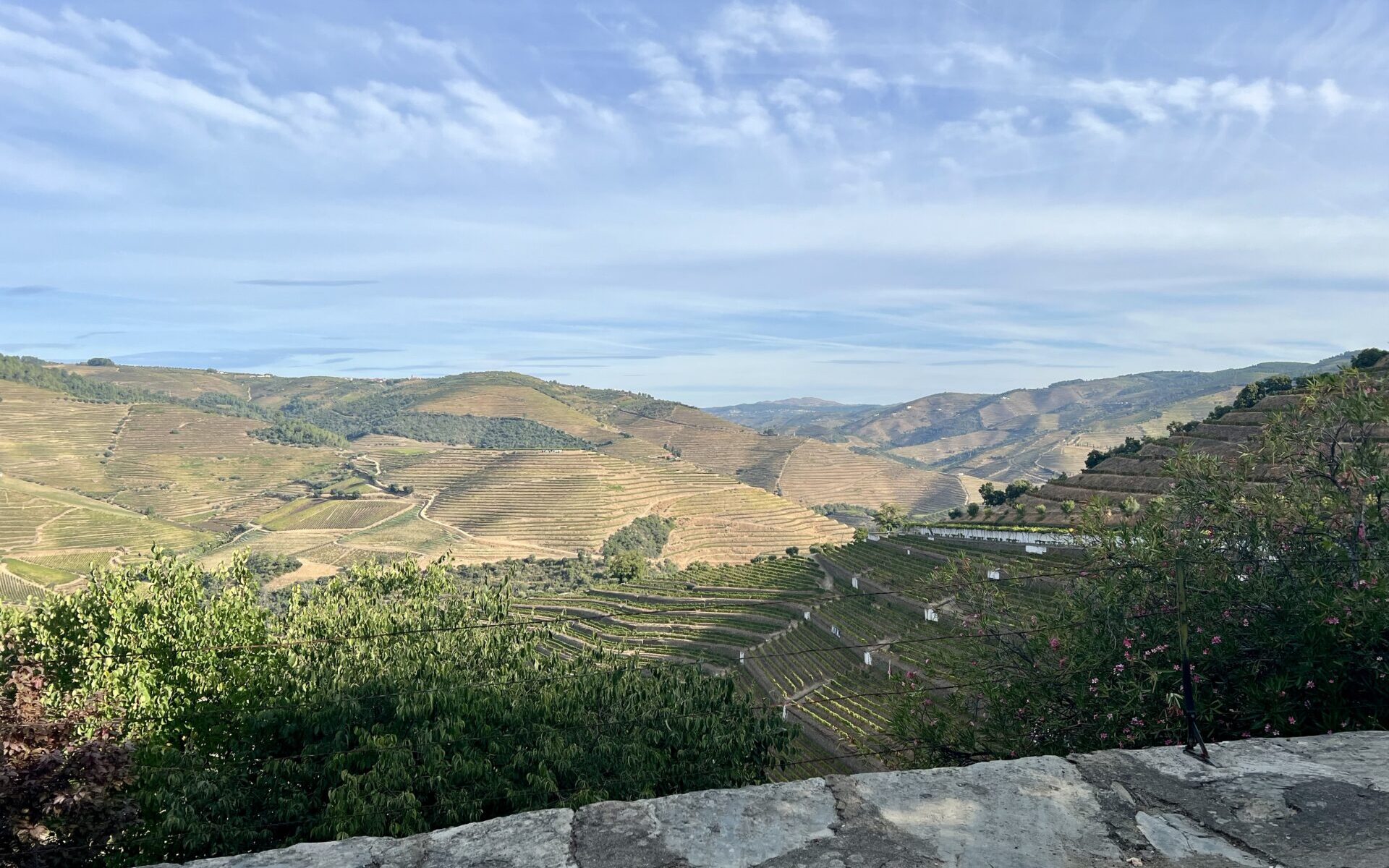
53% of the world’s mountain vineyard is right here in the Douro planted on these steep rocky hillsides with an incline of 30% or more, the very designation of mountain viticulture. Defined in 1756, the Douro is the oldest designated wine region in the world. Covering 24,600 ha it’s also the world’s largest region practicing hot climate, hillside viticulture on these steeply terraced slopes.
Wine has been made in the Douro valley for over two thousand years; a history of human intervention that has created this unique cultural landscape of narrow terraces, supported by hand-built dry stone walls. The Douro Valley was awarded UNESCO World Heritage Status in 2001, a tribute to the continuous work of vine growers here since the Romans.
Micro climates and climate change
As with many wine regions, climate change has brought more erratic weather, more storms. High rainfall has always presented a challenge on these steep slopes, leading to erosion and loss of the precious, thin topsoil.
Terroir
The narrow terraces, or ‘socalcos’ are built to reduce erosion. Shored up by the stone walls that retain both water and soil, with often only one or two rows of vines planted on each terrace. The effect is stunning, but these terraces need continuous maintenance, and everything has to be done by hand. Expensive to maintain and to farm, it’s increasingly difficult to find the skilled labour needed.
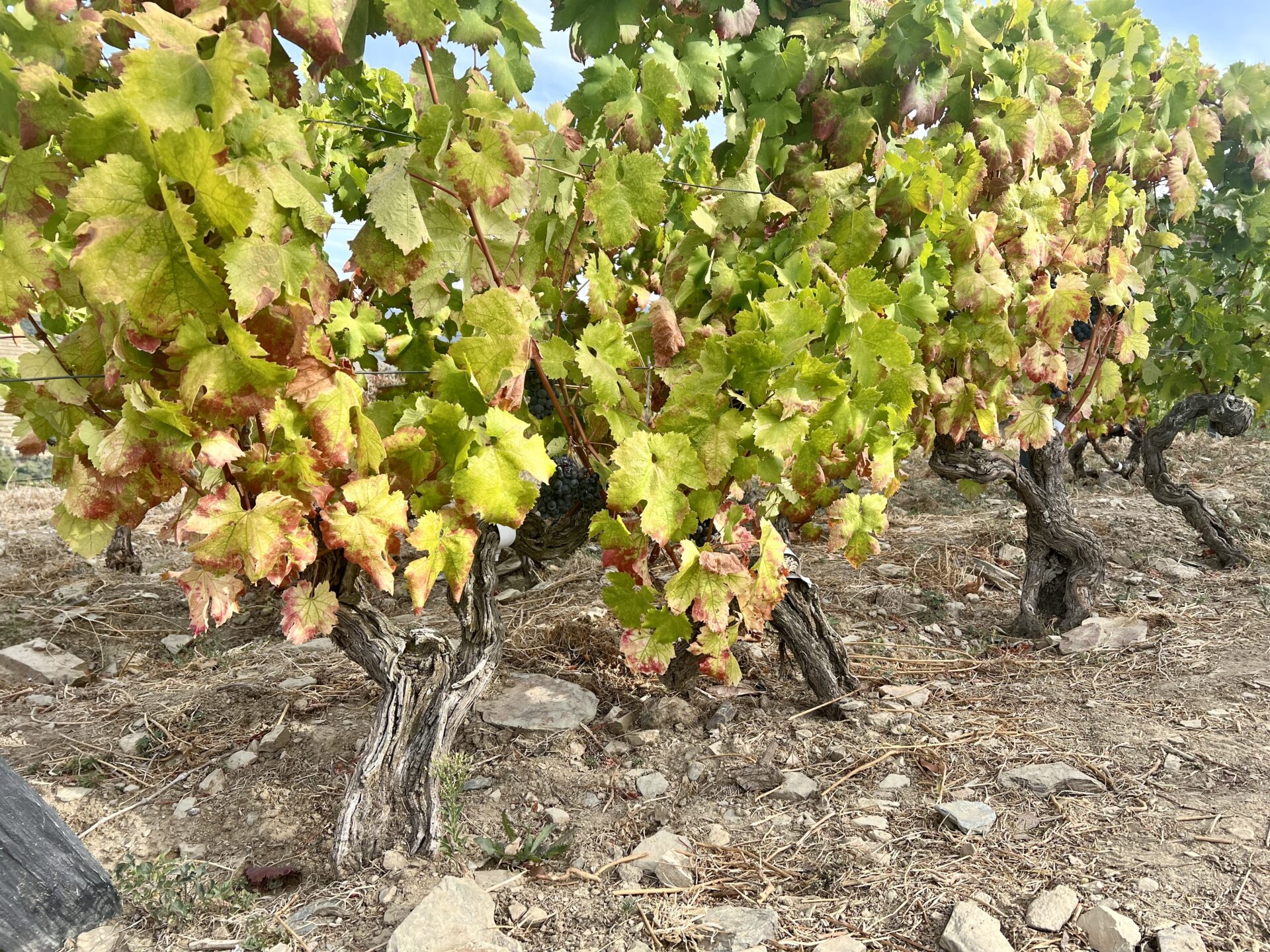
Small roads across the slopes access vines with harvests carried up to waiting trailers. It’s not unusual to see horses ploughing the more inaccessible terraces. These fragile soils lie on top of a loose, schist bedrock that allows vine roots to find their way down to water reserves remaining from winter rain. Over the years, the use of herbicides and loss of cover crops has exacerbated the problems, a philosophy that has definitely now changed across the valley.
To make vineyards easier to manage, a system of wider ‘patamares’ terraces, without walls was introduced in the 1980s. Tractors can access these vines, that are easier to maintain whilst still offering protection from erosion and retaining as much water as possible.
Hot, dry mountain viticulture
On the lower slopes, with less than a 30% incline and less water loss risk, vertical planting is allowed. These greener, unterraced ‘vinha ao alto’ vines looked more familiar to my Bordelais trained eye.
Looking across the valley you can clearly see these three types of terracing and vine cultivation. It all adds to the beauty of the landscape.
Porto Protocol
Given these challenges, it’s perhaps fitting that a dynamic global movement to help the wine industry mitigate climate change and promote sustainability came out of this region.The Porto Protocol was founded by Taylor’s Port, and has over 250 members from 20 countries. They are all working together to share solutions, innovations and resources campaigning for change to protect these and other fragile wine regions.
Delicious agroforestry
Like the fruit trees being planted in and around Bordeaux vines, here olive and citrus trees create biodiversity, shade and protect against erosion. You’ll find delicious olive oils for sale in Quinta shops alongside their wines.
The wines
As the slopes twist and turn around the Douro and its tributaries, grape growers dedicate the warmer south facing orientation for Port production and the cooler north facing slopes for dry table wines. These wines now make up around 50%, production, a dramatic change over the last 20 years, but the excellent fortified wines still carry the image of the region.
90% of grapes here are red, with white grapes planted on higher elevation for maximum freshness and acidity. Producers have over 70 red indigenous grape varieties to choose from, but both Port and unfortified wines are dominated by five principal varieties: Touriga Nacional, Touriga Franca, Ti Roriz (Tempranillo), Tinta Cao with some Tinta Barroca.
Touriga Nacional is the most well-known and one of six new grape varieties recently introduced to Bordeaux under experimentation. Its intense colour, flavours and high tannins are perfect for Port and for the warm climate.
Winning Wine Tourism
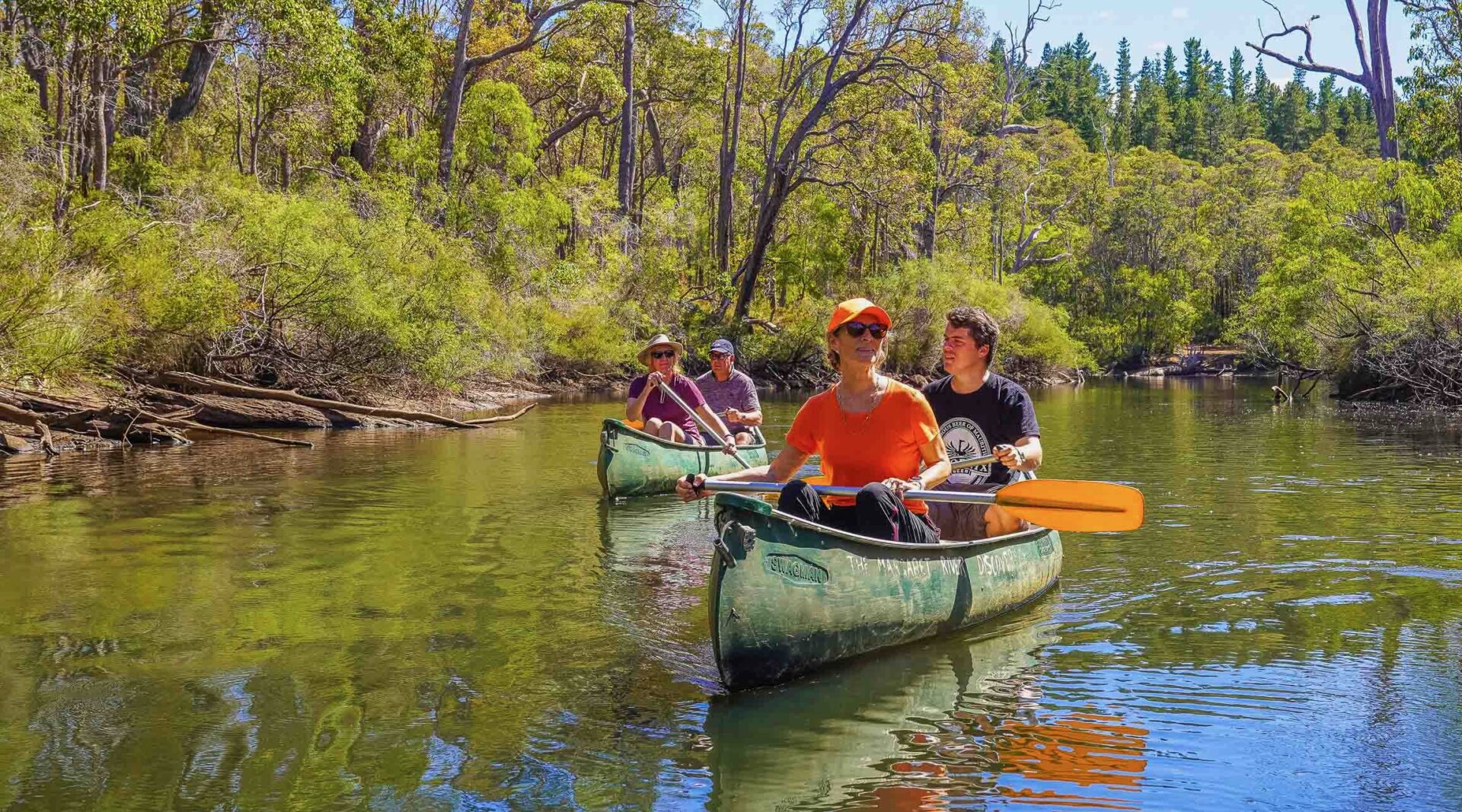
Viticulture here is not easy, and the fortified wine market is complicated. Wine tourism has become key to the economic model of the region, and they are very good at it. These famous wines and the stunning landscapes pull in visitors who have a huge and positive economic impact on the region. Vineyards are opening restaurants and guest rooms; river cruise boats glide up the Douro alongside small day cruises and kayakers. Having kayaked up the Margaret River earlier this year, we took a boat and Kayak trip up the Douro, an excellent way to visit and see the wildlife as well as the vines.
Quinta do Bomfim from the Kayak
Big business
The Taylor Fladgate group has embraced tourism in the city. They converted 10-acres of their old cellars in Vila Nova de Gaia into the WOW (World of Wine) in 2020 opening museums,restaurants, boutiques and wine shops. This was built off the success of their Relais & Chateaux Yeatman Hotel and spa, that opened in 2010 and now has over 100 rooms. The whole project cost close to around $150 million.
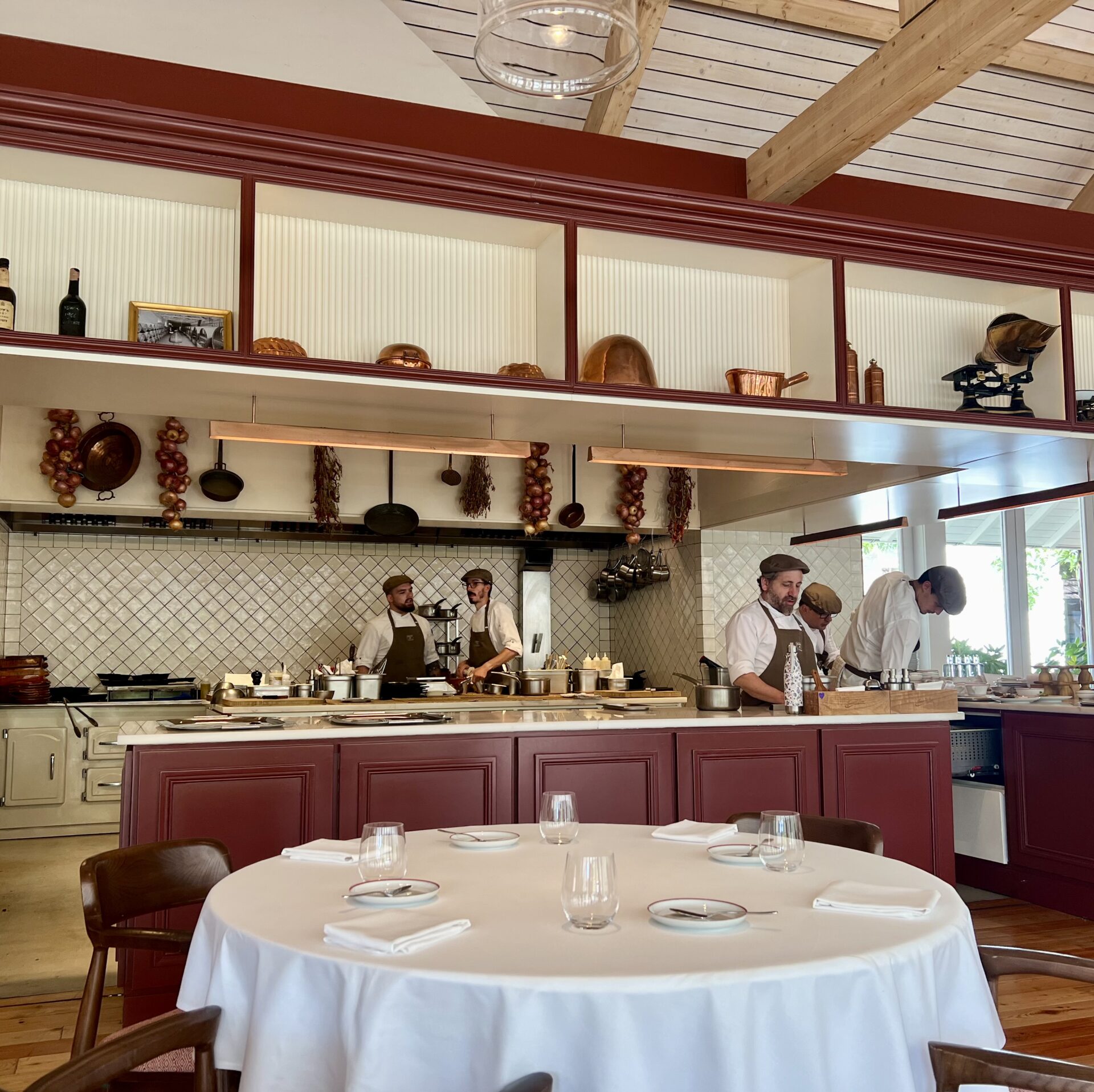
The Symington group, the largest Porto operator with 28 properties including famous names Grahams, Cockburn and Dowes, also own Quinta do Bomfim(a Best of Wine Tourism winner). Right on the bank of the River in Pinhao, they are open to guests for tours and tastings, and have a stunning restaurant with floor to ceiling windows overlooking the river and the terraced vines on the opposite bank. The open kitchen serves delicious locally sourced food, lots of veggie options and their range of Tawny Ports served from impressive double magnums. We also discovered more white port cocktails and Vértice, a vintage Vinho Espumante do Douro made in the hills up above the town.
The open kitchen at Quinta do Bomfim
Intimate welcome
It’s not only the big players that have branched out into wine tourism. We stayed at the gorgeous Quinta de La Rosa, just 2kms across the river and up the slope from Pinhao centre. A family vineyard since 1906, they were one of the very first to embrace wine tourism, offering summer lets for their Quinta Amarela since 1985, way before it was popular. They opened a B & B in 2011, and now the winery is also a boutique hotel with 23 bright, comfortable rooms scattered across the property and two independent four bedroomed Quintas in the vines.
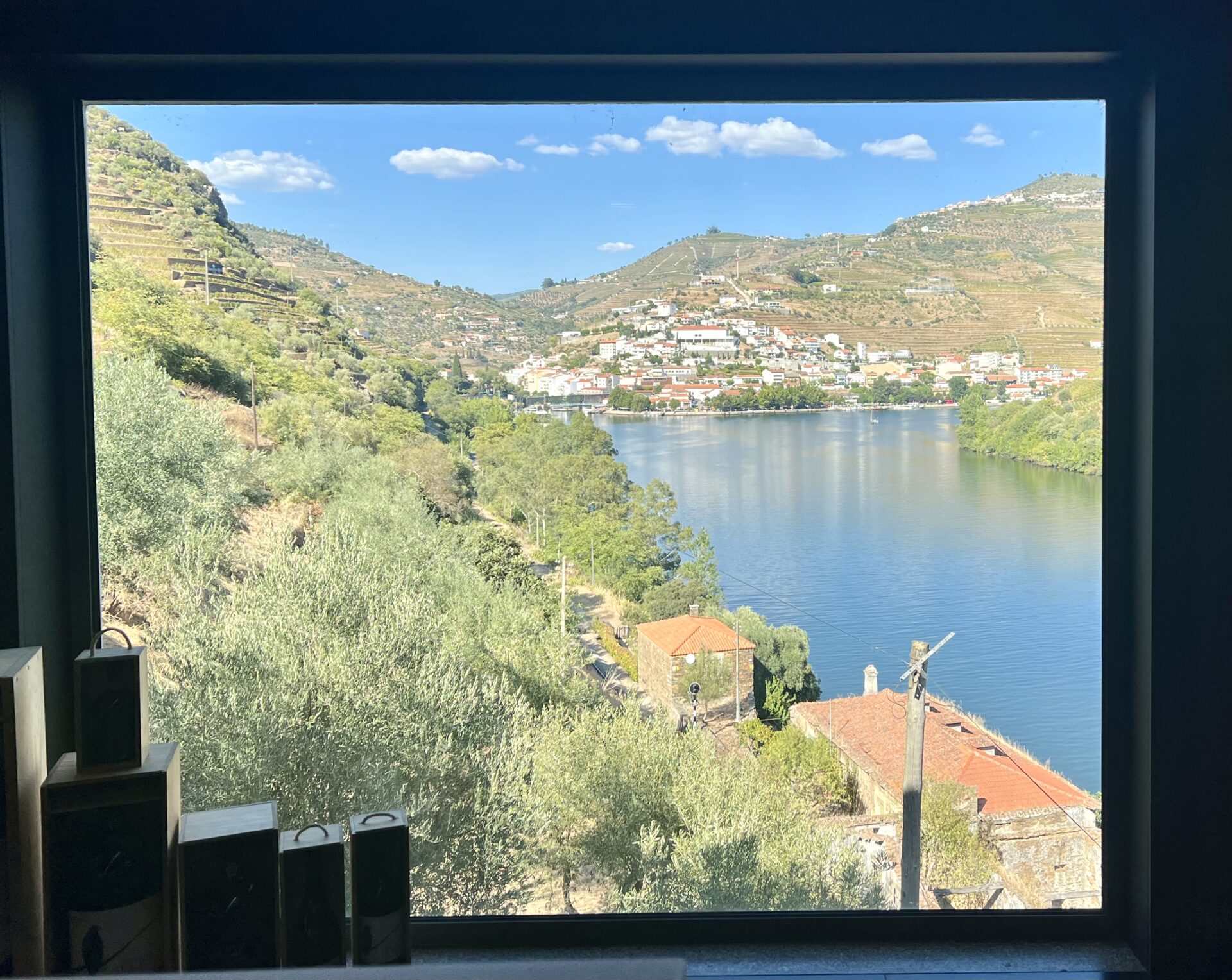
The view from Quinta de la Rosa back to Pinhao
Quinta de la Rosa opened one of the first winery shops in the Douro, offering tours and selling directly to customers and, in 2017, they opened the Cozinha da Clararestaurant followed by Tim’s Terrace offering more casual dining.
The stunning tasting room above the cellars of Quinta de la Rosa
Quinta de la Rosa opened one of the first winery shops in the Douro, offering tours and selling directly to customers and, in 2017, they opened the Cozinha da Clararestaurant followed by Tim’s Terrace offering more casual dining.
After the change in the law in 1985 allowing ageing in the Douro, Quinta de la Rosa started making, ageing and bottling their own Port here in 1988. They started making table wines in 1991, which today represents about 2/3rds of the production, and now have their own brewery, the first in the Douro.
Quinta de la Rosa is a Single-Quinta, meaning all their grapes are grown on a single estate. The 62 hectares of vines are on the north bank of the Douro and enjoy the cooler morning sun. And so did we, with morning yoga and a dip in the pool on the terraces overlooking the valley. We had the same stunning view over breakfast, served in the Cozinha da Clara restaurant.
Breakfast with a backdrop at Cozinha da Clara
It’s surprising that a smaller, family owned and run Quinta is such a pioneer but when you meet current owner Sophia you understand. We watched her taking her morning swim across the river dodging river cruise boats as we enjoyed breakfast! The property has a history of strong women. It was a christening present to Sophia’s grandmother, Claire from her English grandmother. Nearly 100 years ago, she planted the ‘Paradise’ vegetable garden that now supplies the restaurant – keeping it in the family.
The pool and terrace of Quinta de la Rosa, perfect after a hard day’s tasting
Quinta do Noval
We wound our way up the slopes above the Pinaho River to visit another local icon, neighbouring Quinta do Noval, part of the Axa Millésimes portfolio (see how those Bordeaux connections keep popping up?)
The beautiiful old home at Quinta do Noval
This estate dates back to 1715, with the old buildings, white washed to reflect the heat, perched high up on the slopes. 192ha of vines reach from 100 to 500m above sea level with 30 ha of Olives trees that produce up to 7 000 litres pa.
From the vantage point of the beautiful old house, we could clearly see all three types of vineyard terracing. They use horse drawn ploughs and tiny, specialised Swiss tractors to access them. Such a large vineyard offers a diversity of orientations, sun exposure and altitude across the schist and clay terroir, a diversity that explains the complexity of their wines.
Different terracing and olive trees at Quinta do Noval
Since the purchase by Axa in1993, a hundred hectares have been replanted and they have introduced plot by plot viticulture, adapting pruning methods and harvest dates to each parcel of vines and fermenting them separately.
The ancient pre phylloxera vines of Nacional
10 of the oldest plots are still planted to field blends, complanted with varieties that are co-fermented in the traditional way and at the very heart of the vineyard there is a tiny, 1.6 ha plot, Nacional. This is a unique plot, planted with rare, ungrafted pre phylloxera vines. From a distance the trellising looks normal but look closer and the staves supporting the trellising wires are in fact cut from pieces of the same schist stone. They are really part of the terroir. This plot produces one of the rarest Port wines of the region, only 200 to 250 cases a year.
Trellising support cut from the schist – I promise that’s stone not wood!
Since 1986, Quinta do Noval age their wines here in the Douro. From the terrace of the estate, looking across the valley to Alijo we could see the bottling line and warehouse built 1997. Here they perfectly imitate the Atlantic conditions of Porto with 28% humidity and 16°C temperature. All their activities are centralized here in the Douro Valley, although they still have a shop in Porto where you can buy and taste.
The view across the valley to the new cellars
Their Porto wine making is traditional with just a little innovation, they still use the ancient abrasive Granite lagars, foot stomping for a soft extraction then using the robotic ‘feet’ if needed. They add chilled 77° Portuguese, French or Spanish brandy to stop fermentation and bring the wines to 19-22° alcohol.
In the old cellars, big ‘tonéis’ are used to age the Ruby, LBV and Vintage Ports. The wines are tasted in the January of the second year to qualify for vintage with a second tasting to justify. The vintage is always unfiltered.
As you would expect from such a large vineyard, they offer a splendid range and we were again spoiled by the tasting thanks to Patricia Bastos.
Stunning line up from Quinta do Noval
Noval has made LBV since the 1950s, the wine to buy in years when no vintage is declared. In 2010 they added the elegant Noval Black reserve to the range, a Ruby blend, it’s a modern take on the label but also the fruitier and lighter style.
Their Tawny Ports are aged in 640L ‘cascos’ and they recently added their very first Fifty Year Old Tawny Port to the 10, 20 and 40 year olds and the Vintage Colheita. These older Tawnys seem increasingly popular, and I can see why – they are simply stunning.
Since 2004 they have added dry Douro wines to their range – next time!
Majestic
I’m very aware that our trip only skimmed the surface of this region and its wines. I had totally underestimated the diversity of Porto. I’ll be back for more port but also more of the table wines, we tasted a few, enough to pique my curiosity. I’d also like to venture further up the river to Vinho Verde – a champion choice for lower alcohol wines.
Sun rise over Pinhao – majestic
We made our way back to the city for our last night by the sea and found our way to the stunning Porto Campanha train station. As well as the famous tiled décor there is an amazing collection of food stations running along the side of the station. A final reminder of the diversity of food the region also has to offer and how food friendly these wines really are.
Time was too short, Sally and Laura we missed you. Next time – there’s a lot more to see and taste.
Many thanks to Corinne IIic of Axa Millésimes in Bordeaux for organizing such a fabulous visit and tasting to Quinta do Noval
Famous for being home to three of the five first growths of the 1855 classification, Pauillac is known for the deep gravel outcrops that make it the home of Bordeaux Cabernet Sauvignon. The appellation takes its name from the town of Pauillac, on the banks of the Gironde Estuary at the centre of the appellation.
Once a thriving port, the town has fallen into disrepair. Midway up the Médoc peninsula on the famous ‘route des châteaux’ (the wine tourism version of a high-end wine list), tourists often drive through on the way from Latour to Mouton Rothschild with barely a glance at the cafés and restaurants along the promenade.
Now, several important investments merit a closer look. Could this be the beginning of a Pauillac renaissance?
A long maritime history.
In 1777, the Marquis de Lafayette set sail from Pauillac to America to become a hero of the American War of Independence. In its 1890s heyday, Pauillac was home to the French Compagnie Générale Transatlantique cruise liner terminal where trains from Bordeaux brought passengers right to the Trompeloup wharf, just 5 kms north of the town. By the 1920s, improvements to the Gironde Estuary allowed bigger ships to navigate all the way to Bordeaux and the strategic importance of Pauillac started to wane.
From Oil to Airbus
The wharfs were destroyed in bombing raids in 1944, a target due to the oil terminal, depot and refinery built here by Les Pétroles Jupiter (later Shell). Jean Michel Cazes from Château Lynch Bages writes about watching these raids as a child in his autobiography. Pauillac was also an American air force base protecting maritime convoys.
Shell built a model village for the families of their employees, an important boost to the town’s population. The closure of the refinery in the 1980s was devasting for the town. Previously employing up to 300 people, today, less than 40 staff manage a storage facility still processing up to 150 tankers a year.
In 2004, the wharf become a staging post for Airbus A38 parts. Arriving on ocean ships from Hamburg, they were transferred to an impressive barge to wait for the right tide to slide under the Pont de Pierre in Bordeaux, sailing on to Langon to finish their transfer via road to the airbus in Toulouse.
As Airbus activity comes to an end, the wharfs are being rehabilitated to once again welcome Americans, this time as a stopover for ocean going cruise ships too large to moor in Bordeaux. They would previously have moored in Le Verdon at the mouth of the estuary to the north.
Pauillac is perfectly placed for wine tourism. Two cruise ships called in this year, with guests disembarking in the morning to discover the region before embarking to continue their journey in the evening.
Excursions were organised across the Médoc by B Excellence and the tourist office, from vineyards to the seafront at Soulac sur Mer.
New arrivals
There are around five ships planned for 2025 and up to 15 in 2026. Long term, the Grand Port Maritime de Bordeaux (GPMB), owner operator, plans to transform the wharf back to its former glory aiming for 20 calls a year within 4-5 years. Pauillac is also looking to refurbish the town centre pier for smaller river cruise ships. The waterfront has already been renovated with gardens and a nature walk with a cycle path planned to link the port to the town centre.
Waterfront destination
Built on roman foundations the town centre has a long history turned toward the water. Since 1872, it is home to one of the oldest sailing clubs in France, with a marina for 150 boats built in the 1970s and the lifeboat ‘Pichon Baron’ on duty as the tidal waters can be treacherous.
Loudenne II in the Pauillac Marina
Château Loudennehas embraced this dynamism. Owners, Sophie and Christophe Gouache pick their clients up from the waterfront in Pauillac in their 12 seater boat, ‘Loudenne II’, taking them on a cruise to the property. It’s a unique way to discover role water plays in the history and the life of the region, seeing up close the fishermen’s cabins and the islands of the estuary. They taste their wines on board and disembark at the majestic 19th waterfront cellars of the chateau. The building is a witness to the unique history of the property, the Gilbeys, then owners of Château Loudenne, were the first negociants based in the Médoc, rather than in the Port of Bordeaux.
Wine driven
Today 5 000 people live in Pauillac, the wine business and the services that supply it are major employers. Baron Philippe Rothschild, owners of Château Mouton Rothschild, Clerc Milon, Armailhac and Mouton Cadet, have their head office in the town centre with their vineyards just to the north of the town and the Mouton Cadet production facility 10 kms inland.
Agent for change
The most Pauillac of all the Pauillac properties is Château Grand Puy Ducasse with their cellars right on the waterfront. It’s an urban winery, an unusual but historical location, where the property has been making wine here since 1820. The renovation of the chateau and the cellars has brought new life to the waterfront. After three years of renovation, the cellars were christened with the 2023 vintage and opened to visitors in July 2024. The space is designed for wine making but with guests in mind. Before reaching the cellar, an itinerary takes you on a journey through the beautifully renovated salons illustrating the history of the 18th century chateau and its maritime links.
Swallows flying through the new cellars of Château Grand Puy Ducasse
The cellars have a wow factor, the new layout has doubled the number of vats, and they are impressive. Made from shiny stainless steel, suspended from the ceiling for gravity feed, a sculpture of wild swallows flies amongst them. These protected birds had to be re-housed before construction could continue – holding up the opening! A panoramic room above the cellars overlooks the waters of the Gironde Estuary reinforcing the link to the water.
The view from the reception room across to the Gironde Waterfront
Make a run for it
The waterfront of Pauillac comes to life every year, it is the starting and finishing line for the annual Marathon du Médoc. This September, the 38th edition saw 8500 runners from 70 countries join ‘the longest marathon in the world’ so called thanks to the ‘refreshment’ stops at some of the 44 wine chateaux along the route.
There’s also an annual film festivalLes Vendanges du 7ieme Art celebrating francophone films with projections on the waterfront in the presence of the actors.
The Pauillac Waterfront ready for a projection of the Vendanges du 7ieme Art
A taste for hospitality
Until now, visitors stayed outside of town, at the hotel Cordeillan Bages or further north in Saint-Estèphe at the Maison d’Estournel, although the Salamandrerestaurant in Pauillac offers great food and a really good value wine list.
Hôtel des Vignes et des Anges
In 2023, the run down waterfront Hôtel d’Angleterre was fully redesigned and reopened as the Hôtel des Vignes et des Anges.Opposite the Pauillac marina, the hotel has 44 brand new rooms and suites in the 19th century building and its annexe. There’s an indoor pool and wellness area, a cocktail lounge, restaurant, a co-working space and seminar rooms. Part of Best Western Premier Label, owner Catherine Parinaud already owns the Best Western Hôtel Bayonne in Bordeaux Centre.
The pool of the Hotel des Vignes et des Anges
Look out for the opening of Château Fonbadet in 2025, owner Pascale Peyronnie is converting her beautiful Chartreuse home into a fabulous guest house.
The Chartreuse of Château Fonbadet
With the creation of gardens and a walk way along the river, the opening of a new hotel, a stunning new cellar and the arrival of new cruise companies, Pauillac has found a new dynamism. It may once again be the perfect port of call for a visit to the Médoc.
I really should get back to Bordeaux, but before I do, one last post from Margaret River. Below is a far from exhaustive list of places to visit, stay eat and taste in case my previous posts have inspired you to go visit. We didn’t stay nearly long enough to explore everything, but hopefully it’s a pretty good starting place.
I’m not the only one to be seduced by the region, this year (2023), they welcomed over 1.5 million visitors, international visitors represent just 10%, it’s never been more accessible thanks to direct flights to Busselton Airport from both Melbourne and Sydney. We flew internationally into Perth, about a 3-hour very easy drive away
Where to stay?
We stayed a few nights in the heart of Perth atthe beautiful COMO The Treasury, in the renovated, historical state buildings of the city with fabulous restaurants and a stone’s throw from the buzzing water front. And I do love a hotel room with a yoga mat!
Coast or Vineyards?
We stayed overnight at Busselton, keen to see the famous jetty that Edward wanted to swim off – despite the proximity of sharks that we discovered later. Also go for the Foreshore Sunday morning market. We stayed in the HiltonGarden Inn, easy practical and central.
The spectacular Busselton Pier
InDunsbourough Opting for self-catering, we choose Whitesands cottages, across a quiet road from the beach at Dunsborough, which was perfect. Run by Private Properties, who have some absolutely gorgeous properties on their books. The Empire spa and retreat was also recommended to us.
The iconic Margaret River hotel, built in the 1930s in the centre of town, is currently being renovated by the Heytesbury group, owners of Vasse Felix and opening soon. Given the hospitality we received at the winery, this promises to be a great and central location with walking distance to lots of restaurants.
Some vineyards offer accommodation, I was very tempted by the Guest houses at Cherubino, but it seemed a little excessive for just two of us. I’ll go with a group of friends next time if anyone’s keen to join?
Where to eat
InBusseltonInara is a great middle eastern restaurant with an impressive local wine list and lots of veggie options that match perfectly with the wine list, a subject close to my heart (seeWineand2veg). We arrived just before lunch, perfect timing to sample the food at The Goose. Right on the waterfront with amazing pizza, lots of sharing options and wood grilled specialities. They also serve a delicious breakfast and a great take out menu for eating on the beach. The Shelter Brewery and kitchen is another casual dining venue near the water, offering casual dining and a very lively atmosphere to accompany the wide range of beer brewed on site. They also open early for coffee and bagels.
In DunsboroughBlue Manna was probably our favourite in town, an amazingly warm welcome and a delicious and original take on fresh local seafood and so much more.
Steak with Sake and Herring – those are polenta chips – divine!
Yarri, owned by Snake and Herring winery with a great selection of their own wines of course and many others as well as an impressive cocktail list. Indoor/outdoor dining and a menu based on locally sourced fresh produce – mostly from their own organic garden. And they have Sauternes on their wine list.
If you are self-catering like us the pies from theDunsborough Bakery met with Edward’s approval especially after a day’s tasting and the deliPeko Peko offers so much more than just sushi.
Breakfast at the Margaret River Bakery
Breakfast is definitely worth getting up for here, who doesn’t love a little people watching in the mornings? The choice of venues seemed endless, Margaret River Bakery offers a delicious selection of eat in and take out options including their cinnamon rolls, but don’t stop there. They’re at the Margaret River farmers market on the last Saturday of every month if you can work that into your itinerary. If you prefer a beach breakfast go to the White Elephant Café at Gnarabup, they are also open for lunch. Back in Dunsborough La Lah won the vote for best breakfast.
and at La Lah
Wine Lunch So many wineries have delicious food offerings. Vasse Felix and Frui Momento (the Cherubino restaurant – look out for the ‘chick on a stick‘ sculpture, as she is known to locals) have restaurants, with exceptional food, that they will happily pair with their wines for you, brilliant service and beautiful locations.
As beautiful as it was tasty – inch at Frui Memento
Sadly, we didn’t get the timing right to eat at Leeuwin Estate, Cullen, Xanadunor Voyagerbut all have restaurants that also come highly recommended. Next time!
Yet other wineries offer great platters for more casual dining or just to accompany a wine selection. Enjoy outside in their beautiful grounds such as Lenton Brae and Domaine Naturaliste. The white wines of Domaine Naturaliste were simply stunning.
Brewery bites Wineries don’t have the monopoly of good food, The Wild Hop Brewery in Yallingup has a great beer garden and spacious restaurant to enjoy their range of beers and food and the Black Brewing Co has a great menu served in their restaurant and terrace overlooking the lake.
Lunch with a view over te lake at the Black Brewing Co
Wineries to visit
The wineries mentioned in previous posts should absolutely be on your list include Vasse Felix, with the spectacular underground cellar, Cullen Wines and their biodynamic garden and restaurant (see below), Lenton Brae all on Caves road. Don’t forget to call in on Jo Perry at Dormilona on the outskirts of down town Margaret River.
A warm welcome at Lenton Brae
Leeuwin offers brilliant tastings and go downstairs to visit the private collection of the original works of Australian artists featured on the labels of their Art Series wines.
Some of the Art Series, with the originals on display in the gallery on site
Cheribino is the perfect venue to taste wines made from fruit harvested across Western Australia for an deeper understanding of the larger region.
In the atmospheric cellars of Vasse Felix
Bruce Dukes’ name came up so often in different wineries where he has worked, we had to visit his own vineyard,Domaine Naturaliste. The tasting room and gardens are as gorgeous as his wines. I found the whites in particular to be stunning. He has experience across WA but also in California where he gained a Master’s Degree in Viticulture and Oenology as well as working for Francis Ford Coppola.
The perfect place for a picnic – the gardens of Domaine Naturalist
One of the Margaret River’s Cellar door heroes, Sam Bradley offers a very warm welcome at Xanadu. Another property created by a doctor and named after the poetic paradise; you’ll pick up the reference to dragons. Choose from a range of tastings and don’t miss the cellar visit or restaurant.
Edward making himself at home at Xanadu
Off the beaten track A little off the beaten track in North Jindong, but well worth searching out is After Hours, whereWarwick Mathews also makes his 9 to 5 range, created when he finally started making wine full time. Make sure you taste his Gingdong gins too.
Gindong Gin from After Hours
Further south, try and track down Margaret River iconStuart Pym, Winemaker & owner ofFlowstone Wines . You will not be disappointed by his wines or his depth of knowledge (and stories) of the region after 30 years making wine here. Flowstone is inspired by the local caves (see below) just like the geological formations, his wines symbolize the elements of the terroir really bringing a unique sense of place.
Tasting with Stuart Pym at Flowstone
What else?
If you want to walk off the calories, attempt the 135 km Cape to Cape Track, especially if you are there in the spring for the wild flower display. If you don’t want to put in the miles at least visit the two light houses at either end with the breath-taking views.
Mammouth Cave
For an in depth understanding of the terroir, literally, visit the caves that give their name to the road where many of the top wineries are found. There are over 100 limestone caves that date back over a million years running under the Leeuwin Naturaliste Ridge. They are open to the public for self-guided tours. Lake Cave has a permanent lake to admire, Mammoth Cave is enormous and there’s also Jewel Cave and Ngilgi Cave.
How to visit
I can’t recommend Margaret River Discovery Tourenough, billed as ‘The ultimate wine adventure experience’ it didn’t disappoint. Sean Blockside took me totally out of my comfort zone and into the wilds, and then back into the more familiar world of wine.
In good hands
Souvenirs
Wine obviously, but foodies should also pick up some local handmade chocolate from the Margaret River Chocolate Factory. I also really enjoyed the chocolate from Bahen & Co. Their bean to bar chocolate is made in Margaret River by ex-wine makers Jacqui and Josh Bahen, from cocoa sourced directly from growers around the world. Inspired by vintage chocolate making equipment, they turned their hands to a different type of fermentation and blending. The whole range is delicious, we discovered it at Clairault Strieker where we tasted some of their chocolate specifically blended to go with their wines. They also have a great Vineyard Kitchen Restaurant. So many restaurants so little time….
On a lighter note, bring home some of the Vasse Virgin olive oil cosmetics. Louis and Edwina Scherini started making olive oil soap for their children’s sensitive skin, the range now includes moisturising lotions, skin balms, massage oils and much more available in their shop on Margaret River’s main street.
For more information visit the Margaret River Region website. They are never short of ideas. Bon voyage.
If you enjoyed this post, please sign up here to receive future blog posts directly to your inbox or share with a friend. If you would like to read more about Bordeaux, find your copy of Bordeaux Bootcamp here, and learn about Wine and Wellness, with The Drinking Woman’s Diet . Youn can read more of my stories from Bordeaux at Decanter or contact me here.
In my last post from Margaret River, I highlighted the important role Vanya Cullen has and continues to play in the sustainability movement in the region. Vanya is far from being the only dynamic woman in wine here. It seems you can’t enter a cellar here without meeting an innovative woman, although my choice of properties to visit might’ve had a slight bias.
Our very first visit to a Margaret river winery was to Lenton Braewhere wine maker Vanessa Carson received us alongside viticulturalist Russel (Russ) Cooker. There’s several links to Bordeaux at Lenton Brae. Back in 2000, Vanessa won a prize at university to work a vintage in Bordeaux at Beau-Site in St Estèphe. Vanessa was only there for a few months, but it was an eye opening first experience of working in a vineyard and winery. It obviously didn’t put her off, she has been the wine maker at Lenton Brae since 2021 as well as consulting for Plan B! Wines since 2016 and Green Door Wines further north in Bunbury.
Russ told us about their Cabernet and Merlot clones, the first in Margaret River sourced from Bordeaux, no mean feat given the Biosecurity laws in the region. In all they have 19 different clones across their vineyard, that gives them flexibility to adapt the blend with every vintage.
Part of the Lenton Brae range
Lenton Brae is on the famous Caves Road in Wilyabrup, where the deep gravelly loam over clay soils are perfect for Cabernet, but Lenton Brae is also a white wine hero. 60% of the 9 ha vineyard is planted to white varieties. Chardonnay clones from Burgundy are planted alongside the famous Margaret River Gingin clone on cooler Eastern facing slopes of the Brae (Scottish for hill), planted east to west to maximise shading.
In 1987, their very first wine was a Semillon Sauvignon Blanc blend (SSB), and they have just bottled their 37th consecutive vintage. These Bordeaux varieties enjoy the maritime influence and the well-drained soils. Vanessa says their style is inspired by white Graves, aged on lees with 25% fermented in French Oak of various sizes (something we saw in almost all cellars), including 500l ‘puncheons’ that give a gentle oak impact when blended with tank fermented wines. SSB fell out of favour for a while in the region but Lenton Brae never turned their back on it. They are also the sole producers of Pinot Blanc in WA, possibly the only ones in Australia.
With Vanessa Carson and Russ Cooker
Their premium wines are sold under the Wilyabrup Label. Previously planted to Merlot & Pinot, it is now dedicated to Cabernet Sauvignon and Chardonnay. The Sauvignon Blanc fruit coming from further south in cooler Karridale. The estate range is classic Margaret River single varietal wines but also a Touringa Nacional, their famous Pinot Blanc and a delicious 100% Chardonnay Sparkling Blanc de Blanc.
The In Good Hands range is where they have some fun, experimenting with more single varietals.
Vasse Felix Lucky for some
Further along Caves road, still in Wilyabrup, their neighbour Vasse Felix, offers guests a brochure with a series of illustrations that clearly explain harvesting and wine making. Once the grapes enter the cellar, the cartoon figure of a Bart Molony, Chief Viticulturist bringing in the harvest is replaced by a woman with long flowing locks – that’ll be Virginia.
Virginia Willcock has been with Vasse Felix since 2006 and her influence in the winery is clear, as it is across the region. This 2024 is her 18th vintage in Vasse Felix, 33rd in Margaret River and 38th in her lifetime with 4 in Italy.
With Virginia Willcock in cellars of Vasse Felix
The cellar was full of different sizes, shapes and materials of fermentation vessels, illustrating her love of experimentation. Virginia fermented her first Cabernet and Malbec batches with indigenous yeasts in 2012 and by 2018 all of her red ferments were wild and almost all of her white ferments too (Chardonnay of course but also Sauvignon Blanc and Semillon). She finds wild ferments add complexity and nuances in the wine that the unique microbiology of the land brings. She’s doing some carbonic whole bunch fermentation with her Syrah and some fermenting on the skin for the Sauvignon Blanc. There are a few open ferments, and a couple of 1800 litre Cocciopesto vessels called the drunken turtles.
The same experimentation goes for ageing, there’s French oak from diverse origins, of different ages, rarely 100% new and many different sizes including 1000l Garbelotto French oak vats, 225l Bordeaux barrels, 228l Burgundy pièces, 500l puncheons, 1000l vats and 3000l foudres, clay amphora and concrete eggs. It’s nothing if not diverse.
Some of the tools of the trade at Vasse Felix
There’s plenty of wines for Virginia to play with, their wide range is presented across three levels that they explain as, Good to Better to Best, but represent three different styles of Chardonnay and Cabernet although all three Cabernets are technically a blend of Cabernet Sauvignon and Malbec.
The Classic Range includes a Dry White, Dry Rosé and Dry Red. The Filius (son of) range showcases Cabernet Sauvignon, Chardonnay, Shiraz and a Sauvignon Blanc Semillon blend. The Premier Range includes Cabernet Sauvignon, Chardonnay, Syrah (See the nuance Shiraz/Syrah) & Sauvignon Blanc.
Part of the Vasse Felix range
Their two Icon wines are Tom Cullity, the red Bordeaux blend named in honour of the founder, and the Heytesbury Chardonnay named after an ancestor of the Holmes a Court family, owners of Vasse Felix since 1987.
and some of the icons
Vasse Felix just celebrated the 50th vintage of their Cabernet Sauvignon it owes its origin – as does Margaret River – to Dr Thomas Brendan Cullity (see previous post). Working in the UK as a cardiologist in the 1950s, he developed a taste for European wines, coming home he was inspired to try to produce something similar. It seems Tom Cullity and Kevin Cullen may have discussed planting a vineyard together and Kevin helped Tom negotiate the purchase of the Vasse Felix Vineyard site with the original owner before then going on to create his own Cullen Vineyard.
Cabernet Sauvignon at Vasse Felix
The name Vasse comes from the unfortunate sailor Thomas Vasse who fell overboard in Geographe Bay in 1801, and Felix meaning lucky or ‘blessed. Their icon is a Peregrine falcon, the raptor they originally tried to use to control vineyard pests. From the original 8 ha the property, vines are now across four vineyards covering a total of 300ha. The original vines were cuttings of Cabernet Sauvignon, Malbec, Syrah and Riesling from Jack Mann’s Houghton Vineyard in Swan Valley further North. He slept in a shed in his newly planted vineyard and made the first serious wines of the region in the 70s.
The original 57 year old Cabernet Sauvignon vines in ‘Toms Block’ are the Houghton ‘Heritage Clone’, well established in WA (Western Australia) since 1800s. It left France pre-phylloxera and is still grown on its own roots here at Vasse Felix. The original Malbec and Syrah are still there too although it’s been grafted to Cabernet and back again!
‘Great Wines forever’ is their sustainable philosophy and long term vision. They dry farm the estate to build resilience for the ‘tough’ Cabernet Sauvignon. This was brought into the sharp focus with their 2024 vintage, more than one month early with lower yields faster ripening.
Chardonnay and consistency
Most of the Chardonnay at Vasse Felix is the Gingin Clone, imported from UC Davis in the 1950s and characterized by small bunches of ‘chicken and hen’ berries or Millerandage. In Bordeaux this would be seen as a massive inconvenience, here they love this mix of berry sizes as it maintains acidity and gives intensity to the fruit. Relatively late to the ‘Chardy Party’ they planted in 1987 and produced their 1st Chardonnay in 1990, they now have 38 plots of Chardonnay. Until 1994 they sold their Syrah as Hermitage, now it is Vasse Felix Syrah, not Shiraz, reflecting the elegant style they are looking for.
Sparkling
Although 75% of their sales are in Australia, of which 20% directly from the Estate, just 25% goes to export. the UK is an important market so for UK readers you might just be able to find some. I recommend their Sparkling Idée Fixe, it was the perfect start to a simply spectacular lunch in their restaurant.
We met Ellin Tritt, winemaker at Frazer Gallop thanks to Sean Blockside of Margaret River Discovery, onour adventure tour. Ellin was knee deep in vinification. From nearby Bunbury and passionate about wine since she was a young girl, she completed a double degree in winemaking, viticulture and agribusiness before doing vintages in Canada, Provence, Alsace and the Napa Valley. Her experience reaches across Margaret River with Xanadu, Watershed Wines, Naturaliste Vintners and Vasse Felix before joining the team here at Fraser Gallop Estate in 2017 where, with Clive Otto, she makes Cabernet Sauvignon, Chardonnay and Semillon, Sauvignon Blanc blends using minimum intervention and indigenous yeasts. The vines are dry farmed on the same Wilyabrup terroir. They use Bordeaux barrels for the Cabernet Sauvignon and Semillon Sauvignon blanc blends, and Burgundian coopers for the Chardonnay.
Ellin explains the 2023 at Frazer Gallop – great T shirt!
This is the closest we came to anything resembling a Bordeaux chateau, an elegant property amongst the vines, where Sean organised a lunch under the trees and a tasting of the range of wines from this boutique winery including Their Palladian range – a reference to the architecture of the ‘chateau’.
The nearest thing to a French Château
Keeping Margaret River weird
Just the other side of the town of Margaret River, Jo Perry is another MR woman wine maker having a lot of fun. And it shows in the multitude of references all brilliantly illustrated with labels by Tasmanian artist Sean Edward Whelan. You can enjoy his art on her website too.
The amazing artwork of Sean Edward Whelan
Jo Perry handcrafts each wine in an anonymous looking building on the outskirts of the town, which has been mistaken for a tattoo parlour – see the illustration on the door. Although the wines are fabulous, the labels alone are worth the purchase! Her winery is her playground, and you can tell she’s enjoying herself and when you visit, tasting from the myriad of vats, barrels amphora and more, it’s contagious.
Jo, amphora and friends at Dormilona
Dormilona means ‘sleepy head’ in Spanish, but there’s nothing sleepy about Jo, she never stops! She started wine making at 14 years old at Cape Mentelle thanks to her Grandfather. She has made wine in the Rhône, Burgundy, Bordeaux (Côtes de Castillon for Direct wines before heading to Spain for them), New Zealand and California, before coming back to Margaret River, she managed the winemaking operations at two wineries in Galicia, hence the Spanish connection.
She created her own label in 2012, using mainly organic and biodynamic, fruit, but dropped the organic certification, the wait was too long, and she’s got stuff to do! She adheres to the principals though with no synthetic inputs, sheep grazing in the vineyards in winter and chicken manure spread through the vines.
Her wine making is minimalist and experimental with skin contact on whites, fermenting and ageing her ‘Clayface’ label of Cabernet and Chardonnay in amphora and clay eggs. She loves stainless steel and neutral oak puncheons and barrels anything that allows the fruit to shine.
Here’s looking at you, Clayface
Her house wines are called Blanco (Semillon), Tinto (Shiraz), Orenji, (80% Semillon, 20% Sauvignon Blanc fermented on skins for 2 to 3 weeks) and Pinku – no confusion there as to what’s in the bottle despite the skull and crossbones on the label. The Yokel range is made from fruit from the Swan valley with profits going towards saving the endangered Western Swamp Tortoise, native to the Swan Valley. An artistic rendition of said turtle graces the labels of the Chenin Blanc, Rosé and Grenache.
Jo’s Estate wines include a Blanc de Blanc, 100% Chardonnay Pet Nataged in oak withfrozen grape juice for the dosage and the ‘Teachers Pet’ Pet Nat rosé. Her Chardonnay and Chenin Blanc have no skin contact to keep them fresh (the Chenin Blanc was still fizzing when we tasted from the amphora). These vines enjoy an ocean viewand the cooling breeze that goes with it, hence the seaside scene on the label.
Skinnie is an orange wine that spends four to five months on skins in amphora and Rojo Tempranillo and Cabernet. She crafts her Clayface range in amphora and clay eggs, Chenin Blanc, Chardonnay Shiraz and Cabernet. These wines probably have the coolest labels. But it’s hard to choose.
Every winery should have a disco ball
Women in wine in Margaret River aren’t limited to wine making, they are also pioneers of wine tourism – more to come with my recommendations of who and where to visit. Sign up not to miss the next and future blog posts directly to your inbox and share with a friend.
With 30 years in Bordeaux, I bring you a twice-monthly perspective on the stories shaping this, and other wine regions — from sustainability to wellness, women in wine, and beyond.