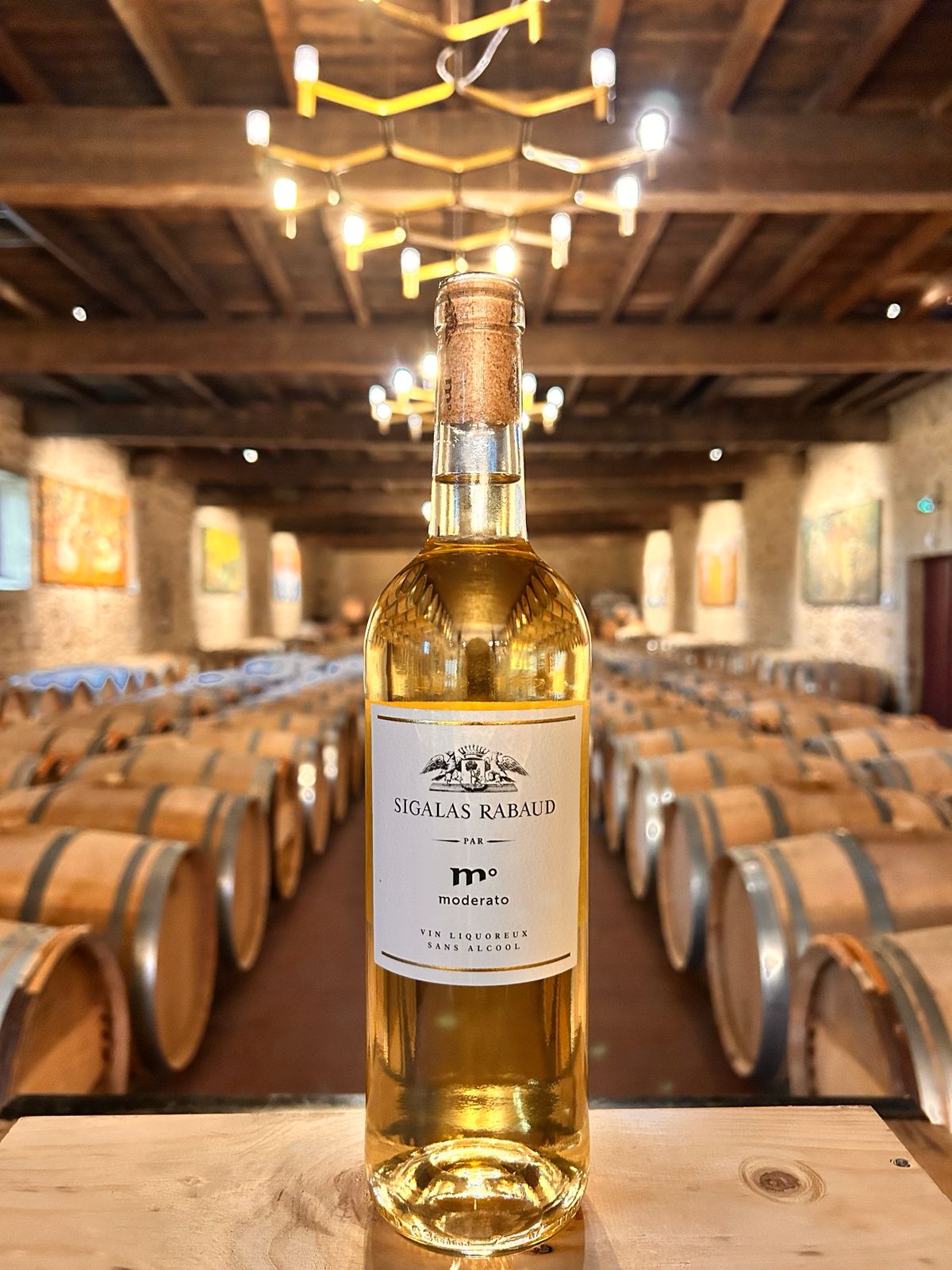
Laure de Lambert Compeyrot is the owner and Director of Château Sigalas Rabaud, 1er Grand Cru Classé de Sauternes. If you are a regular reader, you will recognise her wines from previous blog posts. As she launches a zero-alcohol version of her wine, I chat to her about her vision of wine and wellness.
Could you introduce yourself and your role in the wine industry, please?
I am the sixth generation of the family at the helm of this property, which has been in the family since 1863. Today I manage the development of the domain; everything related to wine from branding strategy to wine tourism, including opening the château to guests.
I am also the president of La Route des Vins de Bordeaux en Graves et Sauternes, and more recently a municipal councilor for Bordeaux, overseeing links between the city and the wine business, as well as the promotion of wine.
What brought you to the wine business?
My career started in the world of art and culture. I worked at the Louvre des Antiquaires, then in publishing, before finally creating a logistics company with a friend. My family wine roots eventually caught up with me, and today I have the privilege of being 100% invested in Château Sigalas Rabaud as CEO.
Zero percent ‘Sauternes’ , a joint venture between Laure and Moderato
What do you love most about the wine business?
It’s an industry where we speak about the weather as often as international strategy; every day is different. It’s challenging and dynamic, but also an industry where personal contact remains so important.
What does the concept of wellness mean to you?
Wellness, or wellbeing, is about finding balance between pleasure, energy, work, sleep and sometimes a delicious butter sauce!
It’s being able to succeed whilst listening to yourself and to the people around you.
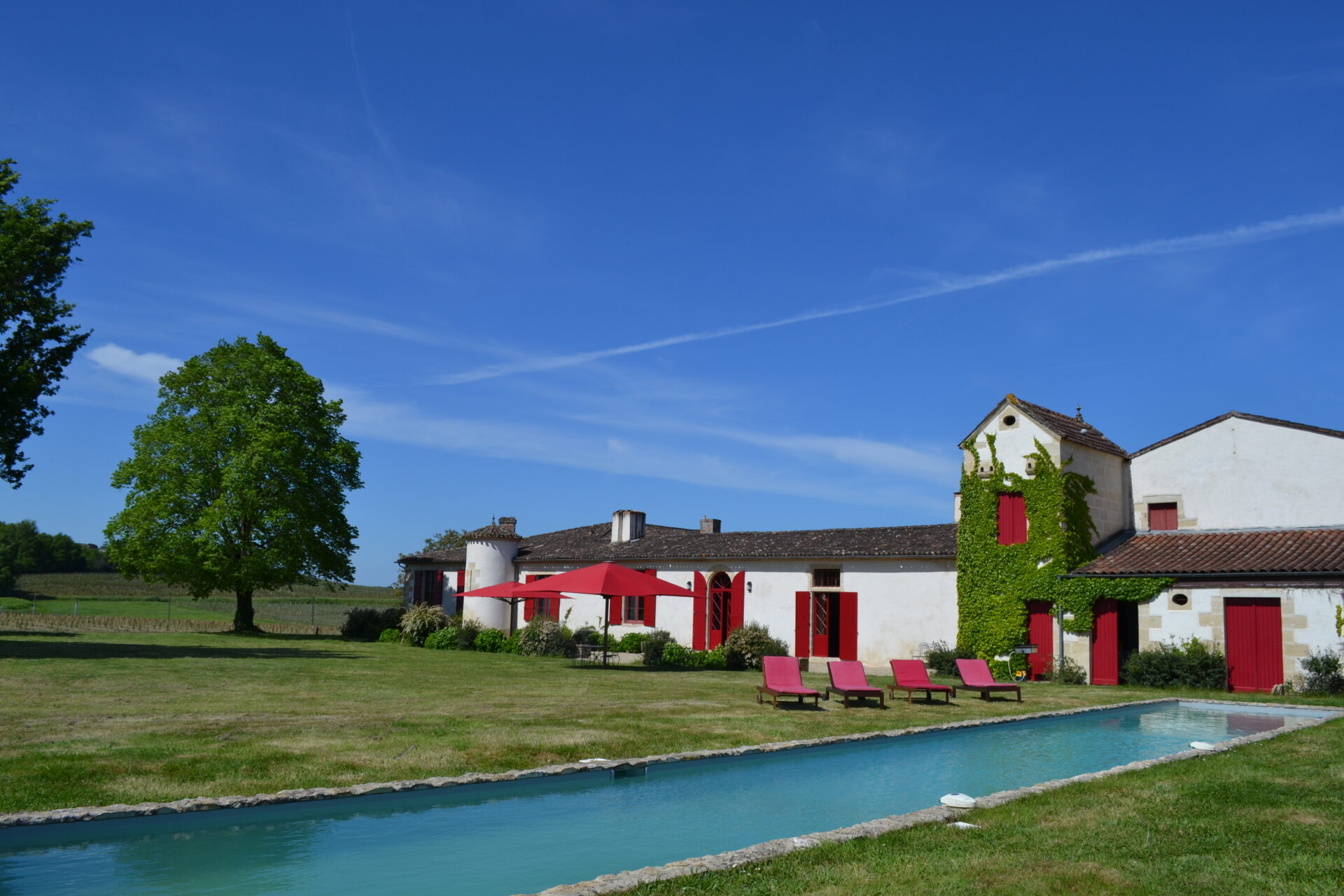
Welcome to Château Sigalas Rabaud
If it’s not indiscreet, how many times do you drink each week and do you limit yourself to a certain quantity of alcohol?
I taste a lot in my line of work, but when I drink it’s with a meal, with friends and family. For me, wine is profoundly linked to conviviality, gastronomy and sharing.
I don’t live with restriction; it’s about equilibrium. There are periods when I drink more through professional obligations, especially for tastings and wine fairs, and other times when I naturally drink less.
Has your attitude towards drinking and wellness changed over the years?
Yes, my vision has evolved over the years. I believe you can be passionate about wine whilst also having awareness and freedom about what and why you drink. It’s precisely this idea that led me to become curious about high-quality non-alcoholic wine: to offer other ways to share, not by opposing different worlds but by bringing them together to enrich the possibilities available to wine lovers.
Are there foods you consciously include or foods you avoid in your diet? If so, what and why?
I don’t follow a diet nor abide by strict rules. I love to cook, eat a balanced diet and share great food. In the family, we have always prioritised local produce, vegetables and fruit, either simply prepared or more sophisticated for special occasions. It’s rare for us to eat pre-prepared food.
Do you take any supplements? Which ones?
I’m not interested in ‘magic powders’ or supplements; I never take them! I believe in common sense, quality products and an excellent foie gras with a glass of Sauternes.
Do you exercise?
Yes, I do, either in a gym in Bordeaux or on a treadmill first thing before breakfast. At the château I’m always walking in the vines, at least 7,000 steps a day!
What are your biggest challenges to staying fit and healthy in your job? How do you overcome them?
In this business there are lots of temptations, the challenge is to resist excess becoming a habit. When I feel I’ve enjoyed myself a little too much, I pay attention – until the next dinner!
Do you set yourself goals, and do they help in your aim to stay well?
Yes, I like having an objective: a pair of jeans I want to be able to wear and a number on the scales I’d rather not reach!
Does the fact you are a woman help, or is it a hindrance in this business, or is it now irrelevant? If so, how would you pinpoint the changes?
Things have evolved enormously, thank goodness. More women have now found their place and feel confident expressing themselves, innovating and sharing their vision. For a longtime the wine world was a very masculine environment. Some of these habits and reflexes still exist today, with women still under-represented at some levels of management. Often it takes a photo of a meeting to make you realise women are missing. Where’s Charlie? 😉 But it is so much better than 20 years ago.
Do you feel there are different expectations in drinking culture for women compared to male colleagues?
Yes, and studies show this is the case.
Have you seen an evolution in attitudes in the business towards drinking in general?
Yes – especially in France.
Does it affect business socialising?
Yes it does.
How do you cope with wellness pressures when you travel, for business and pleasure?
When I travel, I try to keep things simple and balanced (that word again): sleep well, avoid escalators in airports, walk and take the stairs rather than the lift.
My trips are often synonymous with tastings, restaurants and a frenetic rhythm. After a few days of wine fairs and business trips, a bowl of soup, a long walk and a good night’s sleep feel like a luxury … and an obligation!
If you had just one or two top tips for women in wine wanting to stay well, what would they be?
Take time to reflect, meditate or stay calm in order to reconnect with yourself and with others. Stay true to yourself. If you’re in the right place, it’s because you’re meant to be there. Don’t take on others’ opinions if they are not your own. We are not obliged to accept the codes of men, or of other women, who have gone before us.
The ideal spot to indulge in wine and wellness
Is there anything else you would like to share about women in the drinks business or about wine and health?
Go for it – it’s exciting. It’s a demanding universe but one that is rich in human relationships. I believe that wine, when linked to gastronomy, sharing, conviviality and moderation, is an art de vivre, both culture and pleasure.
And keep enjoying wine! My father is 95 years old and has enjoyed wine daily since he was seven.
Join us
If you’d like to meet Laure, discover her wines and beautiful property, please join us at Château Sigalas Rabaud, from 2 – 5 October 2026. There will be insider visits, exceptional wines and relaxed yoga. You’ll meet more women who inspire me, taste some of my favourite Bordeaux and discover how to enjoy them without compromising your health.
If you want to know more about what’s going on behind the scenes in Bordeaux do sign up here to be sure not to miss future blog posts.
A recent Sem-posium in Sonoma Countyshone a light on Sémillon on both sides of the Atlantic. Could now be the time for it to break free of the shadow of Sauvignon?
I’m a fan of Sémillon, I found my way to Bordeaux thanks to Sauternes, where the elastic skins of Sémillon make it the perfect host for Noble Rot (botrytis cinerea) and produce the famous elixir. Only 2-3% of Bordeaux is dedicated to sweet wine production, but Sémillon is also an important part of some of the most prestigious dry white Bordeaux. The small percentage (approx. 10%) of white grapes in Bordeaux is planted to equal parts of Sémillon and Sauvignon (43 % to 44% respectively) with the rest to Muscadelle and other complementary varietals.
A tsunami of Sauvignon
Sauvignon Blanc has powered through Bordeaux, more familiar to consumers by name and by aromatic profile than Sémillon, often considered a ‘nice to have’ in a blend, bringing depth and ageing potential rather than aromatic complexity. It’s a similar story in California, Scott Knippelmeir, viticulturalist at Lambert Bridge Winery in Sonoma County, talks about a ‘tsunami of Sauvignon’ sweeping across the region.
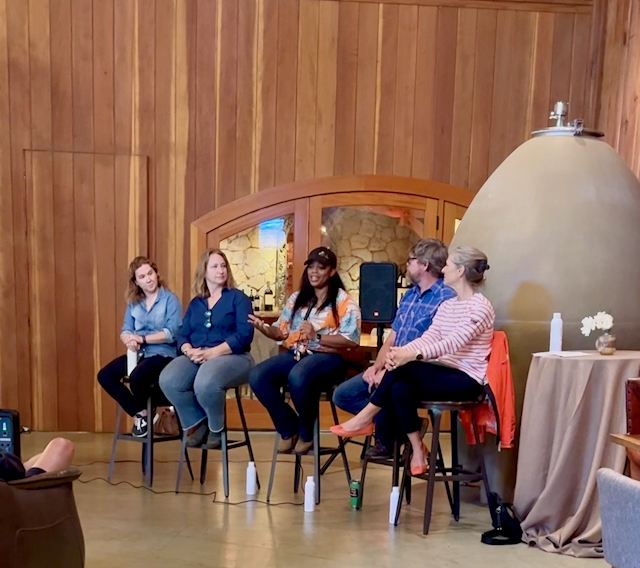
Kendall Hoxsey, Jennifer Higgins, Brenae Royale, Scott Knippelmeir and yours truly chat about Sémillon at Lambert Bridge Winery
Sem-posium
This comparison was one of many at the recent ‘Sem-posium’ organized at Lambert Bridge Winery in Dry Creek Valley, Sonoma County. An opportunity for growers, wine makers and the Sémillon curious to discuss and discover more about this too often over-looked variety. Jennifer Higgins,general manager and wine maker at Lambert Bridge was the instigator of the event. In 2016, Jennifer came to Bordeaux and tasted white Château Haut Brion.
The Tasting of Château Haut Brion that started it all
It changed her perspective on Sémillon. Returning to Sonoma, she looked for some Sémillon grapes to make a similar blend. Originally a one off ‘Lambert Bridge Cuvee Blanc’, (a blend of 70% Sauvignon Blanc and 30% Semillon) it was so well received that she’s been making it ever since.
Sauternes to Sonoma These links with Bordeaux, and Sémillon became closer in 2020. With few grapes to vinify, thanks to wildfires and smoke taint, she turned to Bordeaux to make a red blend with Vinivbut also a Sauternes Cuvée, ‘Sigalas Lambert’ with Château Sigalas Rabaud,1stgrowth Sauternes. Born out of her friendship with owner winemaker Laure de Lambert, it was another deep dive into the complexity and versatility of this grape variety.
The Cuvée Sigalas Lambert
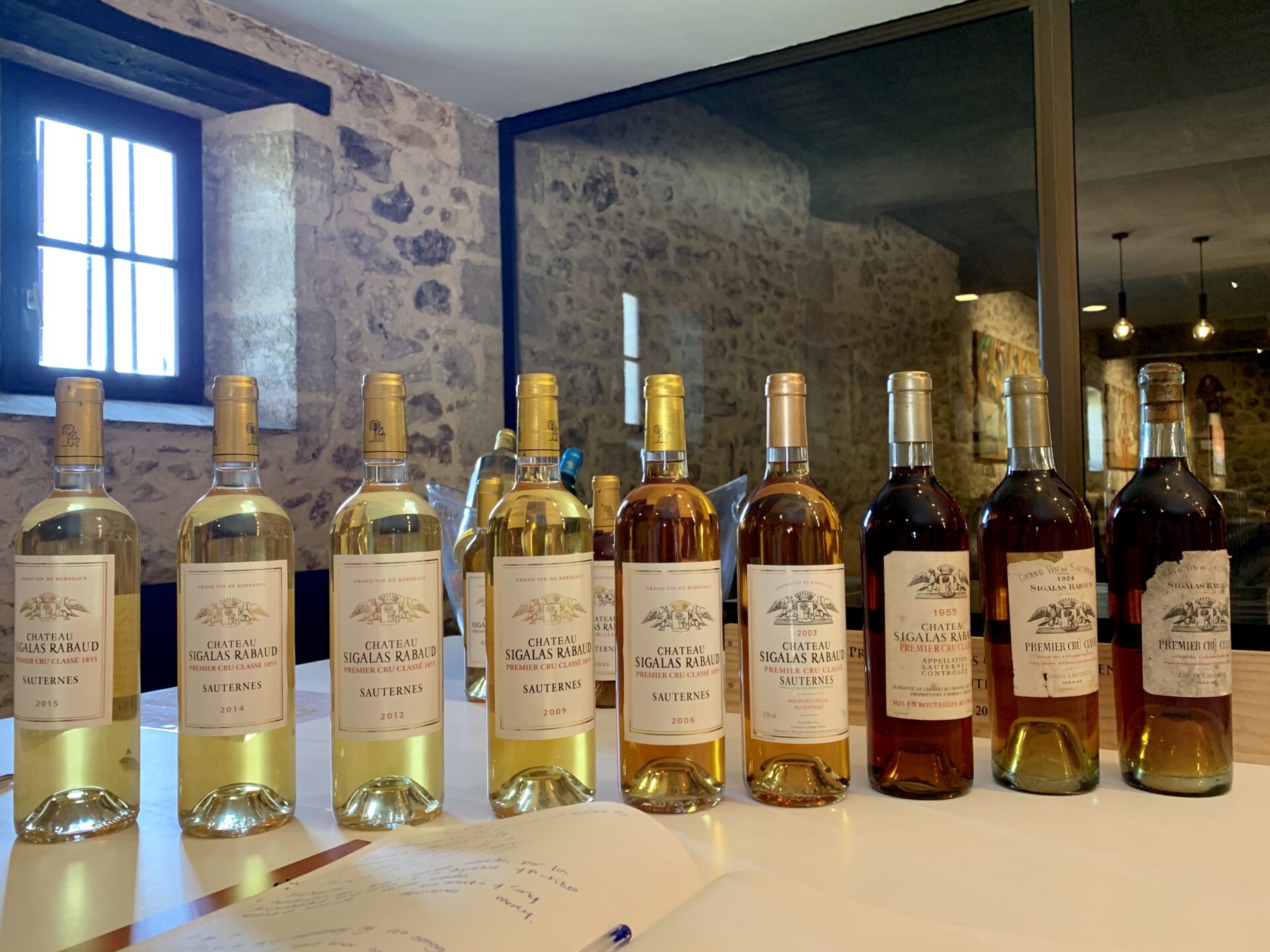
Old bottles, new wines
Laure is the perfect partner, a champion of Sémillon, both sweet and dry. She took over the reins of family property in 2006, and, despite family resistance after six generations of sweet wine producers, in 2009 she introduced a dry white Sémillon-Sauvignon blend, La Demoiselle de Sigalas. Although emblematic of Sauternes, Laure feels that Sémillon remains under-appreciated and its potential still largely unexplored. She’s doing her best to change this. She praises the ‘aromatic richness of Sémillon, that evokes and becomes more complex with age’. It has a fabulous aging potential both in dry and sweet expressions. ‘With age it’s like an excellent Chardonnay even top tasters can be confused’.
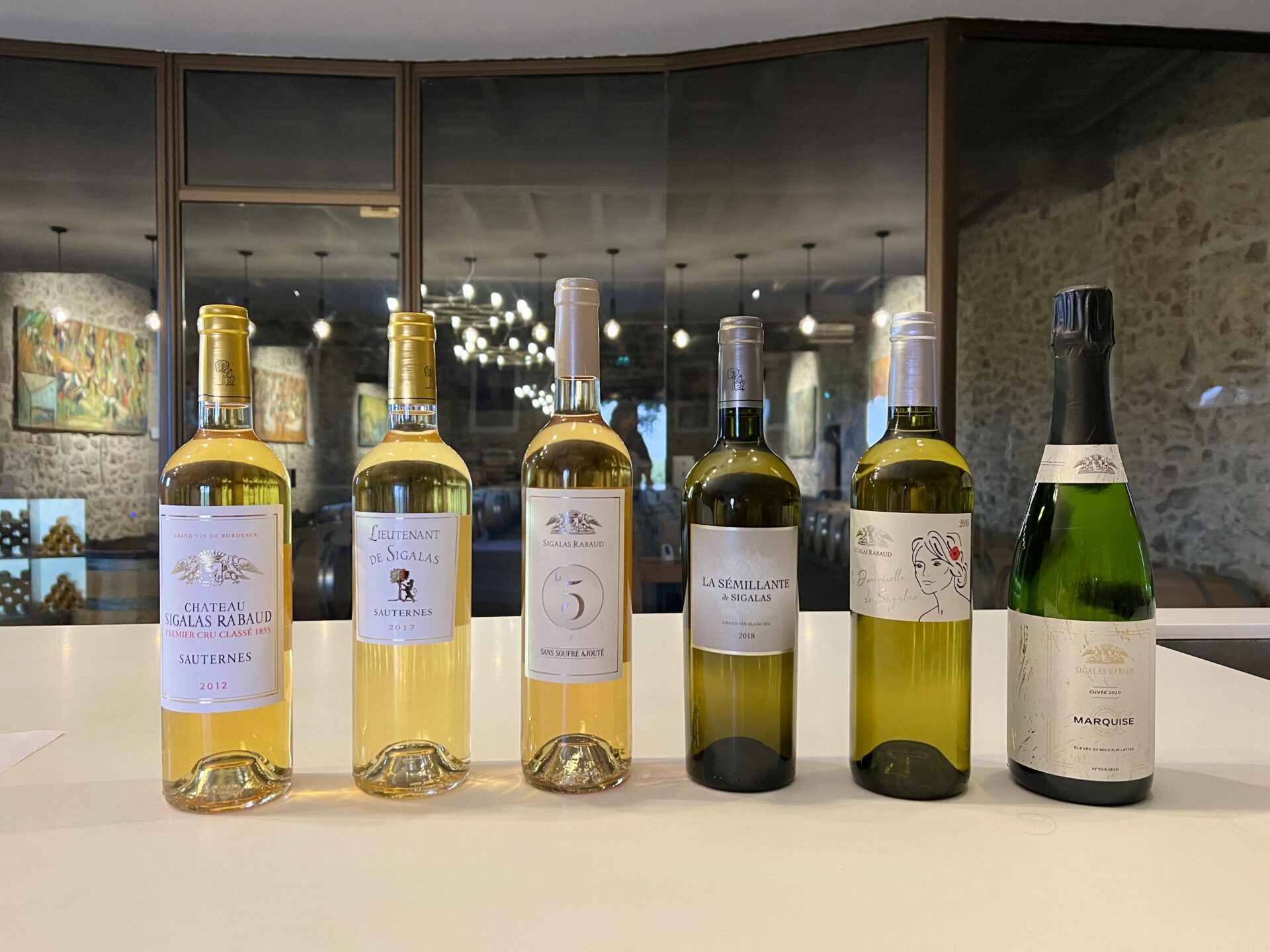
As she found her dry Sémillon more and more interesting, she has increased it’s percentage in the blend (it is now around 95% Sémillon) and two 100% dry Sémillon cuvées followed, La Sémillante and Château Sigalas Sémillon, both vinified and aged on lees in Burgundy barrels. In 2020 she introduced La Marquise, a 100% sparkling Sémillon Crémant de Bordeaux, aged for 30 months on its lees, (with a drop of Sauternes in its ‘liqueur de dosage’ – to keep it the family). All this alongside the classic Château Sigalas Rabaud 1er cru Classé Sauternes.
These multiple expressions of Semillon from a small 14 ha property perfectly showcase the diversity and potential of the variety. For Laure, Sémillon allows ‘the terroir to express itself, which is wonderful for a wine maker’. The gravel soils at Sigalas Rabaud bring finesse and tension, on clay, depth and structure and on sandy soils more simple wines. ‘It’s a real French wine, slightly austere at the beginning but elegant and flavorful as it evolves’.
Although no specific appellation exists for dry whites in Sauternes and Barsac yet, (wines are labelled “Bordeaux Blanc”) there is a history of ‘dry Sauternes’. Researching Sémillon, Laure found a 1948 Château Gilette labelled ‘Sauternes Sec’.
Château Doisy-Daëne in Barsac traces dry white production back to the early 1950s, as does Château Lafaurie Peyragueywhen, under the ownership of Cordier, it was bottled in Alsace bottles as a nod to the family origins.
Since the 1980s there’s a renewal of interest in dry whites here, the names may lack imagination (G de Guiraud, R de Rieussec, S de Suduiraut, M de Malle – all inspired by Y d’Yquem) but the wines are delicious. The gravel, clay and limestone soils of Sauternes and Barsac are perfect for dry whites with Sémillon increasing in blends. Opalie, a 50/50 blend from Château Coutet in Barsac was introduced in 2010, Château Lafaurie Peyraguey reintroduced a dry white in 2014 and Asphodele, a 100% Semillon from Château Climens arrived in 2018. The team from Domaine de Chevalier, who know a thing or two about white Pessac Léognan, produced their first Clos des Lunes in 2011 where, in the heart of Sauternes, they only produce dry wines .
Historic Sémillon
Sémillon has a long and prestigious history in Bordeaux, it’s at the heart of the whites of Graves Pessac Léognan, the only classified dry whites in the region. Bordeaux may be the world’s largest Sémillon vineyard, but it’s not the only place with history.
Unlike Bordeaux where grapes are estate sourced, upon her return to Sonoma, Jennifer could shop around for her Sémillon grapes, although they’re hard to find, (California has approx. 500 acres of Sémillon compared to 17 000 Sauvignon Blanc). She started sourcing in the Russian River Valley, before working with Brenae Royalin 2O20,at the Monte Rosso Vineyard, where Brenae farmed 3.82 acres of Sémillon planted in 1886. Dry-farmed, head-trained (no trellising) and at about 1,000 ft elevation, these are the world’s second-oldest Sémillon vines – just 20 years younger than Hunter Valley’s oldest.
Kendall Hoxsey’s familyhas been farming in Yountville for over 200 years, including 10 acres of Sémillon planted by her father. She says the workers love picking it, also head trained, there’s no wires, which gives them freedom.‘We’re hoping that our new planting down in a cooler area is going to retain acidity, fog goes through and really keeps it cool, so we try to have most of the whites there’.
A range of wines
Lambert Bridge now makes two Sémillon wines, the original‘Cuvée Blanc’ blend with 30% Sémillon partly from Monte Rosso Vineyard and a single varietal fromSei Querce Vineyards inAlexander Valley. Jennifer has been known to throw in ‘a touch’ of Sémillon to round out her Sei Querce Sauvignon Blanc.
Lambert Bridge Cuvé Blanc and Sémillon from Sei Querce
Diversity of terroir, diversity of style
Sémillon is tricky to find in Sonoma but also tricky to grow. Jennifer and Scott are working with growers, learning about the farming all the time, quality really depends how and where it’s grown. Scott farms Sémillon, and a lot more, across the region, even pulling up some red grapes to replant with white grapes specifically for Sauvignon Sémillon blends. ‘I think in the next couple of years we’ll plant in four different places, maybe 10 in 12 acres’. Most is for blends for wine makers who want to create a white wine blend with two to four different varieties.
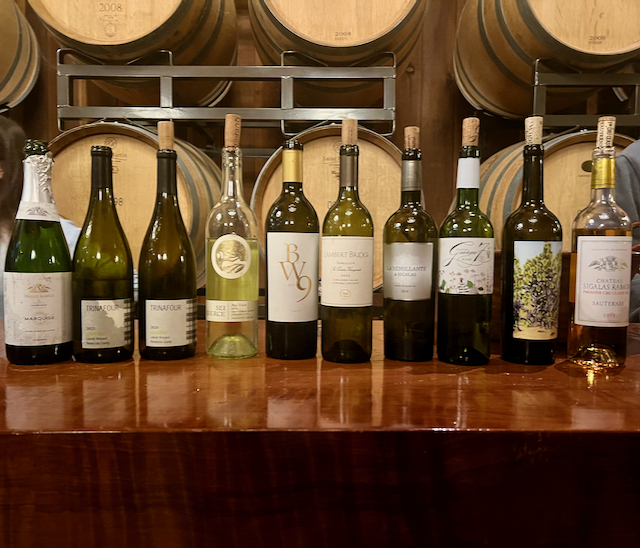
Some of the Sémillons and blends from both sides of the Atlantic ^resented at the Sém-Posium
Place
Drainage is important on these volcanic soils, if the subsoil gets saturated and becomes anaerobic, there can be some manganese toxicity. Not dissimilar to Sauternes, where Sémillon thrives on Laure’s naturally well drained south facing gravel slopes.
For Sémillon in Sonoma cluster spacing is important to avoid rot, especially in where the Petaluma fog comes in. Unlike Sauternes they are not looking for noble rot. The few noble rot wines grown here are thanks to Botrytis introduced by the grower. Not something you’ll see in Bordeaux!
With its high elevation, the Monte Rosso Vineyard enjoys a cooling influence from the San Pablo Bay but is above the fog line. Also, with a southwestern-facing aspect, which means midsummer sunshine from 5 a.m. to about 9:30 pm but with a 150 foot drop – a very different topography to Sauternes. A swift diurnal shift of 15 and 20 degrees softens tannins, rounds off the edge, but keeps acidity that helps these wines age really well.
Brenae in the Old Sémillon vines at Monté Rosso
Sémillon is definitely a grape you have to pay attention to, it’s very reactive. Kendall Hoxsey remembers the horrible heat wave in 2022, ‘Four days prior to the heat wave, nothing was ready, so we were all forced to wait then boom, it’s overripe’. Consensus is that Sémillon has a short window of picking opportunity, going from under to over ripe quickly. Not dissimilar to Merlot.
Lost in Chardonnay
In 2015, Brenae took over the historic ranch of Monte Rosso vineyard in the Moon Mountain District outside the town of Sonoma. ‘Nobody really cared about Sémillon, it was lost in some Chardonnay programme, forgotten about and didn’t get a ton of a TLC’. She started to give the Sémillon a little more attention. ‘These are really vigorous vines, with roots that go about 32 feet through the bedrock’. Brenae shared a photo on Instagram where she’s standing next to a six foot tall Sémillon vine. Many are over five and a half feet with huge variability, ‘There’s fruit low near the ground, some at six feet, and then some on the inside’.
Impressive yields and interplanting
There’s a big difference with Bordeaux yields that are (legally) tiny in comparison. Brenae’s 100 year old vines still produce three and a half tons to the acre, despite being completely dry farmed. ‘Cluster weights were just shy of a pound apiece, they’re massive. I need both hands to hold them because they’ll usually have like two wings on them as well’.
Heavy yields of Sémillon at Monte Rosso
If you aren’t paying attention to the farming, these clusters become enormous, and they’re on top of each other and they’re like water balloons.’ She trims the wings, to reduce weight on these very fragile limbs, after about four pounds canes start to snap.
Managing maturity
Nick said he’s seen some varietal characters just drop off the ledge if you push the tonnage too much, ‘you just get ‘shitty’ juice, and variety goes away quite quickly’. But if you’re not overwhelming the vine with too much fruit, that precipice, doesn’t come as swiftly.
‘We kept the leaves up top, and then go inside and strip the middle, to get airflow without getting the direct sun’. The vines are interplanted with Folle Blanche, Burger, Lenoir, Pinot, St. George and more, a historic legacy. They started mapping but eventually stopped looking and called it 100% Semillon.
InLolonis Vineyard in Redwood Valley, Scott dry farms Sémillon interplanted with Viognier that sits about two feet higher than the Sémillon. He’s curious to see how that shade cover works. He trellises horizontally for even ripening, with Semillon there’s a real delicate balance between pushing it to ripeness and being diligent about managing the fruit load. Brenae agrees, ‘Semillon is super reactive to the weather’, she’s happy to have vines where she can keep the acidity, but with sweet notes, not just in the aromatics, but on the palette as well. She likens the finish to ‘Bodega Bay or something with some oysters’.
Her sweet spot is between 20 bricks and 23 bricks, 19 brix is too low and acid is high, with sharp tannins. ‘Past 23, and you’ll get bigger, flabbier ‘California style’ Sémillon. At the Monte Rosso Vineyard Sémillon harvested between 20 to 23 brix, will get beautiful aromatics, lots of citrus and honeysuckle and melon, and if you find the balance some nice salinity, with spice notes from the volcanic soil.’
Laure tells a similar story from Sauternes. The Sauternes harvest needs several passages through the vineyard, hand picking the grapes affected by noble rot. She applies this same philosophy to her dry Sémillon with at least two passages through the plot, picking grapes at different maturities to keep that balance between freshness, aromatic complexity and the depth and structure that Sémillon brings. A structure she reinforces by fermenting and aging on the lees in barrels.
The consensus is that farming is essential to get the quality and balance, if not you can get ‘fruit balls’ in California. Patience is key, to wait until the flavours come in, a peach nose note, but like peaches, you have to wait for it.
Château Sigalas Rabaud has an historical advantage of having a diversity of excellent old Sémillon vines, on her gravel and sandy, south facing soils that offer perfect conditions for ripening and concentrating the aromas. Planted to 85% Sémillon, she is working with the Chamber of agriculture to preserve and clone the heritage of her 45 year old vines.
Climate Sensitivity
Sémillon seems to be very reactive to the weather on both sides of the Atlantic, particularly sensitive to extremes of temperature. Laure finds her Sémillon is suffering more than previously. She feels the challenge is less the increasing temperatures but more a chaotic climate. Sémillon seems to be suffering from the more brutal changes between hot and cold, with both younger and older vines showing a higher mortality rate than before.
Previously Laure was coplanting the vineyard, replacing dead vines one by one, a slow process but respectful of the vineyard. Historically planted on riparia rootstock, she uses the more vigorous SO4 for the coplants. ‘In Bordeaux’, she says ’you’re not really supposed to talk about vigour’ but she feels this vigour protects the new Sémillon vines from the variation of climate they’re seeing.
Now, with this accelerated mortality she has changed her strategy, four years ago deciding to uproot a small plot in front of the château, planted in 1955. The first plot they’ve completely in 70 years, ‘it was hard to uproot such beautiful old vines’.
New planting at Château Sigalas Rabaud
After three years lying fallow, they replanted in April, using the massal selection, to preserve the typicity of those old vines. Here she’s replanting with 110 Richter on the deep gravel, vigorous but also better at managing water scarcity, even if the deep roots are slower to become established. On the clay less susceptible to drought, they are using 10114.
After the 2017 fires and high winds broke vines at Monte Rosso, Brenae kept the St. George rootstock and grafted on Sémillon, also using parent material from the Sémillon block. ‘In vineyard management, it’s not a popular thing to use old and diseased parent material because you’ll shorten the expected lifespan of the new vines, but we didn’t want to lose the heritage of the vines’.
Ageworthy weight
The lots are small, so the majority of Sémillon in Sonoma is fermented in small stainless steel barrels and some in neutral oak with a bit of new oak to finish. There’s an idea that keeping it on new oak for too long and ‘You lose kind of that essence’. It’s a different approach to Pessac Léognan where Sémillon’s acidity and ageing potential from the temperate Bordeaux climate is reinforced by barrel ageingbuilding wines designed for ageing.
Sauternes – a wine made for ageing
Sémillon doesn’t go through malo on either side of the Atlantic. In Bordeaux retaining acidity is key especially for wines destined for ageing, it’s very rare to see malo on any whites in Bordeaux.
At Lambert Bridge, Jennifer treats it as she does her Sauvignon. ‘In general, the malic is not very high, the acid is definitely the soft part of the blend. That’s what’s being added when you blend with Sémillon’. She also used a concrete egg, ‘It turned out beautifully, it preserved the fruit but with that texture that you get out of concrete. We’ve also fermented Sauvignon Blanc in the egg and then blended it in, it just depends on the year’. ‘If you want more spice and a little bit more weight, the barrel does a great job’.
Brenae is releasing a 2023 Sémillon under her new brand, Violet’s Paradise. ‘It was quite a cool vintage and initially, the wine was a little lean,so I put it in 100% newFrench oak for three months, to round it out and bring out some of the vibrancy and it worked beautifully with spicy typicity’.
Laure ferments her Sémillon and Sauvignon differently for her dry white. The Semillon is fermented and aged in oak and for Le Demoiselle, the Sauvignon is fermented in stainless steel, both are aged on fine lees before blending. The 1er Cru Classé Sauternes is fermented and aged in new oak for 18 months and the crémant spends 30 months on the lees in the bottle before disgorging.
Lighter brighter
As well as the arrival of dry white, Sauternes is adapting. Consumers are looking for a lighter, brighter Sauternes and there’s a desire -y many to create wines that are accessible young. Laure has produced a zero sulphite semi sweet ‘Le 5’, specifically for this market. She serves it over ice with a twist of orange peel.
Hard sell or a hand sell?
In California there’s a market for grapes and a market for finished wine. Kendall Hoxsey says, ‘We’re selling the fruit to wine makers that want to try something different, they want to expose people to different wines, winemakers that have a story to tell.’ When Brenae took over grape sales in 2019, she started looking for people who ‘gave a damn’ about Sémillon, and Jennifer came along!’ Jen purchased one ton of Semillon fruit from Monte Rosso Vineyard in 2020. She remembers ‘The vines were taller than me, and grew beautiful fruit’.
A white wine option for the red wine drinker
In California, Sémillon wines are hard to find, they often sit in a portfolio of a majority of red. It’s about having options, people want options. When they come into the tasting room, they know the Chardonnay, they know the Sauvignon, but some will be willing and wanting to try something new. They are easier to sell with brand equity behind them. ‘Semillon acts as a nice reprieve for the red wine drinkers’ says Brenae,it always has a little bit of weight to it.
The Lambert Bridge Sémillon has been very well received, with their DTC model. Sémillon is a hand sell and they can tell a story. If consumers trust you and know the winemaker, they’re more willing to experiment. It’s about getting people to try it, be seduced by the wine and letting the Semillon speak for itself.
‘It’s not Chardonnay!’ says Brenae ‘It’s just something different. Chardonnay and Sauvignon Blanc are doing well and they’re running the market right now. So, here’s something different that doesn’t stray too far in style’.
Bordeaux dry Sémillon needs a story too, many consumers have never heard of it. As Laure says, ‘In Sauternes we’re used to a difficult sell, selling sweet white wine is not always easy’. Relying on sales of Sauternes is hard, the expense of production, the low yields and the extreme climate sensitivity needed for the Botrytis magic to operate, means these wines are expensive, difficult and unreliable to produce. Producing a more reliable and more approachable dry white is a welcome, steadier source of income. Bottled earlier and with higher yields (although well below California!) they help cash flow. They also offer a more affordable introduction to the region. Offering a range is still relatively unusual in Bordeaux chateaux and is a huge advantage with wine tourism. Château Sigalas Rabaud is open for visits, tastings and lunches with five guest rooms in the Chateau. A glass of dry white on arrival is always welcome.
a selection of the Sigalas range at Lambert Bridge with the Cuvée Sigalas Lambert
Experiments and enthusiasm
Laure sees these experiences as nurturing a greater understanding of the grape variety, its maturity, the impact of botrytis cinerea, the ageing and ageing potential for both dry and sweet. An analytical and pragmatic approach allows for evolution whilst preserving the chateau style. ‘It’s an opportunity to share the richness of our terroir, to show Sauternes as a centre of experimentation that offers a diversity but faithful to a long tradition’.
The Sém Posium
Challenges
Sémillon presents challenges on both side of the Atlantic in the field, the cellar and in the market but it has its fans. There’s other great terroir for Sémillon, we touched on Australia and I tasted some wonderful Sémillon blends on a recent trip to Margaret River where another group of dynamic women are leading the charge.
More than fans, these growers and wine makers are evangelical, experimental and excited about the potential of this too often overlooked variety. Perhaps the next Sem-Posium will be in the Southern Hemisphere?
Thanks for reading, please feel free to share with anyone interested in discovering Sémillon and learning more about Bordeaux. Sign up here to receive future posts directly to your in box. Read the new Green Edition of Bordeaux Bootcamp, and explore Wine and Wellness, with The Drinking Woman’s Diet or say hi here.
As well as writing this blog, I write for other wine publications and share my ‘healthy passion for Bordeaux’ through in-person and online classes. Contact me here to learn more.
There’s nothing new about finishing a whisky in an oak cask, using different provenances, sherry, port and yes, even Bordeaux. I’m particularly fond of a Sauternes finish. Glenmorangie Nectar d’Or was the first one I tasted, it is still delicious. The group LVMH owns both Glenmorangie and Château d’Yquem, which must come in handy when sourcing barrels. I also love Glenfiddich and was in Scotland for the unveiling of a Cérons finish whisky, using barrels from Château de Seuil.
There’s about to be a new one on the block, a joint venture between a sweet wine producer from a nearby hill overlooking the river and an island whisky distillery. I’m sworn to secrecy for the moment but watch this space.
But Gin?
Barrel aged gin is rare but can be found, (there’s a particularly delicious Bordeaux barrel aged negroni), but now there is a Sauternes finished gin, or Barsac to be precise.
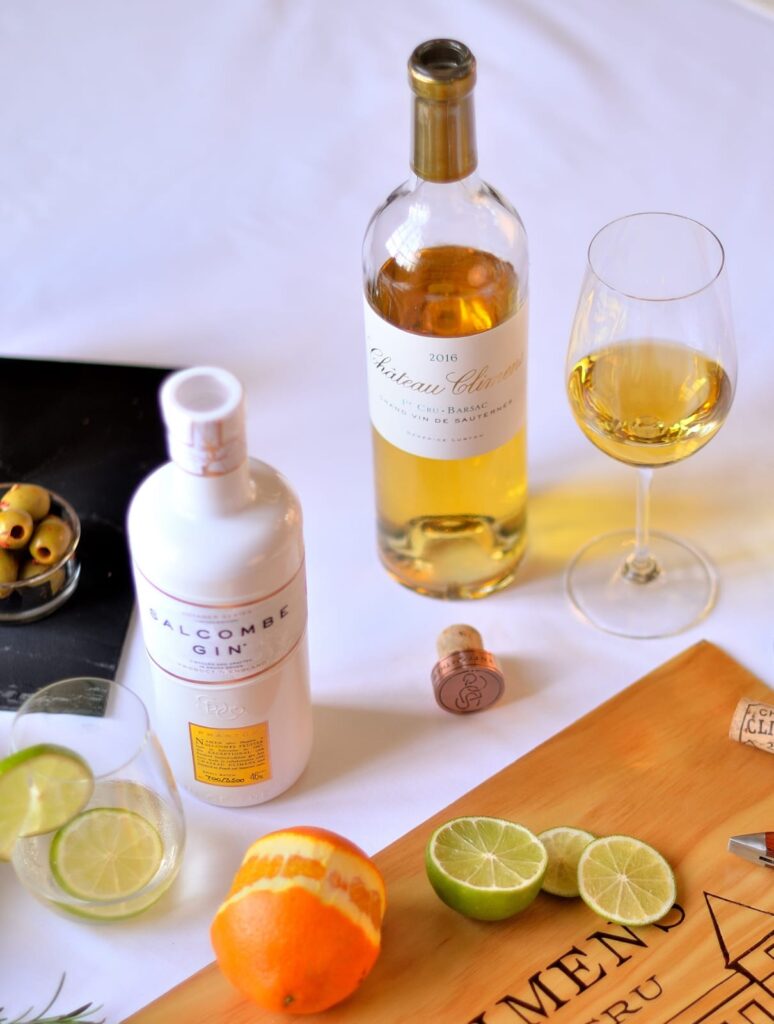
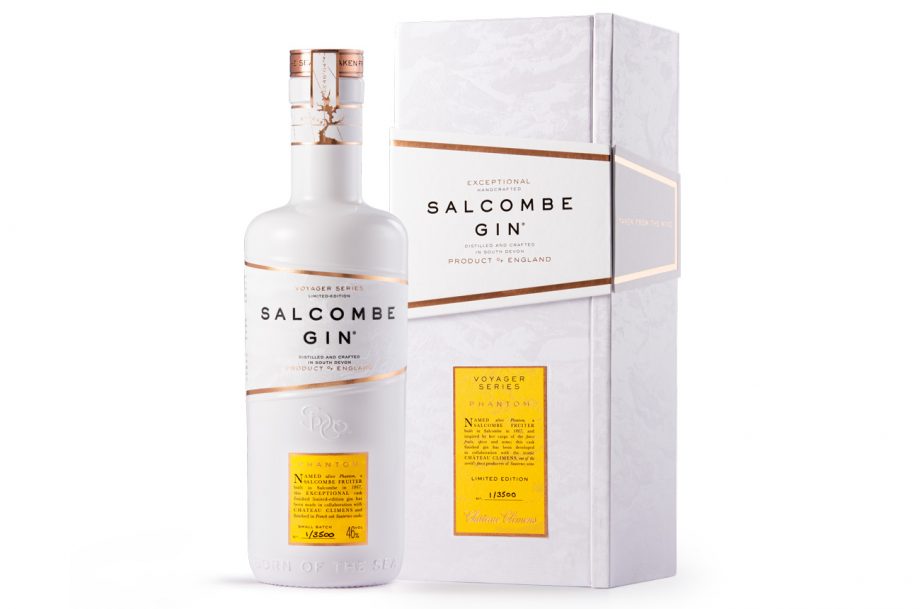
Château Climens and Salcombe Gin have joined forces to create Phantom. The name was inspired by a ghostly vision of the Chateau emerging from the famous morning mist on the first visit of Angus Lugsdin, to Château Climens.
Angus is the creator of Salcombe Gin, from the Devon Coast in the South of England. Phantom is also the name of a 19th century boat that shipped botanicals for the gins to the port town of Salcombe.
Photo credit Ferderic Nivelle, cellar master at Château Climens, clearly a man of many talents!
The gin is the sixth in the limited edition ‘Voyager series’, a range inspired and crafted by chefs and wine personalities.
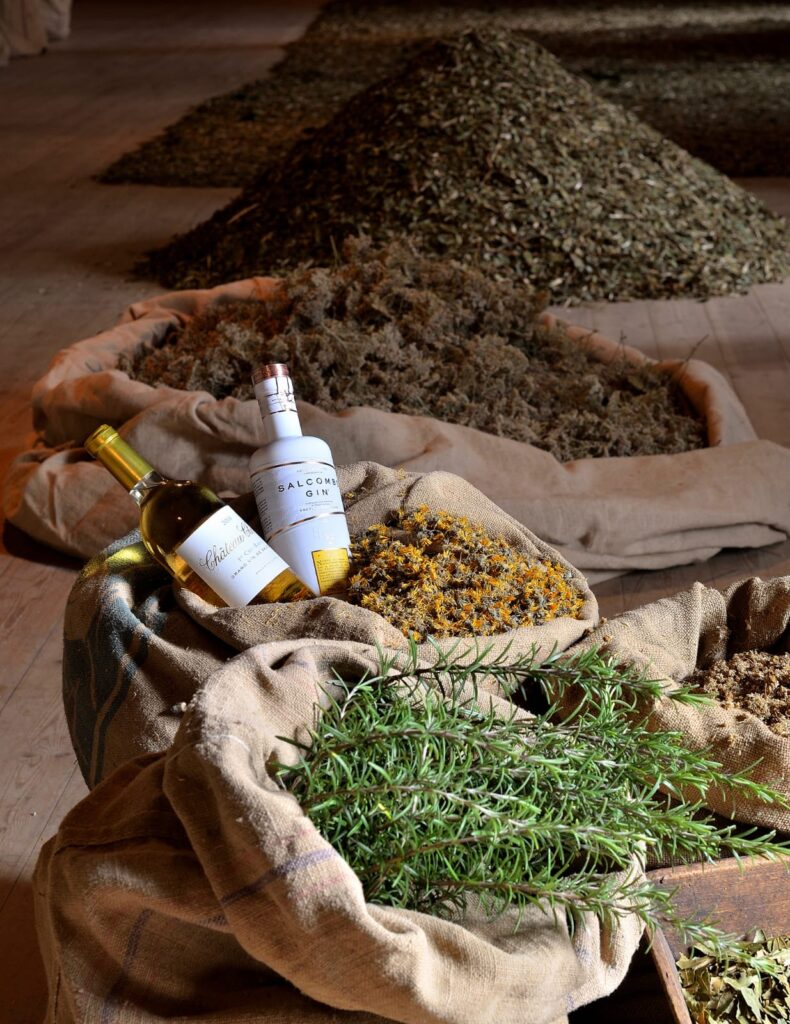
The uniqueness of this gin comes not only from ageing in Château Climens barrels that previous held the sweet wines of the property, but also from the botanicals used during distillation. Seven of the 16 botanicals used are from the vineyard. Owner wine maker Bérénice Lurton is passionate about the biodiversity of her estate. A biodynamic producer, she sources locally grown herbs to create her vine treatments. These herbs are dried in an attic above the fermentation cellar, which is also a venue for wine and yoga classes.
Botanicals drying in La tisannerie of Château Climens. Photo credit Ferderic Nivelle
From these herbs, Bérénice and Angus along with cellar master Frédéric Nivelle, selected marigold flowers, fennel, nettle, cypress and laurel, and, after several trials added rose petals from the Chateau. Once distilled, the gin was aged for eight months in five barrels (or casks once we start talking about spirits) that previously held the 2015 or the 2016 vintages.
Sadly I haven’t tasted it yet – but I’ll have a bottle waiting for me when I get back to Europe – I’ll let you know, but the finished gin is described (and I quote) as having:
‘a decadent cask finish, mimicking the aromas and flavours of the wine: honeyed peaches, rose petals, cypress, lavender and orange blossom on the nose. Notes of apricots, jasmine, toasted oak, spices and caramelised orange peel follow on the palate. There is a fresh green savoury hint from the nettle and fennel making it light but enhancing the depth of flavour. The finish is acacia honey and cantaloupe melon, balanced with the minerality of fresh orange peel pith’.
Serve Phantom with organe peel and tonic to bring out the citrus flavours the Climens barrels bring. Photo credit Ferderic Nivelle
They suggest serving it with orange peel and tonic, which makes sense given the citrus aromas of Climens – my mouth is watering.
The elegant Phantom packaging.
The limited edition of 3,500 50 cl bottles are presented in an embossed white bottle with a copper stopper and packed in a matching white and copper box. It is almost Christmas.
Or Coffee?
If you thought Gin and Barsac was an interesting pairing, what about Sauternes and coffee?
Château Sigalas Rabaud, first growth of Sauternes, has been in the same family since 1863. The current owner wine maker, Laure de Lambert, is the sixth generation of the family at the helm. She’s not letting tradition stand in the way of innovation.
The barrel cellar of Château Sigalas Rabaud, where the ageing of the coffee beans took place.
Alongside Simon Verger from the hotel and two Michelin star restaurant Haaitza in nearby Pyla and coffee specialist Yoann Bride from the Brûlerie Comtoise in the Jura, they have launched a unique project. It was a meeting of minds.
They have been experimenting since January, ageing raw coffee beans in barrels that previously held the classified growth Sauternes.
From wine labels tocoffee labels – look familiar?
They left the green beans for eight, nine and ten weeks, rolling the barrels regularly to impregnate the grains with the floral and citrus notes characteristic of the ‘grand vin’. Finally they chose nine weeks as the ideal ageing period, then roasting it. The coffee is now for sale at the Brûlerie Comtoise but will be available at the Château too. They might even serve it at breakfast if you stay in one of their lovely guests rooms.
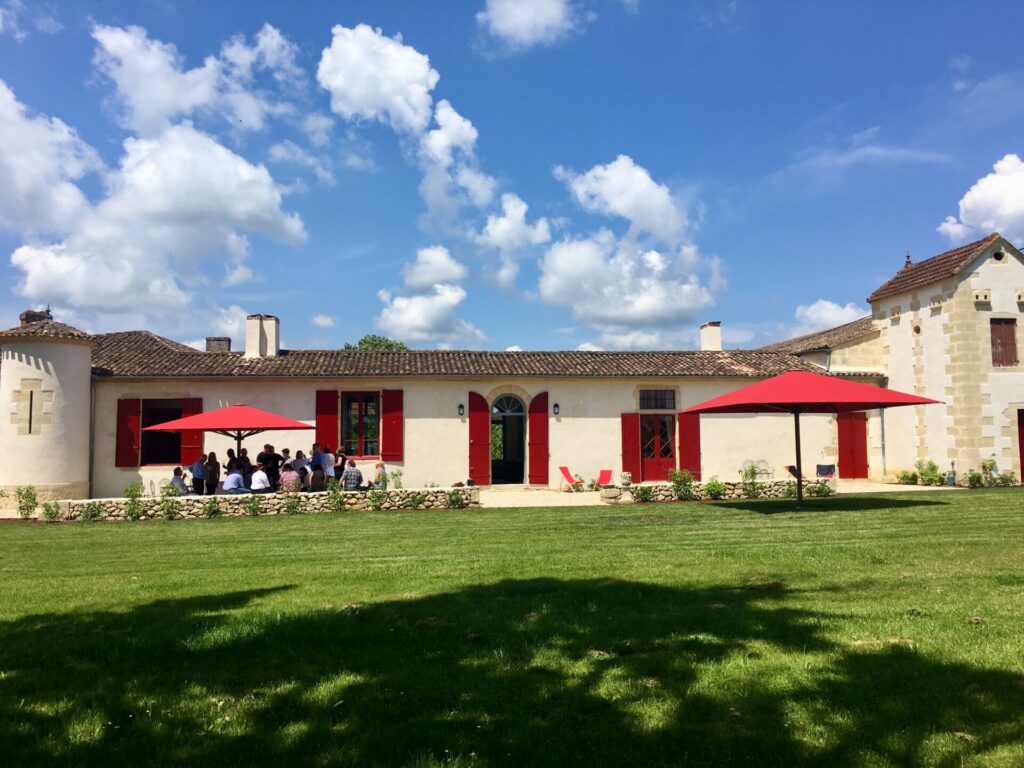
The terrace at Château Sigalas Rabaud in Sauternes
I can recommend sipping a coffee on the beautiful terrace of the property, overlooking the vines after tasting their wines.
If you have enjoyed this post, please sign up here to receive future blog posts directly to your in box. If you would like to learn more about Bordeaux, buy your copy of Bordeaux Bootcamp here, to learn more about Wine and Wellness, buy your copy of The Drinking Woman’s Diet here.
If you think women in the world of the wine world is something new and/or unusual, where have you been in recent years? You might be forgiven for thinking that in such a traditional bastion of wine as Bordeaux, women in the vineyards and cellars might be more unusual that in other regions – think again. Historically, there have always been influential women on the Bordeaux wine scene, as well as many others working behind the scenes.
Some of Bordeaux’s leading vineyards are still going strong today thanks to the historical role of women. Jean de Bellon was the first owner of Chateau Haut Brion in the 16th century and it’s not only Champagne that has famous widows. As a young widow, Françoise Josephine de Sauvage d’Yquem was thrown into prison twice during the French revolution but she continued to make Château d’Yquem prosper. The Comtesse de Bournazel successfully took over the reigns of the family Chateau de Malle in Sauternes on the death of her husband, before handing it over to her son. Château Pichon Longueville Comtesse de Lalande is named after another Comtesse responsible for its success.
Properties may be handed down from fathers to daughters who continue to grow the family estates. Famously Baroness Philippine Rothschild continued and expanded her father’s work at Mouton Rothschild, Corinne Mentzelopoulos owns and runs Chateau Margaux with her daughter. More recently, Siaska Rothschild took over running Château Lafite from her father Baron Eric, and Stephanie de Bouard-Rivoal is now in charge of Chateau Angelus alongside her cousin Thierry Grenié,with Emmanuelle Fulchi their cellar master. There is nothing new about feminine power in Bordeaux wine.
Not so long ago it was unusual to see a woman working in the cellars – with an older generation of male wine makers talking about women ‘turning’ the wine – and that is still in living memory. Women are now making the wines as well as owning, running and marketing them. A few that come to mind, and not only in the top growths, are Marjolaine de Cornack at Chateau Marquis d’Alesme, Maylis De Laborderie at Chateau La Lagune, (both working with female owners), Paz Espejo at Château Lanessan and Caroline Artaud at Château Forcas Hostens. Some women are carrying on from the parents in a family vineyard, such as Estelle Roumage at Chateau Lestrille, Armelle Falcy Cruse at Château du Taillan, and I could go on.
I organized my first Women in Wine Tour in Bordeaux back in 2007, so again nothing new here, but these women, and many more, came back on my radar thanks to the recent visit here in Bordeaux of the American association Women for Wine sense (WWS). Created in 1990 by two leading Californian women in wine, Michaela Rodeno and Julie Johnson, WWS aims to increase knowledge about wine through education as a counterweight to the anti-alcohol lobby. Their premise is a better understanding of wine leads to more responsible consumption. The success of this organisation has been phenomenal; they now have a network of 10 chapters and growing throughout the US and a charitable arm that sponsors wine education for women in the industry.
I have run several Bordeaux seminars for WWS members in the US over the last year but this was their first trip to Bordeaux. With Decanter Tours it seemed only natural to concentrate on vineyards with a feminine signature, choosing properties for them to visit that were owned by, managed by or where women made the wine. I’m aware it’s sexist – but it was great fun!
We were spoilt for choice with just three days we only scratched the surface. Following their tour, I wanted to use this post to profile some of the leading women in Bordeaux but as I started looking at the long list I realised that it would take a book rather than a blog post to do them justice, so I’ll just concentrate on the women that offered us such a warm welcome and amazing hospitality during our tour.
Margaux has traditionally been considered the most feminine of all the Medoc appellations, thanks to its signature sumptuousness and velvety tannins, so it seemed like the perfect place to start. Chateau Margaux is known as the most feminine of all the 1st growths by its style as well as being owned and run by Corinne and Alexandra Mentzelopoulos. The harvest had just started when we were there, with a man at the helm; Philippe Bascules splits his wine making between Bordeaux and Napa – and was very excited about explaining the complementarity of making wines both sides of the Atlantic – he is a very busy man!
With Philippe Bascaules wine maker at Chateau Margaux above the new Pavillon Blanc cellars.
Further north, Lilian and Melanie Barton Sartorius, another mother and daughter team, are working together. As Lilian takes on more and more responsibility at the family vineyards, Leoville and Langoa Barton, her daughter Melanie, the eighth generation of the Bartons in Bordeaux and the first qualified oenologist of the family, has taken over the wine making at their new vineyard Mauvesin Barton in Moulis, purchased in 2011.
Lilian and Melanie Barton-Sartorius at Chateau Mauvesin
We also met the latest member of the family, Oona, the Parson Russell terrier puppy, who completely stole the limelight!
The newest member of the Barton family
Pascale Peyronie welcomed us to her family property Chateau Fonbadet in Pauillac. After working alongside her father for 20 years, she has stepped into his shoes to run the vineyard. Her vines are on some of the best and priciest gravel terroir in Pauillac, smack in the middle of the famous names of Chateau Mouton Rothschild, Chateau Latour, Chateau Lynch Bages, Chateau Pichon Baron and Longueville Comtesse. You can imagine that she has received some interesting offers for her vines, but she continues to produce Chateau Fonbadet as an independent Cru Bourgeois rather than succumbing to the temptation of an easier life, although she did exchange three ha of vines with Mouton Rothschild to re-organise the vineyard. When she showed us around, her 92-year-old father was still on hand to meet the ladies and help serve the wine.
Is it a characteristic for women to work more closely together? We had several examples of collaboration between neighbouring women in wine which make me think that perhaps it is.
Four properties in Margaux owned and/or managed by women have grouped together to welcome visitors into their chateaux. Well aware that chateau visits can be repetitive (vines, cellars, barrels, tasting, repeat), Lise Latrille of Château Prieuré Lichine, Nathalie Schyler of Chateau Kirwan, Marie Laure Lurton of La Tour de Bessan and Anne-Francoise Quié of Chateau Rauzan Gassies have grouped together to create a ‘Une Journée Gourmande à Margaux’. These dynamic women explained this project to us over lunch in the beautiful kitchens of Chateau Prieuré Lichine.
Ladies who lunch at Chateau Prieuré Lichine
Their idea was to create a tour where each visit concentrates on a different part of the wine process. The tour starts at Château Prieuré-Lichine, with a history of the Medoc while sipping on their white wine (yes there are some rare white wines in the Medoc even though they don’t carry the name). Then at Chateau Rauzan Gassies they explore the importance of terroir, tasting the wines from the three vineyards owned by the Quié family. Lunch at Chateau Kirwanis the opportunity to taste the wines from all four vineyards paired with regional dishes before a visit to Château La Tour Bessan to try your hand at blending, tasting your results alongside local chocolates – there’s a reason this is called a ‘Gourmande’ tour.
Nathalie Schyler of Chateau Kirwan, Lise Latrille of Château Prieure Lichine and Marie-Laure Lurton of Château La Tour Bessan.
Women do seem to be very open to developing wine tourism. I was recently asked to cover leading women winners of best of Wine Tourism awards reinforcing this impression. Chatting with Florence Cathiard at Château Smith Haut Lafite, one of the pioneers of wine tourism in the region, it was interesting to compare the European and the American approach to wine tourism. The chateau with its open door policy, new land art exhibition alongside the more traditional visits, as well as the phenomenal success her daughters have had, both with The Sources de Caudalie resort and the Caudalie cosmetics is a case study for successful wine tourism.
Talking wine tourism with Florence Cathiard at Chateau Smith Haut Lafitte
We had another experience of collaboration with the women of sweet Bordeaux. A picnic lunch in the park of Chateau de Cerons, with Caroline Peyromat and her neighbour Nicola Alison from Chateau du Seuil, was the ideal way to discover the characteristics of the tiny Cerons appellation but also to share their red and white wines from the Graves appellation.
Then on to Sauternes and Barsac for a progressive dinner, the idea was to show just how food friendly the sweet wines of Bordeaux really are. After a visit and tasting at Chateau Yquem with cellar Master Sandrine Garbay, and a look at the new in-chateau boutique, we headed down the hill to the terrace of Château Sigalas Rabaud. Here, with tapas, we tasted the range of wines made by owner wine maker Laure de Lambert including her 100% dry Sémilion (La Semillante) and a Sweet Bordeaux made with no Sulphur le 5 – quite a technical challenge.
Tasting the semillon juice at Chateau Sigalas Rabaud before fermentation
Then on to Barsac, to first growth Château Climens, for the main course served with three vintages from the property, after discovering where owner wine maker Berenice Lurton dries and prepares the herbs she uses in her biodynamic preparations.
La Tisanerie at Château Climens in Barsac
And of course dessert served at neighbour Château Coutet by Aline Baily, and we all slept soundly on the coach all the way home!
The chapel at Château Coutet
We found this same spirit of cooperation in Pomerol. The neighbours came over to lunch organised by Monique Bailly at the new Ronan by Client winery of Château Client. Hosted by Nathalie Bez, we were joined by Maireille Cazaux Director and wine maker at Chateau La Conseillante and Diana Berrouet Garcia Wine maker at Chateau Petit Village.Tasting their wines side by side, although they are so close, showed just how important the notion of terroir can be even in as small an appellation as Pomerol.
Tasting with the neighbors in Pomerol
Cellar master Emmanuel Fulchi hosted us at Chateau Angelus, taking us into the vineyard to get to grips with the terroir in their two properties, Chateau Angelus and Chateau Bellevue. Walking amongst the almost ripe grapes, we could understand the subtle differences of terroir up and down the south facing foothills of the limestone slopes of Saint Emilion.
Emmanuelle Fulchi explains the Saint Emilion terroir at Château Angelus
The tasting was a master class in right bank Merlot. Bellevue is 100% Merlot and Angelus a blend of Merlot and Cabernet Franc. Recently returned from a Merlot seminar in the US, Emmanuel shared her surprise at the reputation Merlot suffers from in the States. The tasting firmly dispelled any questions hanging over the great potential of Merlot on the right bank.
The Women for Wine Sense visit was both an opportunity to shine a light on the women in Bordeaux but also to dispel a few Bordeaux myths. They are planning to return, so it’s back to the drawing board to see which other Bordeaux Women in Wine we can visit on their next trip – we will be spoilt for choice.
The sweet wines of Bordeaux are too often overlooked. They were at the height of their fame and success in the 19th century, whereas now they are too often relegated to a dessert wine after dinner, when everyone is already replete, or as an optional add-on to a Bordeaux wine tour.
The wines have an undeserved reputation for being expensive. They are certainly costly, and difficult, to produce. Low yields, labour intensive, risky harvests, but they are rarely expensive to buy, certainly not compared to many Bordeaux reds. Sweet Bordeaux wines merit a closer look. Do get yourself to Sauternes, it has never been easier or more exciting. Add an extra day (or two) on your next Bordeaux wine tour – it’s nearer than Pauillac and no further than Saint Emilion and every wine tourist finds time to go there.
When I say Sauternes, I really mean Sweet Bordeaux. Did you know there are 15 different appellations in Bordeaux where sweet wines can be made? Some are really tiny and don’t make sweet wine every year. The first person to list them all in the comments below will receive a signed copy of my new book ‘The Drinking Woman’s Diet’.
So what is so exciting? First the wines themselves: wine makers are producing sweet Bordeaux wines that are brighter, lighter and perfectly adapted to so many drinking opportunities, from aperitif, to fish, from roast chicken to blue cheese. Try them with spicy food and there are always the classic matches of foie gras and dessert – but be bold, don’t limit yourselves to the classics. The producers don’t – they will show you the way. The doors of Sauternes chateaux are now thrown wide open for amateurs and enthusiasts alike to sample the wines alongside all sorts of food options.
Sweet Bordeaux and fish? Be more adventurous.
The area is beautiful. The rolling hills of the Sauternes plateau, the vines of Barsac along the Garonne and the limestone slopes of Saint Croix du Mont, Cadillac and Loupiac on the right bank are often swathed in the legendary early morning mists, responsible for the noble rot and adding to the romantic atmosphere. In amongst all this there is a wealth of wonderful architecture, witness to the historic and prosperous past of the region and the success of these fine wines.
The beautiful morning mists of Sauternes
One such gem is Château Lafaurie Peyraguey, a 1er Grand Classé (a first growth) in the heart of Sauternes – just down the slope from Château d’Yquem (always the reference).
Dating back to the 13th century, this proud, fortress-like construction has always been an iconic part of the diverse architecture of the appellation. Renovations were under taken by the previous owners but under the new ownership of Sylvio Denz it is really enjoying a renaissance, with the opening in June of the Lalique Hotel as a 400th birthday present to the estate.
Chateau Lafaurie-Peyraguey, home to the new Lalique Hotel
Denz is no stranger to wine; he owns a wine auction house in his native Switzerland, vineyards in Spain and Italy and Château Péby Faugères and Château Faugères in Saint Emilion and Château Cap de Faugères in Castillon-Côtes de Bordeaux. Lalique is no stranger to wine either. Rene Lalique was from the town of Ay in Champagne, (a Lalique discovery trail opened there this spring). He designed a collection of Yquem carafes and glasses in 1934, and a Barsac collection in 1939.
This is the third Lalique hotel, La Villa René Lalique opened in 2015 (a Relais & Châteaux 5 star hotel and 2 star restaurant) and Château Hochberg in 2016, both in Alsace where the crystal is made.
Make yourself comfortable at The Lalique Hotel
The decor at The Hotel Lalique in Sauternes is amazing, there is Lalique crystal everywhere; the door handles, the arm rests of chairs and sofas, crystal panels of the signature grape motif inlaid into the furniture, crystal vine leaf light fittings and chandeliers and vases and other objets d’art scattered around the rooms and check out the taps. It’s like a permanent crystal treasure hunt.
The crystal treasure hunt
A modern extension (glass of course) houses the restaurant; the ceiling is decorated with gold crystal Semillon leaves. More Lalique pieces grace the tables, including perfect replicas of the salt and pepper mills co-created by René Lalique and Peugeot in 1924.
Some of the beautiful crystal ‘objets-d’arts’ are for sale in the boutique alongside the wines of the property.
It takes quite a chef to compete with all this and Jérôme Schilling, the former executive chef of Villa René Lalique, (two Michelin stars) rises to the challenge with a menu that plays with different ways of using Sauternes in preparing the food as well as serving it. In his opinion ‘Sweet wine brings other foods into the realm of haute cuisine’. I’ll drink to that.
The Restaurant with views over the vines of Sauternes
Lalique at Lafaurie Peyraguey is set to be an excellent showcase for Sauternes, if you were waiting for an excuse to get down there this is it.
Sauternes is not a one-stop shop; there are plenty of other things that merit the trip.
When you are sitting at your table in the Lalique restaurant you look straight across the vines to neighbouring Château Sigalas Rabaud, another 1855 1st growth. You can’t miss the bright red parasols on the sunny terrace. I’ve mentioned Sigalas Rabaud before, due to the dynamism of owner-wine maker Laure de Lambert Compeyrot. Since taking over the family property in 2006, she has added two dry white wines to their portfolio, including a 100% dry Sémillon, and a ‘natural’ sweet wine (i.e. without sulphur). Called Le 5 It is a typical example of a move in the region toward brighter, lighter wines. She is just as dynamic in wine tourism, she has opened the doors of the traditional one storey Chartreuse, where you can happily spend an afternoon sipping her wines on the terrace: Sauternes – the perfect siesta wine.
The Terrace of Château Sigalas Rabaud
The most spectacular Chartreuse in the sweet wine region of Bordeaux is Château de Cérons, taking its name from the appellation with one of the smallest productions in Bordeaux.
Chateau de Cerons
Château de Cérons is a listed historic monument, built in the early 17th century on a gravel terrace overlooking the Garonne River.
Xavier and Caroline Perromat, who took over the family estate in 2012, will make you feel at home under the trees in their park overlooking the beautiful 12th century church. Settle in to enjoy a picnic with a by the glass selection of the dry white and red Graves that the property produces, their rosé and of course their flagship sweet Cérons.
If you want a more substantial lunch, Chateau Guiraud back in Sauternes has also recently opened a restaurant, La Chapelle, in the beautiful old chapel in the grounds next to the Château. As well as Château Guiraud by the glass, they have a really good selection of half bottles of Sauternes and Barsac on the wine list, a great way to taste your way across the appellation.
La Chapelle de Château Guiraud
It’s not all about food and wine in Sauternes, you can also just hang out, literally. Château Rayne Vigneau, another 1st growth, sits right at the top of the plateau of Sauternes, considered by many locals to be some of the best terroir in the region. Their hillsides of vines run down from the fairy-tale chateau – still lived in by the previous owner of the vineyard – with views across the Ciron valley.
To get a better viewpoint, don a harness and hoist yourself up a 200-year-old Cedar tree, here you can sip your wine seated at a suspended table high above the vines. Or get up close and personal with the terroir on a horse back tour through the different soils that make up this beautiful region. Returning to the chateau, you can blend wines from the individual grape varieties to create your very own blend of Sauternes.
Hanging out at Chateau Rayne Vigneau
Barsac and Sauternes are often said in the same breath. Barsac is one of the five villages that makeup the appellation, but the only one that has the choice to put its name on the wine labels. When you come you really should visit Barsac too. It is lower than the Sauternes plateau, closer to the Garonne, on a soil dominated by limestone with a thin layer of red, iron dominated clay and sand giving wines a lovely freshness – a trend towards which most sweet wine producers are now working. There are two first growths in Barsac: Chateau Climens and Château Coutet. Visit them both.
La Tisanerie at Château Climens. Photo credit @ F. Nivelle
Château Climensis owned and run by Berenice Lurton and she is passionate about Biodynamics. A visit to Climens will allow you to discover the wines but also get an understanding of biodynamics with a visit to her ’tisanerie’, a special plant and herb drying room dedicated to biodynamic preparations. Climens was one of the Bordeaux vineyards that produced no wine at all in 2017 due to the terrible frost early in the season.
Château Coutet
Nearby Château Coutet is also a must see. It is an impressive 13th century fortress with its own chapel and the cellars are in what used to be the stables of the Lur Saluces family, then owners of Château d’Yquem. The Baly family now owns and runs the property and they offer a warm welcome. What I really enjoyed was a unique way of understanding the aromatic complexity of these wines. With a local jam maker, owner Aline Baly has created a range of grape preserves from the emblematic grapes of the region, one from Sauvignon grapes, one from Muscadelle and one from Sémillon. There is also one made from Sémillon affected by botrytis, which really educates the palate as to how the complexity of these great sweet wines develops. Tasting each of these is a great introduction to how the different elements come together to make these special wines.
Discover the flavours of Barsac
One day is just not long enough to discover everything there is on offer. It is a good job there is a new hotel here If you wait a while, you will be able to enjoy more Sauternes hospitality at Château d’Arche. This Classified Growth has operated a hotel in the 17th century château since before I arrived in town. Now everything is getting an upgrade. The cellars first, they are investing over three million euros in an eco friendly winery, with a vegetal roof and wooden architecture to blend in with the surrounding area. This will also give them room to welcome visitors with an emphasis on discovering the unique viticulture needed to create a great sweet wine. The hotel will also be renovated with and there are rumours of a high-end spa. A little relaxation after all this activity? Watch this space.
Chanel might own two vineyards in Bordeaux, Château Rauzan Segla in Margaux and Château Canon in Saint Emilion, but it is in Sauternes that you can find a wine called No 5. Those following me will know that Sauternes was my first love in Bordeaux – in so many ways. These Sweet Bordeaux wines may have an international reputation for excellence but that doesn’t mean they are always an easy sell. Why not? One reason is an image of being wines reserved for ‘special occasions’, as being expensive, and of not knowing exactly when and with what to serve them. Producers are trying very hard to make this easier for consumers.
When she took over the property in 2006 this First growth of the 1855 Classification produced two wines, the ‘Grand vin’ Château Sigalas Rabaud and a second wine ‘Le Lieutenant de Sigalas’ AOC Sauternes – so far so classic.
On trend, she then introduced a dry white wine Le Demoiselle de Sigalas, a Semillon/ Sauvignon Blanc blend, since the terroir of Sauternes has become renowned for the quality of its dry whites. La Semillante was introduced to the range in 2013, having the unique signature of 100% dry Semillon and, although a small production, has already gained a reputation for its elegance.
Behind the scenes, Laure continued to experiment with sweet white production, looking to perfect the quality, year on year, but also to respond to a demand for an ‘easier drinking’ sweet Bordeaux.
The question she asked herself was how to make a ‘natural sweet wine’. Natural? To ensure the right balance between alcohol and sweetness wine makers typically introduce sulphur to arrest fermentation when they feel enough natural sugar in the must has been transformed through fermentation into alcohol, leaving the residual sugar that gives the characteristic botrytised sweetness to the wines. The use of sulphur also protects the wine against oxidation and ensures that there is no refermentation of the residual sugar.
A natural wine (i.e. without sulphur) means this fermentation will stop naturally, when it find its own equilibrium rather than being dictated by the wine maker. This means that the selection of a precise ripeness (sugar levels) of the berries is all-important. The wine still requires protection against oxygen to preserve the elegant fruit and flower aromas from the berries and the fresh acidity, which is such a perfect foil for the sweetness, but without the use of sulphur.
To pull this off, vigilance is needed from grape picking, during fermentation and right up to the point of bottling. Investment in cooling equipment insures this signature freshness is preserved and it is reinforced by a very slight sparkle. It’s taken Laure and her team a lot of time, trials and errors, and a lot of friends over for tastings, to create a wine they are happy with. The 2016 vintage sees the launch of the fifth wine produced by the family, what better name than No 5, especially as I find that Laure has more than a passing resemblance to Audrey Tatou in the film Coco.
At 12.5% alcohol it is below the level of a classic Sauternes and with just 60g of residual sugar per litre (about half the sugar levels of the grand vin) it is labelled under the Bordeaux Supérieur Appellation rather than Sauternes: light, bright, sweet and affordable. The perfect tipple for happy hour.
We’re snowed in. I’m not complaining, that’s what we came to the mountains for. Over the last 4 days it hasn’t stopped and it’s fabulous. Fortunately the cellar is well stocked. I drove over here from Bordeaux and managed to find room, amongst all the ski kit, for a few bottles. You can take the girl out of Bordeaux……..
So what do you drink in the snow? Here are 10 suggestions, Bordeaux biased given the supply chain, but not only.
Having a snowdrift by the front door is really useful for cooling wine so we’ll start with some white. If you are wondering how a chilled white wine can be warming, try Sauternes. 2001 is a favourite Sweet Bordeaux vintage and we just happened to have a bottle of Doisy Daene 2001, which is drinking beautifully. These wines really benefit from some bottle age, giving lovely caramelised fruit aromas and the characteristic saffron spice notes that are a signature of botrytis. Dry whites from Bordeaux are also a favourite so I’ll include the lovely Semillante from Sauternes 1st growth Château Sigalas Rabaud, one of the few 100% Semillon from Bordeaux. I haven’t found another yet – but I’m open to suggestions.
Perfect cooling conditions
Chateau Smith Haut Lafittealso seems an appropriate choice for the mountains; the owners, Florence and Daniel Cathiard, were both national ski champions before buying the property. The white wasn’t included alongside the red when it was classified in 1953 nor in 1959 but it has outshone the red in several vintages. The Sémillon-Sauvignon blend and barrel ageing makes for a white that just gets better with a few years in bottle.
But let’s not ignore the local whites. The Swiss love their white wines and use all sorts of varietals you’re unlikely to find elsewhere. A couple of favourites sampled this week are The Chasselas from The Dutruy Brothers at Domaine de la Treille from vines overlooking Lake Geneva. Thibault Panas, chef sommelier at The Lausanne Beau Rivage Palace, selected this ‘Cuvée Spéciale’. He should know as he manages one of the largest wine cellars in Europe with over 750 000 bottles and 3000 references of which about 250 are Swiss.
Chasselas chosen by The Beau Rivage Palace
Then chosen for the name (but I didn’t regret it) The Fendant from Charles Bonvin (that’s his real name) called Sans Culottes – no knickers – haven’t got to the bottom (sorry) of the name but I will try and find out. Worked really well with a little locally smoked salmon trout.
What’s in a name?
Then of course there are red wines – just what you need to warm the soul after a long day in the snow and the perfect match for the hearty cuisine of the mountains. Swiss whites may be the traditional match for the cheese fondues, but I prefer the ‘Chinese Fondue’ a take on beef fondue but cooked in beef broth rather that oil as a lighter alternative. This merits a lovely red. We washed ours down with a Château Beauregard, Pomerol 2011, another example of over-performance in an under rated vintage. The fresh acidity coped with those lovely cream sauces we dunked the beef in – not so light after all. My other local favourite food is Rosti, a type of hash browns covered in different toppings – think potato pizza on steroids. We chose Château Monbrison, Margaux 2015, a lovely wine from a great appellation in a great vintage offering excellent value for money.
Perfect with fondue
Then of course there’s the chocolate. The Swiss are famous for their milk chocolate – all those cows? But they make lovely dark chocolate too. I love red wine with chocolate, a cabernet driven Medoc from a ripe Vintage, Château Pedesclaux, Pauillac 2009 worked really well with warm chocolate cake, but in this cold weather what really works for me is something more fortified; port or whisky. A Taylors late Bottled Vintage 2010would be a good place to start and whisky is the perfect winter warmer. I enjoyed a lovely glass ofGlenfiddich 10 year old at the bar of The Palace hotel on Saturday night – fortifying for the rather slippy ride home (I wasn’t driving – just saying).
Perfect Port
So the tenth? Well 2 options; either a bit of fizz to compete with the sparkly snow. A glass of champagne cooled in the snow is always a winner. I’m quite taken with the wines ofAR Lenoble, a small family champagne house producing wonderful elegant champagnes worthy of a great name. The second option? Cuddling up with a warming tisane. The local farmers collect mountain herbs here all summer, dry them and sell them in the local village shop – not sure quite what’s in there but it tastes delicious and makes you sleep like a baby. I’m hibernating now until the snow stops falling.
This seems like just the right time to take a quick look at where my wine adventures have taken me in 2016 and at plans for 2017. I thought I’d let some photos do the talking, although looking back through the images of the year it has been a challenge to choose just a few to sum up the last 12 months – so here’s a go, by theme.
A year in drinks: as well as wine, there was quite a penchant for cocktails in 2016, my girlfriends responsible for this know who they are!
Comparing the old and the new identities of Château Quintus in Saint Emilion
Bordeaux Bubbles on the banks of the Dordogne at La Maison de l’Amiral.
A Médoc line up for staff at PLCB Fine Wines and Good Spirits, Harrisburg
Tasting the wonderful wines at Eisele in Napa
An intimate tasting at Chateau Angelus
Who said the Bordelais always take themselves too seriously? Not the Courselle sisters at Chateau Theuiley.
A beautiful example of how well Sauternes can age at Chateau Doisy Daëne.
Frosé with Bordeaux Clairet – perfect summer drinking
And for something completely different Lactilium Vodka made from milk, by the team at Chateau Gruaud Larose.
A year of food: wine goes with food goes with wine and I have been lucky enough to experience some wonderful meals in some wonderful settings. Some meals have been haute cuisine, others a simple vineyard lunch, even wine dinners in the tropics. All have served as research for my next book ‘The Drinking Woman’s Diet’, which will be published in 2017, exploring how to stay healthy whilst drinking for a living.
Anniversary celebrations at Chateau Biac
Sunset Croquet at Château Phelan Segur
Ready for dinner at Château Montrose
A picnic basket ready for lunch on the terrace at Chateau Petit Village in Pomerol
A vineyard lunch at Chateau Guibeau
Putting Bordeaux Tutors to work on practical food and wine pairing during their accreditation.
An after lunch glass of Chateau Sigalas Ribaud at the Belles Perdrix restaurant at Château Troplong Mondot. They won their 1st Michelin star in 2016.
Enjoying lunch at the Chateau Haut Brion restaurant, Le Clarence, in Paris
Informal dining in a formal setting at Chateau Pichon Baron
from healthy
to a less healthy breakfast
Settling for a happy medium
Healthy can be delicious – much needed detox at Viva Mayr in August.
Post cure retox!
A year of teaching: wonderful opportunities to share my experience and knowledge of Bordeaux to the East, the West and of course in Bordeaux, with more successful Accredited Bordeaux Tutor candidates. I continue to learn just as much from their knowledge of other wine regions as I share with them the latest from Bordeaux. It’s been fun doing video tastings too, especially the live tastings with the Cru Bourgeois to the US.
The beautiful view over Lake Geneva was a bit of a distraction at Glion Hotel School
Explaining the Bordeaux wines at the Bordeaux Wine School
The future of Hong Kong wine service with students at the Hotel and Tourism Institute of Hong Kong.
The latest 2016 Bordeaux Tutor Accreditation at Chateau La Louviere
Teaching sales team from Southern Wines and Spirits in California.
Medoc Masterclass with Swires Group service team at Upper House Hotel in Hong Kong.
Wine, Women and clothes: Bordeaux Bootcamp tasting at Susan Graf Ltd.
A year of writing: for those of you who follow this Blog I’ve shared some of the news from Bordeaux and things I’ve learnt and enjoyed on my travels. For those who don’t please join us, or follow me on twitter, instagram or the Insider Tasting Facebook page.
I also contributed to other blogs, including the Great Wine Capitals blog, profiling the Bordeaux Best of Wine Tourism winners but it’s also an opportunity to discover other leaders in wine tourism across the globe – more of which below.
I updated my book Bordeaux Bootcamp, the Insider Tasting guide to getting to grips with Bordeaux basics, with the latest facts and figures and I’m now working on the final draft of The Drinking Woman’s Diet, reuniting my two passions of Wine and Wellbeing explaining how the two are not mutually exclusive. It will be in print in 2017.
Bordeaux Bootcamp, the second edition is now available on Amazon.
And finally a year of touring: welcoming guests to Bordeaux. With more and more properties opening their doors my guests can now stay in their very own Bordeaux chateau, where I introduce them to the wine makers, movers and shakers, experiencing the Bordeaux vineyard lifestyle for themselves.
Chateau Le Pape, one of the chateaux in Bordeaux you can make your own.
Modern cellars at Chateau Pedesclaux
and at Beau Sejour Becot
historical cellars at Chateau de Cérons
A new take on an ancient wine making technique at Château La Maison Blanche
Time for a tasting at Chateau Smith Haut Lafitte
Francois Despagne gets closer to the terroir at Chateau Grand Corbin Despagne
Flowering of the 2016 vintage.
Veraison
The Sauvignon blanc at Chateau Olivier – some of the first grapes to be picked in 2016.
Hand sorting the bunches of 2016 Merlot at Chateau Villemaurine in Saint Emilion
Some hidden treasures : The vaulted Merovingian well at Chateau Coutet in Saint Emilion
Alexandre de Bethmann shares another secret – the ice house at Chateau Olivier.
An itimate Cru Bourgeois tasting lunch for Bordeaux tutors at Château Peyrabon.
Next year? More of the same I hope but also some new destinations and different experiences. Already on the itinerary are: tours in the Rhone and Provence, a distillery tour in Scotland, seminars and master classes in Switzerland, the UK, Hong Kong and the annual coast-to-coast US Road-show with an appearance at the Women for Wine Sense conference in the Finger Lakes. Lots of opportunities to for you to join me with and new destinations you might like to add to your future wish list?
The new Cité du Vin in Bordeaux – for your 2017 to do list. Credit: Arnaud Bertrande
I look forward to welcoming those of you coming back to Bordeaux in 2017 and some of you for the first time, or to sharing Bordeaux with you in classrooms or conferences across the globe.
Future projects include corporate and wine and wellness retreats amongst the vines and I’m excited to be working on an International Wine Tourism project sharing some of the best from other leading wine producing countries, more of which to follow.
Wine and Wellness – it’s all about the balance!
Please contact me for more information or stay tuned to the blog, I’ll be sharing my progress.
Thank you to everyone who has joined me this year, if you haven’t please do so in 2017, it will be a busy year with many opportunities for us to meet up, I hope to see you.
The same names do tend to pop up again and again on my blog – I don’t apologise for having my favourites and Chateau Sigalas Rabaud is one of them.
Chateau Sigalas Rabaud
It ticks a lot of boxes for me:
– sweet wines are, of course, part of my Bordeaux history,
– it is tiny (just 14 ha – the smallest of the 1er Crus) so defies the perception of Bordeaux vineyards all being enormous estates.
– despite being a 1st growth of Sauternes from the 1855 classification it is still family owned and has been for 7 generations
– it is run by a woman who is also the wine maker.
I rest my case.
Chateau Sigalas Rabaud is perched on a gentle southern slope of the ‘terrasse du Sauternais’ where all the top growths of Sauternes are situated. The gravel topsoil, deposited over a clay subsoil by the Garonne River 600,000 years ago, gives the best of both worlds; gravel for ripeness, clay for water supply.
Less than 500 metres to the North West of Château d’Yquem, it is closer to the Ciron, the small cold stream responsible for the autumn fog, the key to the development of the fungus Botrytis Cinerea. Its slope exposes the grapes to a light breeze, drying the botrytised grapes in October, encouraging both the noble rot and the subsequent concentration of the natural sugars for these great sweet wines.
Morning mists from the Ciron
Being a family property has its challenges but also its advantages; it implies a notion of stewardship; a respect for the terroir and the long view of leaving a living soil to future generations, preserving the biodiversity. Through observation, ploughing the soil and the use of pheromones to repulse some pests means the property has vastly reduced any pesticide use and eliminated the use of weed killers.
Laure de Lambert Compeyrot checking on barrel aging Sauternes
The feminine side of the property runs through its history Rabaud was founded at the end of the 17th century and passed down as dowry through one of the daughters. In 1863, Henry de Sigalas acquired the Château and his only son sold the biggest part of the property (now Chateau Rabaud Promis) in 1903, keeping only the “jewel” of the terroir, that homogeneous southern slope that makes up the property today. Henry added his name to the property and it became Château Sigalas Rabaud. There’s nothing new about vanity vineyards!
La Marquise
In 1951, Château Sigalas Rabaud was taken over by Henry’s granddaughter, Marie-Antoinette de Sigalas, who was married to the Marquis de Lambert des Granges. Two generations later, in 2006, Laure de Lambert Compeyrot joined the estate as technical director. She succeeded her father as manager, the Marquis Gérard de Lambert des Granges, in 2013 buying her uncle’s shares, to become the major shareholder of the château, following in the footsteps of her grandmother, Marie-Antoinette de Sigalas, and bringing back a feminine signature to the estate.
Laure de Lambert Compeyrot – elegance runs in the family.
Her two sons, who work in their own Bordeaux merchant house also, help out – the seventh generation of the family.
As well as Chateau Sigalas Rabaud Sauternes the property produces a second Sauternes, Le Lieutenant de Sigalas, and Laure is also one of the pioneers of the dry white revolution in Sauternes. Despite some resistance from the family she introduced La Demoiselle de Sigalas, the first dry white wine in the history of the property, named after the rather beautiful Marquise. As her confidence grew, Laure continued to innovate with the 100% dry Sémillon ‘La Semillante’.
The wines of Chateau Sigalas Rabaud
This varietal is used in white blends throughout Bordeaux, dry as well as sweet although it is more often associated with sweet Bordeaux. It is rare to find a 100% dry Sémillon. It is quite different in style to the Sauvignon-led dry whites with more weight, a very floral nose when young and a potential for ageing.
Often relegated to a dessert wine, Sweet Bordeaux wines are so much more versatile than we often give them credit for. Chateau Sigalas Rabaud, like many others in the sweet appellations, are turning their back on the heavier style of wine, crafting wines with a freshness and elegance that compliment so many foods.
Sweet wine doesn’t have to be served with dessert
Or you could just sit back and enjoy a glass on it’s own – I know I do.
If you are a regular reader, you’ll know from previous posts I am a fan of Bordeaux dry white and in particular those from the terroir of Sauternes.
It takes beautifully ripe berries affected by noble rot to create the spectacular sweet wines from the south West Bordeaux of the Bordeaux vineyards. Some wine growers pounce on this fruit before the treasured fungus attacks it, and make lovely aromatic dry whites from them.
Sémillon is the signature grape of the sweet white wines of Bordeaux, making up 80% of the blends on average complemented by Sauvignon Blanc and sometimes a little Muscadelle. Although this obviously varies from estate to estate and vintage to vintage.
Normally the dry whites invert the ratio and are dominated by Sauvignon, But not always.I have already mentioned La Semillante, the 100% dry Sémillon made by Laure de Lambert at Chateau Siglalas Rabaud in a previous post.
At the start of the 2015 harvest I interviewed her along with Jacques Lurton who, with his global experience of Sémillon, is acting as a consultant for the third year running on this wine.
The dry whites from Chateau Sigalas Rabaud with the 1er Cru Classé Sauternes
Jacques owns and make the Islander Estate wines on Kangaroo Island in Australia, as well as in Bordeaux and the Loire. Jacques is part of the Lurton family, a Bordeaux wine dynasty. He studied and worked with Denis Dubourdieux, known as the ‘white wine pope’ of Bordeaux – having been at the forefront of innovation in white wine making for the last 20 years when these wines really started to shine.
The dry white harvest at Chateau Sigalas Rabaud
You might enjoy the conversation between two of the new generation from old Bordeaux families about how they are facing some of the challenges. It’s a long video but I couldn’t bear to cut anything out; they talk about the Sauternes too of course. This is such a perfect example of the dynamism and openness that now characterises Bordeaux.
Click here to see the interview with Laure and Jacques. With many thanks to Graham Booker of Avalon Images. http://www.avalonimages.fr/
Get the Bordeaux Inside Track
With 30 years in Bordeaux, I bring you a twice-monthly perspective on the stories shaping this, and other wine regions — from sustainability to wellness, women in wine, and beyond.