Is the future of Sauternes feminine? Is the future of Sauternes dry? Is the future of Sauternes fizzy? I thought that last one might get your attention.
Wine tasters often use the adjective feminine or masculine when describing wines; Feminine being used Merlot driven wines as opposed to more ‘masculine’ Cabernet driven wines. Then again, Margaux is often described as the most feminine of the Medoc appellations. Smooth, elegant, approachable are all rather feminine characteristics n’est pas?
Sauternes is also considered a feminine wine as, rather condescendingly perhaps, the sweetness of the wine is traditionally thought to appeal to a feminine palate. The history of Sauternes is feminine too. It was Françoise Joséphine de Sauvage d’Yquem, young widow and owner of Chateau d’Yquem who was imprisoned twice during the revolution but managed to keep the Château in the family.
Sandrine Garbay, cellar master of Chateau d’Yquem
The feminine tradition continues at Chateau d’Yquem as the current cellar Master is also a woman; Sandrine Garbay. Other top Sauternes properties also have women at their helm; Laure de Lambert Compeyrot is cellar master and co-owner of the smallest Sauternes Classified growth Chateau Sigalas Rabaud. In Barsac both Chateau Climens and Chateau Coutet have women at their helm. Chateau Coutet names the tiny production of its top wine, produced only in exceptional years, Cuvée Madame, after Madame Rolland-Guy, owner of the property from 1922 to 1977.
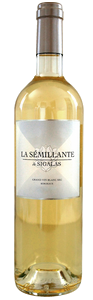
I’ve already mentioned in a previous post in October 2012 that many consider this sweet wine terroir to be just as good for dry whites with many properties producing dry white from their vines. This trend continues as Laure de Lambert Compeyrot has added another dry white wine to her successful Demoiselle de Sigalas; La Semillante is a 100% dry Semillon made with wine maker Jacques Lurton who has become a specialist in producing wonderful aromatic whites (and delightful reds) from terroir all over the world. His Loire wines are worth searching out too.
La Sémillante, 100% dry white semillon from château Sigalas Rabaud
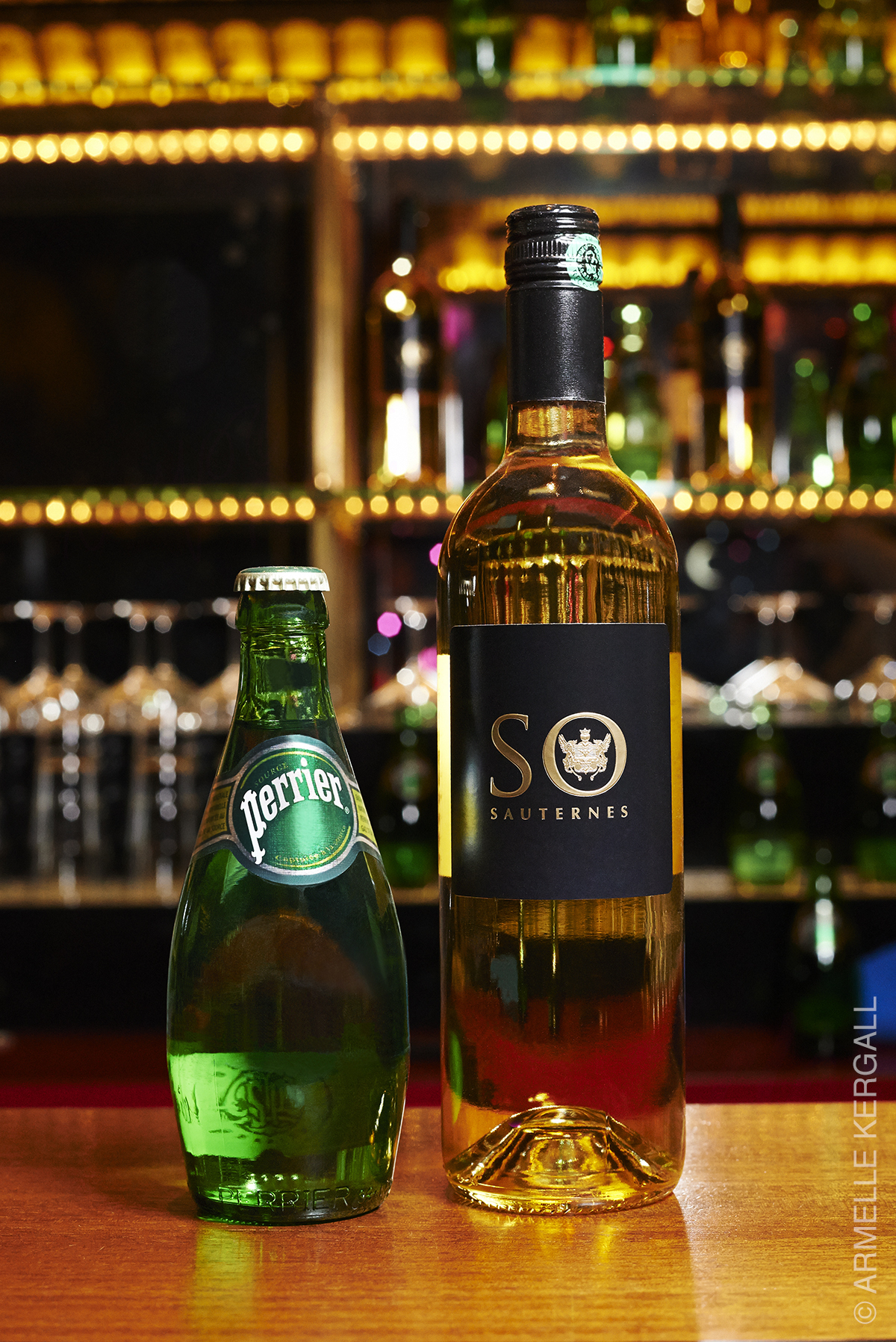
So what about the sparkling? No one is yet producing sparkling Sauternes to my knowledge. Florence Cathiard, owner of Pessac Léognan Classified Growth Chateau Smith Haut Lafitte, has come up with an idea to get Sauternes in the sights of barmen men and mixologists with SO Sauternes®.
Presenting the new SO Sauternes® in a resolutely modern bottle, the idea is topair with Perrier creating a cocktail to appeal to a younger generation perhaps not familiar with this venerable wine. This takes Sauternes away from its dessert wine purgatory and puts in the limelight and in the sights of trendy Parisian mixologists, some of whom have added their own particular twist and cocktail recipe.
SO Sauternes and Perrier
Shocking some might say, but other similar initiatives have now become mainstream;. When Cognac launched itself as a mixer there were a few raised eyebrows, now look at its success and the ‘swimming pool’ of adding ice to champagne launched by Moet has also become a staple of trendy beach bars in the summer months.
There is nothing new. One evening many (many) years ago, when my husband Hamilton first started selling Chateau Guiraud in the US, he was in a NYC hotel bar with wine guru Alexis Lichine who had taken him under his wing. Shocked when he saw New Yorkers ordering fine white Burgundy and topping it up with soda water to make spritzers he said so. Alexis, ever the pragmatist, said ‘Hamilton we should be so lucky they are drinking wine at all and not martinis, then years ago they all would be drinking Martinis’ – this was the early 80s after all.
We could say they same of Sauternes – so drink it in whichever way takes your fancy.
And it is a question. Organic vine growing is increasing all over France and in Bordeaux in particular; Aquitaine is the third largest region of organic vines right behind Languedoc and Provence. In 2012 organic production in the region increased by 3% compared to 2011 with 735 organic wine producers cultivating 9752 ha and with another 4276 ha in conversion (a three year period). Most of these are in Bordeaux, and of these most are on the right bank.
But not everyone is convinced that this organic trend is a good thing. One of the issues raised is copper residue. Producing organic wines is particularly difficult in Bordeaux due to the humid oceanic climate and the fungal diseases (mildew and odium) that thrive in these conditions. Copper sulphate and lime (known as Bouilli Bordelais or Bordeaux mixture) is the traditional method for treating these diseases and is permitted in organic agriculture. It’s great for roses too.
Although the amounts of copper permitted for use in organic agriculture are less than in traditional agriculture, (4kg/ha/year of metal copper compared to 6kg averaged over five years for traditional agriculture), some argue that, as other options for treating are limited in organic production, it encourages use of more rather than less copper. The rain also washes this mixture off the vines, so re-application rates are high in a rainy year. More sophisticated synthetic treatments absorbed by the vine can continue to combat the problem despite the rain but are not permitted under an organic regime.
However several organic growers have mentioned to me that after several seasons using organic and especially biodynamic methods, they see the plant defending itself better against these diseases as the vines develop their own natural resistance the result being the need for less treatment.
Intensive use of copper has toxic effects on soils especially in light sandy soils. Formerly, doses of 30kg/ha/year were not uncommon, so this new regulation is a huge improvement. Organic producers of course agree that it would be better to stop using this heavy metal completely and research is under way to use other organic fungicides like sulphur or potassium bicarbonate, plant extracts and clay.
One of the issues in a region like Bordeaux, along with the humid oceanic climate is of course mono-culture (vines represent 50% of the agricultural area of the Gironde). The concentration of vines in the region leads to the rapid spread of diseases such mildew, odium, phyloxera and new problems such as Esca. Now the Asian Drosophila are also raising concerns amongst growers. Prevention is always better than cure and part of the ecological and organic movement is to increase biodiversity to combat this, which is a type of poly-culture in itself. You can see this in Bordeaux for example with the planting of wild flowers, in land lying fallow in between planting as well as elsewhere in the vineyards and the creation of hedgerows.
The importance of Biodiversity in the vineyard.
The notion of biodiversity is also about preserving the genetic diversity of the vines. Although only 6 red and a few more white grape varieties are currently permitted in the production of the AOC wines of Bordeaux, it was not always thus. Over the years, the range of varieties and of clones of vines planted has reduced. Through massal selection of vines from existing plots for grafting onto rootstocks for new plantings, many properties can maintain their unique vine profile, hence increasing both their complexity and their specificity. This technique pioneered by properties such as Château Haut Brion and is now more and more common for properties working closely with the specialised local vine nurseries. Some properties such as Smith Haut Lafitte have their own nurseries; theirs is safe from any genetic contamination on the “La Lande” island on the Garonne River. Château Guiraud created a vine conservatory in 2001, housing a collection of hundreds of Semillon and Sauvignon Blanc vines from different vineyards that are used for research on massal selection. From this stock they produce 40,000 vines each year used by themselves and other Bordeaux vineyards.
Vine clones ready for planting
There has been an organic wine label in Europe since August 2012 with a corresponding logo. This Europe-wide label includes regulations for cellar management and winemaking as well as grape growing. Previously in existence wines had to be labelled as wine from organic grapes rather than organic wines – a subtle difference but an important one for purists. This new label obviously only allows the use of organic grapes but also limits the use of wine making additives (including S02) and sets the permitted organic wine practices.
The new European organic wine logo
Producers also have the option to use the AB (Agriculture Biologique) logo, which covers all organic agricultural production. This is not to be confused with natural wines for which, as yet, there is no legal European definition but which implies one produced using organic (or biodynamic) principles with a minimum of technological intervention.
Chateau de Seuil in Graves uses both the AB and the new Organic Wine logos on their label
However, not all organic wines producers use the logo. It is not obligatory. Some producers choose to be organic as a part of their philosophy but prefer not to mention it on the label. Too much information on the label? Managing expectations? Or perhaps they just feel that their brand and what it represents speaks for itself.
Many producers feel that the certification either does not go far enough or perhaps too far, in the damp climate of Bordeaux where the threat of mildew and odium are never far away, a slip up or a need for treatment in a tricky vintage (2013 springs to mind), means you are back to the drawing board for another three years.
Organic is not just for classified growths, on the contrary it is very much a grass roots movement (no pun intended) as the majority of properties certified as organic are not classified. There are a few notable exceptions, which brings welcome attention to the trend such as Chateau Pontet Canet in Pauillac was certified organic in 2010 and Chateau Guiraud in Sauternes in 2011. Chateau Fonroque in Saint Emilion has been certified biodynamic since 2005 and neighbouring Chateau Fonplégade is organically since 2013, the owners also have a organically certified vineyard in Napa to name a few.
And it is not just organic; sustainable agriculture and biodynamics are also part of the Bordeaux eco-mix and there are certifications for both.
Sustainable agriculture is a vague term open to many interpretations but is a notion that has a powerful impact on consumers. There is a Terra Vitis certification in France that committed growers can adhere to. Pheromone traps and sexual confusion in the vineyard, ploughing, modelling of diseases and close measurement of climate that allow a much reduced and more targeted use of agrichemicals are all techniques associated with sustainable agricultural methods.
Pheremone wires on vines at Chateau Sigalas Raubaud in Sauternes
Biodynamic viticulture takes organic culture a step further, often characterised by the process of burying cow horns full of manure or using the cycles of the moon there’s unsurprisingly a lot more to it than that. Practitioners consider the vineyard as a complete organism in itself and only use biodynamic treatments on the vines, mainly home made herbal concoctions, self-sufficiency being a key part of both organic and biodynamic principles. Biodynamic certification is subject to European regulations by the independent organisation Demeter and also Biodyvin the international union of biodynamic wine makers, the wine sector leads the biodynamic sector in France; in 2012 more than half of the 450 certified biodynamic French farms were vineyards.
Constant experimentation is a signature of Bordeaux wine making, both in the vines and in the cellars, and nowhere more so than in the sustainable/organic/biodynamic sector. Few properties would launch into a new method of culture or wine making without experimenting first. For example 3ha of the 78ha that make up Chateau Pichon Comtesse de Lalande are currently farmed organically and 3ha are biodynamic. Chateau Margaux is also experimenting and Chateau Latour has also been switching to biodynamic methods as can be illustrated by the horses often seen ploughing the vineyards.
Chateau Smith-Haut Lafitte has instigated it’s own Bio Precision approach, aiming to match the innovative viticulture and vinification techniques respect of the environment, promoting bio diversity through hedge plantation, use of natural grass, production of organic compost, horse ploughing, etc. They carry this through into the new ‘stealth’ wine cellar mentioned in a previous post. So there is clearly no conflict between organic and high tech.
Experimentation is the cellars too. Château Pontet Canet has been certified organic since 2010. They started in 2004 with 30ha and were so convinced they went 100% as of 2005, although with weather conditions in 2007 they were obliged to spray so it back to the drawing board until 2010. They then experimented in the cellars introducing a few concrete eggs or ‘amphorae’ in 2010. As of 2012 they now use 35% amphora for aging the wines alongside 50% oak barrels and the remaining 15% in one-year old oak. These amphorae bring the notion of terroir right into the cellar; the concrete is mixed with gravel stones for the Cabernet and with limestone for the Merlot along with the yellow clay from the vineyard.
The amphorae in the cellars of Chateau Pontet Canet
As I mentioned above the right bank has the greatest concentration of organic properties and it is an area that has been a hot bed of innovation in wine making technology as well as agricultural methods since the late 1980’s.
It reminds me of how when the ‘garage wine’ movement first started in the right bank with a lot of more established producers showing disdain for the ideas but now later harvest dates, cold soaks and selection tables are common place throughout Bordeaux – we are seeing a similar thing with organic agricultural techniques, more and more producers are reducing chemical loads, ploughing, using lighter tractors, growing green crops between plantings and using pheromones in their vines to control the vine moths through sexual confusion. This last practice is also open to some criticism as again not everyone is convinced that having large concentrations of insect pheromones in the air is necessarily a good thing.
Some properties may not be certified or searching certification but the theories and methods introduced by the certification are taking a hold and the results can be clearly seen as you drive around the vineyards. Non certified properties use many of the sustainable, organic and biodynamic principles such as Chateau Clinet in Pomerol, where owner wine marker Ronan Laborde talks of gentle farming methods and uses the biodynamic practice of tying the vines rather than trimming. This works perfectly on the vines that, as of 2004, they raised by 10-15 cm to obtain a larger leaf area to favour the ripening of the grapes. A programme that took 2 years to complete.
‘Living’ soil at Chateau Clinet
It’s now common to see more ploughing going on between vines to control weeds but also to aerate and bring the soil back to life. This is done more and more by horses. Chateau may either have their own horses such as at Chateau Latour, Chateau Pontet Canet or Chateau Troplong Mondot or by using specialist companies that provide the horse drawn ploughing services. Chateau Cheval Blanc uses such a service and yes, when I was there, it was a white horse pulling the plough.
Ploughing at Chateau Pontet Canet
Francois Despagne, owner of Chateau Grand Corbin Despagne, classified growth of Saint Emilion, is one of the most passionate viticulturalists I know in Bordeaux and is certified sustainable by Terravitis and had several experimental plots on the vineyard under organic before converting and becoming organic and is now experimenting with bio dynamics. His brother, Nicolas, owner of Chateau la Maison Blanche up the road in Montagne Saint Emilion, is a passionate advocate of biodynamics.
Bending the vines rather than strumming them – a practice once limited to biodynamics is now seen more often in Bordeaux vineyards
Certification is an expensive and complicated process and not all growers have the money or the manpower necessary to implement it, even if they agree with the philosophy. The CIVB (Conseil des Vins de Bordeaux – The Bordeaux wine council) has devised a way to help such properties. The System de Management Environmental (SME) is a process whereby the cost of a consultant and the certification process is shared between the CIVB and a group of wine makers or chateaux. The members also appreciate this collective initiative as an opportunity to exchange notes and share problems they encounter along the way. Currently 141 wine producers have reached the ISO 14001 environmental certification through this system and another 300 are currently engaged in the process, including wine merchants and cooperatives as well at chateaux, altogether totalling 12 500 ha of Bordeaux vines.
There are other interprofessional schemes; Bordeaux was the first vineyard to have a collective Carbon footprint project for the « Bordeaux Wine Climate plan 2020 » launched in 2010 with the objective of 20% less green house effect, 20% energy savings, 20% renewable energy, 20% water savings by 2020 in line with the European objective of cutting its emissions to 20 per cent below 1990 levels by 2020, The Bordeaux objective is -40 000 t.eq C by this date. It was 203 000 t.eq C in 2010. On-line Carbon foot print calculator is freely available for the Bordeaux wine community so they can measure and adapt their carbon footprint accordingly.
So where does this leave us? In 2012 over 40 400 ha of farmland were certified organic in France with another 24 351 in conversion (a 3 year programme). This is about 8% of French vines but also 6% of French organic agriculture – so wines are well ahead of the trend and the prognosis for 2013 was over 51 000ha.
Being ecologically responsible might give wine makers a nice warm feeling, but what is the motivation? With the majority of vineyards in Bordeaux being family owned, ecology is taken very seriously as chateau owners often consider themselves caretakers rather than owners, with a responsibility to hand down a healthy vineyard to future generations. Is there a price premium? In certain markets there is but it also gives access to new markets and helps differentiate products in what is a very competitive market, especially in mid-range priced wines. Does the organic or biodynamic product taste better? Well the jury still seems to be out although research shows there seems to be a higher concentration of some tannins as well as having an effect on alcohol levels. However, to produce both organic and biodynamic wines, requires attention to detail and this is clearly one way to ensure great quality.
But what about the market? Wine only accounts for 10% of sales of organic food in France but it’s on the increase; 15% a year from a turnover of 413 M € in 2012, a third of which is sold directly from estates – so better margins for producers. Market data provided by Agence Bio in 2011 gave the revenue from organic wines as 360 million Euros at 4 per cent of all wine sold in the country. This was a higher share of organic than for the total food market, where organic food sales constitute just 2.3 per cent.
What does the future hold? European organic wine certification remains a work in progress with an update expected in August 2015. The various private certification standards are seen as a base for further evolution of pan-European standards looking at themes such as: biodiversity in grape production, soil fertility and soil life, alternative approaches to pests and diseases, sustainability of grape production, wine processing and storage, quality and source of organic wine ingredients, of yeasts quality both including wild yeasts and spontaneous fermentation, limitations on additives including a possible total of sulphites, further limitations on processing techniques, limitations on tools and equipment, etc, etc.
In 2011 8% of French vineyards were organic (61 000 ha) compared to about 6% of the EU as a whole (interestingly enough the UK showed the highest percentage at over 16% – but I know it’s a tiny surface area compared to France) it is notable that the organic vineyards have exhibited far higher growth rates than the overall organic farmland.
In a global context, Europe is by far the largest player when it comes to organic vineyards: Europe’s 260,000 hectares of organic vineyards constitute 89 per cent of the total area under organic vines worldwide and represent 3.7 per cent of all vineyards. Major producers outside Europe are the United States (almost 12,000 hectares in 2008) and Chile (4,600 hectares).
As mentioned above, just like all wine makers organic wine makers love to experiment and the organic wine movement seems to be particularly good at participatory R & D, in both the field and wine cellars. Subjects such as lowering copper input are being looked at in this way and they are also working with other agricultural products where copper use is an issue see http://www.co-free.eu
Everyone benefits; wine is a relatively prosperous agricultural sector –not everywhere (that includes parts of Bordeaux) and it is also a competitive and dynamic sector and research into issues of organic wine benefit other agricultural products too. I think this is where the future lies, along with more closely aligned legislation with export markets so different organic producers from around the world can sell as organic in their various export markets.
The 2015 review of the organic wine certification is around the corner – it needs that time lapse to have a couple of vintages under our belts especially in Bordeaux when wines are often bottled between 24 and 30 months after harvest – exciting times ahead for gentil farmers.
After an interminable wait that had every winemaker’s eyes turned to the sky, the harvest is now finished in the Bordeaux vineyard and the red wines are almost all run off into barrels or undergoing Malo in tanks.
Fermentation at Chateau d’Aiguilhe in Castillon Côtes de Bordeaux
Pumping over at Chateau Lynch Bages in Pauillac
Emptying the vats after the running off at Chateau Haut Brion in Pessac-Leognan
Mother nature has kept everyone on their toes this year with what has been a challenging vintage (that’s the polite version!)
The first 3 months of 2013 were marked by cold and steady rain. A late spring with a dry April meant bud break was late (mid April) and the return of the cool weather and more rain made the late flowering difficult for Merlot which, although the most precocious Bordeaux red varietal, only started to blossom around June 10th, compared to May 31st in 2012.
The rain between June 17th and June 23rd caused millerandage (development of berries without pips which remain tiny) and coulure (badly fertilized flowers drop without giving any fruit). These phenomena cause a substantial decrease in the potential quantity of the harvest.
Summer finally arrived in July, sun and heat set in and the 330 hours of sunshine in one month equalled the 1991 record. However the summer was marred by thunderstorms and hail. During the night of July 18th hail fell on a very small zone in the Medoc and then again on July 25th and 26 on the entire region.
Uneven developement of the Merlot grapes necesitated a lot of sorting
Despite the summer warmth the development of vegetation remained delayed by 15 days. August was also sunny (42 hours more than average), with temperatures close to the norm, but again marred by thunderstorms with a devastating hailstorm on Friday 2nd of August. 15 000 hectares were hit by the hail, 7000 of which were shattered at 80%, representing 6% of the total Bordeaux vineyard. Concentrated in the Entre-Deux-Mers region this has created a dramatic situation for some producers whose yields are extremely low or non-existent this year.
By the 3rd week of August the Véraison (change of colour of the berries) was underway, leading to a harvest date predicted as 8 to 15 days later than average, based upon the late flowering date.
So at the start of harvest there was cause for concern but as usual with a vintage like this the picture was very varied from region to region. Bordeaux is a big place so the scene is very different depending upon the appellation and the different varietals. Terroir has played a part, better-drained soils with exposure to winds being an advantage in a damp growing season. Merlot has suffered most from the cool, damp spring – being early budding and flowering with a greater sensitivity to the Millerandange and Coulure (see above), the development of many bunches of Merlot has been uneven.
However the grape growers have not contented themselves to simply follow the weather patterns. Their actions throughout the year in preparing for the vintage have had an obvious effect on the quality of the grapes on the vines.
Selection in the field
Careful deleafing and green harvesting has allowed the air to circulate around the bunches of grapes and reduced the incidence of mould on the Merlot in these plots. Interestingly the argument for organic production has also been debated this year. With this humidity, vines are susceptible to mildew and later to bad or grey botrytis. However some plots that have been under organic culture for several years seem to be showing a greater resistance to mould and other diseases that flourish in these conditions. This is a good thing, as, under organic agriculture, the farmers cannot treat their grapes with systemic molecules. They are only allowed to use the Bordeaux mixture (copper sulphate and lime), which unfortunately washes off with the next rainfall, making for expensive and repetitive treatments. With the vintage approaching, organic treatments are limited to a powdering of talc to soak up some of the excess humidity. There is also the possibility that anti fungal treatments thicken the skins of the grapes meaning they ripen later. Those not using these treatments were at an advantage this year. Ripening was difficult and late, especially for the Cabernets with not everyone brave enough to wait for fear of more rainstorms and the spread of more rot.
Selection bunch by bunch
September continued to be wet, with an especially heavy storm on 28th bringing 30% of the month’s rain in a few minutes and although temperatures were up slightly (½ degree) creating an almost tropical feel in some areas, and more rot, the average levels of sunshine were down over the month.
Merlot is currently the most widespread grape in Bordeaux (65% in 2012) and it suffered this year; fortunately the Cabernets tell a different story. The late development this year left many fearing that the Cabernet, especially the Cabernet Sauvignon, would struggle to ripen. But whereas the Merlot has only a short window of opportunity for harvesting, the Cabernets, thanks to their thicker skin, are sturdier and can wait. Fortunately the sun decided to shine early October giving some warm days and cooler nights – perfect for Cabernet – for those who could wait either because they had nerves of steel or a cooler windier terroir that slowed down the development of that pesky rot.
Selection berry by berry by hand at Châtheau Olivier in Pessac-Leognan
and by Optical Selection at Chateau Phelan Segur in Saint Estephe
There were some beautiful healthy bunchesand some very scary ones
Talking of mould, it may strike fear into the hearts of red producers but sweet white wine producers are delighted. The Noble Rot (Botrytis Cinerea) developed well on the Semillon and Sauvignon grapes in the sweet wine areas. The first tries (selections) gave cause for producers to be cautiously optimistic after their trials of 2012 despite some isolated hail in the village of Illats mid harvest. The later tries where not quite as concentrated but again careful selection and blending will produce some beautiful sweet wines in 2013.
The developement of Botrytis on Semillon at Chateau d’Arche in Sauternes
Beautiful botrytis at Chateau Sigalas Rabuad in Sauternes
Fermentation starting at Chateau Sigalas Rabaud
The dry whites are also safely in the vats now and although the volume may be lower than a normal year, producers are happy with the quality of their crop.
Beautifully healthy Sauvignon bunches at Chateau Latour Martillac in Pessac-Leognan
What is encouraging is that new technology is at hand to help the wine maker in such a vintage. Having done the best they can to ensure the quality in the field has been, inevitably in such a vintage, a need for strict berry selection prior to fermentation.
Having done the best they can to ensure quality in the field, producers keen to maintain a reputation for quality also employ a strict berry selection, prior to fermentation. Whether in the field, or at the cellar door, new technologies such as selection tables, optical selectors and tribae help this labour intensive process. It must be heartbreaking to throw berries away but it is the price to be paid when faced with the challenges that such a vintage presents.
What is sure is that 2013 will show lower yields and it will be well worth a visit to the futures tastings in April 2014 to see how the wine makers of Bordeaux have risen to this, their latest challenge.
Three visits in Pessac Leognan and Sauternes today to see the beginning of the dry white
The grapes arrive in the cellars of Château La Mission Haut Brion in a refrigerated truck.
Using dry ice to protect the crop during pressing at Château Guiraud for Le G de Guiraud
A little help picking the grapes at Château Sigalas Rabaud for the second vintage of the La Demoiselle de Sigalas dry white.
What is the smallest first growth in the 1855 classification?
You all said Haut Brion didn’t you? but no – think out of the box and remember Sauternes and Barsac…Château Sigalas Rabaud at just 14ha is the smallest 1st growth.
Secret shared by Laure de Lambert whilst tasting her delicious 2003 this afternoon and just before she delivers her first dry white wine from the property.
“La Demoiselle de Sigalas” will be available for sale from Ets Martin in Saint Emilion as of this weekend – Highly recommended.
Ripening Sigalas Rabaud grapes on the Gunzian gravel.
Laure de Lambert is working closely with her father but this dynamic young winemaker is never the less slowly but surely making her influence felt at Sauternes 1er grand cru classé Château Sigalas Rabaud.
2009 will be the first vintage that this small ‘boutique ‘ Sauternes will make a dry white white wine, the production of which has become common practice amongst the top Sauternes and Barsac properties.
We tasted from the 4 barrels of this Semillion-Sauvignon blend and what a delightfully floral and complex wine.
Normally the dry white wines of the region take as their name the initial of the Sauternes premier vin, following in the footsteps of Y d’Yquem. However S and R are already taken what to do?
The name is to be confirmed but will probably be La Demoiselle de Sigalas after her very dynamic Grand mother – now we know who Laure takes after!
Laure de Lambert shares her new wine directly from the barrel
The sweet wine producers of Bordeaux always tell us what a great match these wines, so often relegated to dessert, are for spicy and ‘exotic cuisine’.
Well I’m in the perfect location to find out; an Indian Buffet and yes there is a Sauternes on the wine list – and guess what? Château Sigalas Rabaud, what a well travelled wine – last seen in its 2002 version in Geneva, (see post on 3rd March). This time it’s a delicious 1995 and yes it does work but honestly I’m afraid to say it showed to its best advantage with the tropical fruit platter for dessert
No this is not a shrinking Alice in Wonderland it’s Bordeaux Blonde on one of the outsized chairs at Arthurs in Geneva.
A trendy bar-restaurant with a great food and wine matching concept: over 30 wines by the glass each one recommended with a different dish, what’s more 15 of the 24 still & non fortified wines were from Bordeaux.
And the winner is …….Château Sigalas Rabaud 2002 offered with both a starter (foie gras) and dessert (Creme brule).
Last January Napa Women in Wine invited their Bordeaux counterparts to discover the Napa Vineyard. This year was the return match.
From the 11th to 15th January, The 16 ladies from Napa travelled the length and breadth of Bordeaux from Pomerol to the Medoc, Saint Emilion to Sauternes and Pessac Leognan visint gproperties where women plys a major role either as wine makers, owners or managers. Included on the itinerary were Château La Lagune, Château la Tour Bessan, Château Margaux, Château kirwan, Château Paloumey, Château Franc Mayne, Château Teyssier, Château Troplong Mondot, Château Sigalas Rabaud, Château Yquem, Château Haut Bailly and Château de Seuil.
It was not just tourism; several conferences on themes including marketing, understanding Bordeaux, a presentation on the role of the negociant by Paz Espero and ‘Tasting Terroir’ by Nicole Croft.
The participants from both sides of the Atlantic were
From California
Jane Ballentine – William Cole
Pavi Lawson – Pavi Wines
Heidi Barrett – La Sirena
Cherie Melka – Melka Wines
Sandy Blecher – Arns Family Winery Beth Milliken – Spottswood
Carissa Chappellet – Chappellet Winery
Mary Novak – Spottswood
Carolyn Duryea Smith – Hourglass Suzanne Pavitt – Phifer Pavitt Wines
Ursula Hermacinski – Screaming Eagle
Pam Starr – Crocker & Starr
Sharon Harris – AmiCellars
Pierette Titus – Titus Vineyards,
Erin Lail – LailVineyard
Michele Torres – Trincharo Family Vineyards
And from Bordeaux
Sandrine Garbay, Wine Maker – Château d’Yquem- AOC Sauternes.
Laure Compeyrot, propriétaire – Château Sigalas Rabaud – AOC Sauternes.
Myriam Ruer, négociant propriétaire de Vinprod
Nicola Allison, propriétaire – Château du Seuil – AOC Graves
Griet Laviale, propriétaire & Laurence Ters, Wine Maker : Château Franc Mayne, AOC saint Emilion Château de Lussac, AOC Lussac Saint Emilion – Château Vieux Mallet – AOC Pomerol
Caroline Frey, propriétaire – Château La Lagune , AOC Haut-Médoc
Sophie Thierry, propriétaire – Château Kirwan, AOC Margaux
Martine Cazeneuve propriétaire & Babara Engerer, RP Château Paloumey, AOC Haut-Médoc
Marie-Laure Lurton, propriétaire – Château de Villegeorge , AOC Haut-Médoc- Château Duplessis, AOC Moulis – Château La Tour Bessan, AOC Margaux.
Lyn Maltus, propriétaire Château Teyssier, AOC Saint Emilion Grand cru
and my good self !
Get the Bordeaux Inside Track
With 30 years in Bordeaux, I bring you a twice-monthly perspective on the stories shaping this, and other wine regions — from sustainability to wellness, women in wine, and beyond.