Is the future of Sauternes feminine? Is the future of Sauternes dry? Is the future of Sauternes fizzy? I thought that last one might get your attention.
Wine tasters often use the adjective feminine or masculine when describing wines; Feminine being used Merlot driven wines as opposed to more ‘masculine’ Cabernet driven wines. Then again, Margaux is often described as the most feminine of the Medoc appellations. Smooth, elegant, approachable are all rather feminine characteristics n’est pas?
Sauternes is also considered a feminine wine as, rather condescendingly perhaps, the sweetness of the wine is traditionally thought to appeal to a feminine palate. The history of Sauternes is feminine too. It was Françoise Joséphine de Sauvage d’Yquem, young widow and owner of Chateau d’Yquem who was imprisoned twice during the revolution but managed to keep the Château in the family.

The feminine tradition continues at Chateau d’Yquem as the current cellar Master is also a woman; Sandrine Garbay. Other top Sauternes properties also have women at their helm; Laure de Lambert Compeyrot is cellar master and co-owner of the smallest Sauternes Classified growth Chateau Sigalas Rabaud. In Barsac both Chateau Climens and Chateau Coutet have women at their helm. Chateau Coutet names the tiny production of its top wine, produced only in exceptional years, Cuvée Madame, after Madame Rolland-Guy, owner of the property from 1922 to 1977.
I’ve already mentioned in a previous post in October 2012 that many consider this sweet wine terroir to be just as good for dry whites with many properties producing dry white from their vines. This trend continues as Laure de Lambert Compeyrot has added another dry white wine to her successful Demoiselle de Sigalas; La Semillante is a 100% dry Semillon made with wine maker Jacques Lurton who has become a specialist in producing wonderful aromatic whites (and delightful reds) from terroir all over the world. His Loire wines are worth searching out too.
La Sémillante, 100% dry white semillon from château Sigalas Rabaud
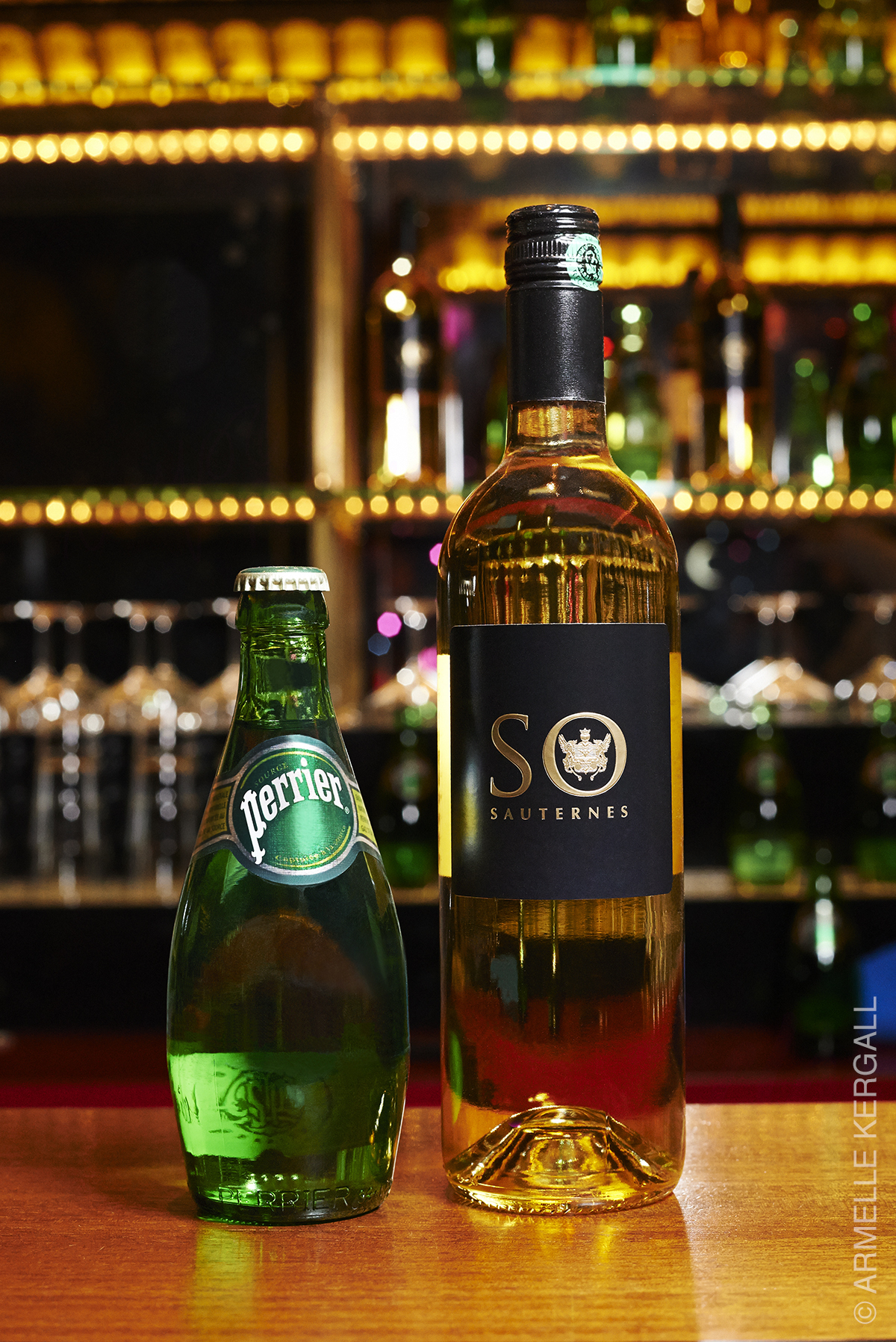
So what about the sparkling? No one is yet producing sparkling Sauternes to my knowledge. Florence Cathiard, owner of Pessac Léognan Classified Growth Chateau Smith Haut Lafitte, has come up with an idea to get Sauternes in the sights of barmen men and mixologists with SO Sauternes®.
The Cathiards, along with the Moulin Family (owners of the Galeries Lafayette department stores) purchased Chateau Bastor Lamontagne in Sauternes last year along side Château Beauregard in Pomerol and Chateau Saint Robert in the Graves.
Presenting the new SO Sauternes® in a resolutely modern bottle, the idea is to pair with Perrier creating a cocktail to appeal to a younger generation perhaps not familiar with this venerable wine. This takes Sauternes away from its dessert wine purgatory and puts in the limelight and in the sights of trendy Parisian mixologists, some of whom have added their own particular twist and cocktail recipe.

Shocking some might say, but other similar initiatives have now become mainstream;. When Cognac launched itself as a mixer there were a few raised eyebrows, now look at its success and the ‘swimming pool’ of adding ice to champagne launched by Moet has also become a staple of trendy beach bars in the summer months.
There is nothing new. One evening many (many) years ago, when my husband Hamilton first started selling Chateau Guiraud in the US, he was in a NYC hotel bar with wine guru Alexis Lichine who had taken him under his wing. Shocked when he saw New Yorkers ordering fine white Burgundy and topping it up with soda water to make spritzers he said so. Alexis, ever the pragmatist, said ‘Hamilton we should be so lucky they are drinking wine at all and not martinis, then years ago they all would be drinking Martinis’ – this was the early 80s after all.
We could say they same of Sauternes – so drink it in whichever way takes your fancy.